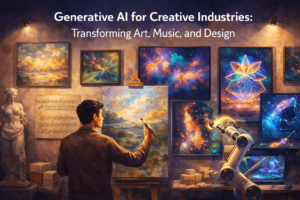
The Creative Revolution: How Generative AI is Transforming Art, Music, and Design
Generative AI has emerged as one of the most transformative forces in creative industries, fundamentally changing how we create, consume, and think about art, music, design, and entertainment. From generating photorealistic images in seconds to composing symphonies and writing screenplays, AI is not just automating creative tasks—it’s opening entirely new forms of artistic expression.
The creative economy, worth over $2.25 trillion globally, is experiencing its most significant disruption since the digital revolution. Artists, musicians, designers, and content creators are discovering that generative AI can be a powerful collaborator, amplifying human creativity rather than replacing it. This transformation is democratizing creative tools, enabling anyone with an idea to produce professional-quality content.
This comprehensive guide explores how generative AI is reshaping creative industries, the tools leading this revolution, and what this means for the future of human creativity.
Understanding Generative AI in Creative Contexts
How Creative AI Works
Generative AI models learn patterns from vast datasets of creative works—millions of images, songs, texts, and videos. Through techniques like diffusion models, GANs (Generative Adversarial Networks), and transformers, these systems can generate entirely new content that follows learned patterns while introducing novel combinations and variations.
Unlike traditional creative software that requires explicit instructions for every element, generative AI understands concepts, styles, and contexts. You can describe what you want in natural language, and the AI interprets your vision, filling in details based on its training. This shift from tool-based to intention-based creation is revolutionary.
The Spectrum of AI Creativity
Generative AI operates across a spectrum of creative autonomy. At one end, it serves as an advanced tool executing specific human directions. At the other, it acts as an autonomous creative agent generating original works with minimal human input. Most applications fall somewhere in between, with AI and humans collaborating in various ways.
Visual Arts and Design Revolution
AI image generation
Text-to-image models like Midjourney, DALL-E 3, and Stable Diffusion have democratized visual creation. Artists can generate complex scenes, characters, and concepts by describing them in words. Professional illustrators use these tools to rapidly prototype ideas, explore style variations, and overcome creative blocks.
The fashion industry uses AI to generate endless design variations, predicting trends and creating personalized collections. Architects employ AI to visualize buildings in different styles and environments instantly. Game developers generate concept art, textures, and entire worlds procedurally, reducing development time from months to days.
Digital Art Enhancement
AI doesn’t just create from scratch—it enhances existing artwork. Style transfer algorithms apply artistic styles to photographs, turning them into paintings reminiscent of Van Gogh or Picasso. Super-resolution AI upscales low-quality images to high resolution, recovering details that didn’t exist in the original.
Professional photographers use AI for advanced editing that would take hours manually. Portrait photographers employ AI to perfect skin tones, adjust lighting, and even change facial expressions naturally. The technology enables amateur photographers to achieve professional results with minimal technical knowledge.
3D and Animation
Generative AI is revolutionizing 3D modeling and animation. Text-to-3D models create complex 3D objects from descriptions, while AI motion capture generates realistic animations from simple video inputs. This technology is making 3D content creation accessible to individuals and small studios previously priced out of the market.
Film studios use AI to generate crowd scenes, create digital doubles of actors, and produce complex visual effects at a fraction of traditional costs. The technology enables new forms of interactive media where environments and characters adapt in real-time to viewer preferences.
Music and Audio Innovation
AI Music Composition
AI composers like AIVA, Amper Music, and Google’s MusicLM create original music in any genre or style. Film composers use AI to generate initial scores that they refine and orchestrate. Video game developers employ AI to create adaptive soundtracks that change based on gameplay, ensuring unique musical experiences for each player.
Musicians use AI as a collaborative partner, generating chord progressions, melodies, and arrangements that spark new creative directions. The technology helps overcome writer’s block and enables exploration of musical styles outside an artist’s comfort zone.
Voice Synthesis and Cloning
AI voice technology has reached near-perfect human quality. Services like ElevenLabs and Replica Studios create realistic voice performances from text, enabling content creators to produce professional narration without recording studios. The technology preserves voices of deceased actors for posthumous performances and enables real-time voice translation while maintaining speaker characteristics.
Podcast creators use AI voices for consistent narration across episodes. Audiobook publishers produce books in multiple languages with native-sounding narrators. Educational content creators provide personalized learning experiences with AI tutors that speak in familiar voices.
Sound Design and Effects
AI generates custom sound effects matching specific descriptions, eliminating hours of searching through sound libraries. Film post-production uses AI to clean dialogue, remove background noise, and spatially position sounds for immersive experiences. The technology enables real-time sound generation for virtual reality, creating audio that responds dynamically to user actions.
Writing and Content Creation
Creative Writing Enhancement
Writers use AI as a creative partner for brainstorming, outlining, and overcoming writer’s block. Tools like Claude, GPT-4, and specialized writing AIs help develop characters, plot structures, and dialogue. Screenwriters employ AI to format scripts, ensure consistency, and generate multiple story variations for testing.
Publishers use AI for initial manuscript evaluation, identifying promising works and suggesting improvements. The technology helps non-native speakers write fluently in other languages while maintaining their unique voice and perspective.
Marketing and Advertising
Generative AI transforms marketing content creation, producing personalized copy at scale. Agencies generate hundreds of ad variations for A/B testing, each tailored to specific demographics. Social media managers use AI to maintain consistent posting schedules with engaging, platform-optimized content.
E-commerce platforms generate unique product descriptions for millions of items, improving SEO and customer engagement. Email marketing campaigns feature AI-generated subject lines and content personalized to individual recipient preferences, dramatically improving open and conversion rates.
Interactive Storytelling
AI enables new forms of interactive narrative where stories adapt to reader choices in real-time. Video games feature AI-generated dialogue that responds naturally to player actions, creating unique story experiences. Educational platforms use AI to create personalized learning narratives that adapt to student progress and interests.
Film and Video Production
Pre-Production Innovation
Film studios use AI for script analysis, predicting audience reception and box office performance. Storyboard generation AI creates visual sequences from script descriptions, accelerating pre-visualization. Casting directors employ AI to match actors to roles based on performance analysis and audience preferences.
Production Enhancement
Virtual production uses AI to generate photorealistic backgrounds in real-time, replacing green screens with dynamic environments. Deep learning algorithms enable real-time face replacement and de-aging, eliminating expensive post-production work. AI-powered cameras automatically frame shots, track subjects, and adjust settings for optimal cinematography.
Post-Production Revolution
Editors use AI to automatically assemble rough cuts based on script requirements and emotional pacing. Color grading AI matches shots instantly, maintaining visual consistency across entire films. Visual effects artists employ AI to rotoscope, track, and composite elements that would take weeks manually.
AI generates entire crowd scenes, digital environments, and creature animations from minimal input. The technology enables small studios to produce Hollywood-quality effects on independent budgets, democratizing high-end film production.
Fashion and Industrial Design
Fashion Design Innovation
Fashion houses use AI to predict trends by analyzing social media, runway shows, and street photography. Designers generate thousands of design variations instantly, exploring color palettes, patterns, and silhouettes impossible to conceive manually. Virtual fashion shows feature AI-generated models wearing designs that exist only digitally.
Personalized fashion uses AI to create custom designs based on individual body measurements, style preferences, and lifestyle needs. The technology enables on-demand manufacturing, reducing waste and inventory costs while providing unique products for each customer.
Product Design Revolution
Industrial designers use generative design AI to create products optimized for specific criteria—weight, strength, cost, or aesthetics. The technology generates thousands of design iterations, many featuring organic forms impossible to conceive through traditional methods.
Automotive companies employ AI to design everything from efficient engine components to aerodynamic body shapes. Furniture designers create pieces that adapt to user preferences and space constraints. Consumer electronics companies use AI to optimize product ergonomics and user interfaces.
Challenges and Ethical Considerations
Copyright and Ownership
The question of who owns AI-generated content remains largely unresolved. When AI trains on copyrighted works, does the output infringe on those copyrights? Can AI-generated art be copyrighted? These questions are being debated in courts worldwide, with different jurisdictions reaching different conclusions.
Artists worry about AI training on their work without compensation. Some platforms now offer opt-out mechanisms, while others explore revenue-sharing models. The creative community is divided between those embracing AI as a tool and those viewing it as a threat to their livelihood.
Authenticity and Attribution
As AI-generated content becomes indistinguishable from human-created work, questions of authenticity arise. Should AI-generated content be labeled? How do we value human creativity when machines can produce similar results instantly? These questions challenge fundamental assumptions about art and creativity.
Job Displacement vs. Augmentation
While AI eliminates some creative jobs, it creates others and augments many more. Prompt engineers, AI trainers, and AI-human collaboration specialists represent new career paths. Many creatives find AI amplifies their productivity, allowing them to focus on higher-level creative decisions while AI handles execution.
The Future of Creative AI
Emerging Technologies
Real-time AI collaboration tools will enable multiple creators and AI systems to work together seamlessly. Brain-computer interfaces could allow direct thought-to-creation, eliminating the barrier between imagination and realization. Quantum computing may enable AI to generate content of unprecedented complexity and originality.
New Art Forms
AI is enabling entirely new creative mediums. Generative virtual worlds create infinite, explorable spaces. AI-human performance art features real-time collaboration between artists and machines. Adaptive media changes based on viewer emotions, creating personalized artistic experiences.
Democratization of Creativity
As AI tools become more accessible, creative expression will no longer be limited by technical skill. Anyone with imagination can produce professional-quality content. This democratization could lead to an explosion of diverse voices and perspectives in creative fields.
Best Practices for Creative AI
For Individual Creators
- View AI as a collaborator, not a replacement
- Develop strong conceptual and curatorial skills
- Learn prompt engineering for your creative domain
- Maintain your unique voice and perspective
- Stay informed about copyright and ethical considerations
- Build workflows that combine AI efficiency with human creativity
For Creative Organizations
- Invest in AI literacy for all creative staff
- Develop clear policies on AI use and attribution
- Create hybrid workflows combining human and AI strengths
- Respect intellectual property and artist concerns
- Focus on unique value that human creativity provides
- Prepare for rapid industry changes
Conclusion
Generative AI represents the most significant transformation in creative industries since the advent of digital tools. It’s not replacing human creativity but augmenting it, enabling new forms of expression and democratizing access to creative tools. The technology challenges us to reconsider what creativity means and where human value lies in the creative process.
Success in this new landscape requires embracing AI as a creative partner while maintaining the uniquely human elements that give art meaning—emotion, intention, and cultural context. Creators who learn to collaborate with AI while preserving their unique voice will thrive in this new era.
The future of creativity is not human or AI, but human and AI, working together to push the boundaries of what’s possible. As these technologies continue to evolve, they’ll enable forms of creative expression we can’t yet imagine, opening new frontiers for human imagination.
Continue Learning: Related Articles
AI Content Creation Tools for Bloggers: Comparison and ROI Analysis
Introduction to AI Content Creation for Bloggers
The content creation landscape has been transformed by artificial inte…
📖 13 min read
AI Productivity Hacks: Reclaim Hours Every Week Using Smart Tools
Introduction: How AI Can Reclaim Your Time
Knowledge workers report feeling more stressed and busy than ever despite te…
📖 14 min read
Getting Started with AI: Complete Beginner’s Guide to Machine Learning
Introduction: AI is More Accessible Than You Think
The world of artificial intelligence can seem intimidating. Terms li…
📖 15 min read
AI Image Generators Compared: DALL-E 3 vs Midjourney vs Stable Diffusion
The AI Art Revolution
AI image generation has exploded into the mainstream, with tools capable of creating stunning art…
📖 6 min read
💡 Explore 80+ AI implementation guides on Harshith.org
