Understanding Agentic AI
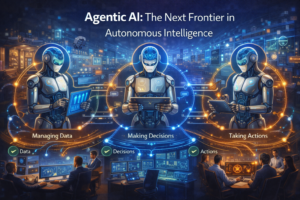
Agentic AI represents a paradigm shift in artificial intelligence development, moving beyond traditional reactive systems to create autonomous agents capable of independent decision-making and goal-oriented behavior. Unlike conventional AI systems that respond to specific inputs with predetermined outputs, agentic AI systems can perceive their environment, make decisions, take actions, and learn from the results of those actions without explicit human intervention for each step.
The Evolution from Traditional AI to Agentic Systems
The journey toward agentic AI began with the earliest expert systems and rule-based AI of the 1980s. These systems were limited to executing predefined rules in specific domains. As machine learning evolved, we saw the emergence of more flexible systems capable of learning from data. However, these systems still lacked true autonomy—they required human oversight for significant decisions.
Modern agentic AI systems represent the next evolutionary step. They combine multiple AI techniques including deep learning, reinforcement learning, and natural language processing to create systems that can understand context, make decisions, and execute complex tasks with minimal human intervention.
Key Characteristics of Agentic AI
Autonomy: Agentic systems can operate independently without constant human guidance. They have the ability to set their own goals within defined parameters and work toward achieving them through a series of coordinated actions.
Perception and Sensing: These systems continuously monitor their environment through various sensors and data inputs. This perception allows them to understand the current state of the world and how it changes over time, enabling more informed decision-making.
Decision-Making: Agentic AI systems employ sophisticated decision-making frameworks, often based on reinforcement learning algorithms that weigh different options and select actions that maximize their defined objective functions.
Learning and Adaptation: Unlike static systems, agentic AI learns from its experiences. Each interaction with the environment provides feedback that helps the system refine its strategies and improve its performance over time.
Goal-Oriented Behavior: These systems are designed with specific objectives in mind. Whether it’s optimizing manufacturing processes, managing financial portfolios, or conducting scientific research, agentic AI systems work persistently toward their defined goals.
Real-World Applications of Agentic AI
Manufacturing and Robotics: Autonomous robots in manufacturing facilities that can perform complex assembly tasks, quality control, and optimize production workflows without human intervention. These systems learn from their mistakes and continuously improve efficiency.
Healthcare: AI agents that can analyze patient data, suggest diagnoses, recommend treatment plans, and monitor patient progress over time. These systems integrate information from multiple sources to provide comprehensive care recommendations.
Financial Services: Trading agents that analyze market conditions, execute trades, and manage investment portfolios autonomously. These systems process vast amounts of market data to identify opportunities and manage risk in real-time.
Logistics and Supply Chain: Autonomous systems that optimize routing, manage inventory, predict demand, and coordinate with suppliers. These agents can significantly reduce costs and improve delivery times.
Research and Development: AI agents that can design experiments, interpret results, and propose new research directions. This accelerates the pace of scientific discovery across multiple domains.
Technical Foundations
Agentic AI systems typically rely on several key technologies:
Reinforcement Learning: This approach allows agents to learn optimal behaviors through trial and error, receiving rewards for desirable actions and penalties for undesirable ones. Deep reinforcement learning combines this with deep neural networks to handle complex, high-dimensional state spaces.
Transformer Networks: These architectures enable agents to process sequential information effectively, maintaining context over long periods and attending to relevant information.
Multi-Agent Systems: Many agentic AI applications involve multiple agents working together, requiring sophisticated communication protocols and coordination mechanisms.
Knowledge Representation: Agentic systems need ways to represent knowledge about their domain, including rules, relationships, and constraints that guide their decision-making.
Challenges in Agentic AI Development
Safety and Control: Ensuring that autonomous agents act in ways aligned with human values is one of the most critical challenges. As agents gain more autonomy, the potential impact of their decisions increases, making safety paramount.
Interpretability: Understanding why an agent made a particular decision is crucial for trust and accountability. Black-box decision-making is problematic in high-stakes applications.
Robustness: Agentic systems must handle unexpected situations gracefully. They need to be robust to adversarial attacks and capable of recovering from errors.
Scalability: Creating systems that can scale from controlled laboratory environments to real-world deployment requires overcoming significant technical and logistical challenges.
The Future of Agentic AI
As agentic AI continues to advance, we can expect increasing deployment across industries. The convergence of improved algorithms, more powerful computing hardware, and better training methodologies will enable more capable autonomous systems. However, this progress must be accompanied by careful consideration of ethical implications and robust safety frameworks.
Organizations that successfully develop and deploy agentic AI systems will gain significant competitive advantages through improved efficiency, reduced costs, and the ability to tackle complex problems that were previously intractable.
The field is rapidly evolving, with new breakthroughs occurring regularly. Those working in AI, business strategy, and policy development need to stay informed about agentic AI developments and their potential impacts.
Continue Learning: Related Articles
Prompt Engineering: The Art and Science of Communicating with Large Language Models
Prompt Engineering: Mastering the Art of Communicating with Large Language Models
Large language models like GPT-4, Cla…
📖 7 min read
Building AI-Powered Web Applications: A Complete Developer Guide
Building Modern AI-Powered Web Applications: A Complete Developer Guide
The integration of artificial intelligence into…
📖 13 min read
Build an AI Content Moderator: Complete Python Tutorial for Text and Image Moderation
Introduction to AI Content Moderation
Content moderation is one of the most critical applications of AI in the modern i…
📖 12 min read
Machine Learning with Python: Complete Beginner's Guide
Python has emerged as the undisputed leader for machine learning development, offering an ecosystem of powerful librarie…
📖 10 min read
💡 Explore 80+ AI implementation guides on Harshith.org
