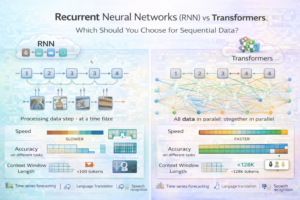
Recurrent Neural Networks (RNN) vs Transformers: Which Should You Choose for Sequential Data?
Meta Description: Compare RNNs, LSTMs, GRUs, and Transformers for sequential data processing. Understand speed, accuracy, scalability trade-offs to choose the best architecture for your task.
Introduction: Processing Sequences
Sequential data is ubiquitous: text (language modeling, translation), time series (stock prices, sensor readings), audio (speech recognition), and video. Two paradigms have dominated: Recurrent Neural Networks (RNNs) and Transformers.
RNNs, introduced in the 1980s, process sequences one element at a time, maintaining hidden state. Transformers, introduced in 2017, process entire sequences in parallel using attention. The shift from RNNs to Transformers is one of the most significant transitions in deep learning history.
This comprehensive guide explains both architectures, their trade-offs, and when to use each. By 2026, transformers dominate most applications, but RNNs remain important in specialized contexts.
Understanding RNNs: Processing Sequences Sequentially
The RNN Concept
An RNN maintains a hidden state that gets updated as it processes each element of a sequence.
Forward Pass Equations:
h_t = tanh(W_hh * h_{t-1} + W_xh * x_t + b_h)  // Update hidden state
 y_t = W_hy * h_t + b_y  // Predict output
Where:
- h_t = hidden state at time t
- x_t = input at time t
- W_hh, W_xh, W_hy = weight matrices (shared across all time steps!)
- y_t = output at time t
Key Property: Weight Sharing
Same weights applied at each time step. This gives RNNs their generalization power but also causes optimization challenges.
RNN Example: Predicting Next Word
- Input: “The cat sat on the”
- Process: h_0 = zeros() → h_1 (process “The”) → h_2 (process “cat”) → h_3 (process “sat”) → h_4 (process “on”) → h_5 (process “the”)
- Predict: y_5 = P(“mat”, “floor”, “bed”, …)
- Hidden state h_5 contains information about entire sequence
The Vanishing Gradient Problem
During backpropagation, gradients flow backward through time. With many time steps, gradients become exponentially small (vanishing) or large (exploding).
Mathematical Cause:
dL/dW = dL/dh_T * dh_T/dh_{T-1} * ... * dh_1/dW
Each multiplication by dh_t/dh_{t-1} (derivative of tanh ≈ 0.1-0.9) compounds.
Consequence: RNNs forget distant history (>20-30 time steps).
Solution: LSTM (Long Short-Term Memory)
LSTM introduces cell state (long-term memory) and gates (what to remember/forget).
LSTM Components:
- Forget Gate: f_t = sigmoid(W_f * [h_{t-1}, x_t] + b_f) // What to forget?
- Input Gate: i_t = sigmoid(W_i * [h_{t-1}, x_t] + b_i) // What new info?
- Candidate Memory: C̃_t = tanh(W_c * [h_{t-1}, x_t] + b_c) // New memory content
- Cell State Update: C_t = f_t ⊙ C_{t-1} + i_t ⊙ C̃_t // Update long-term memory
- Output Gate: o_t = sigmoid(W_o * [h_{t-1}, x_t] + b_o) // What to output?
- Hidden State: h_t = o_t ⊙ tanh(C_t)
Key Innovation: Additive connection in cell state update (C_t = f_t * C_{t-1} + …) preserves gradients through addition (unlike RNN multiplication).
Benefits of LSTM:
- Can capture long-range dependencies (100+ time steps)
- Gradient flow improved through addition in cell state
- Gating mechanism allows selective memory
- Dramatically better accuracy than vanilla RNN
Parameters Comparison:
- Vanilla RNN: 3 weight matrices (W_hh, W_xh, W_hy)
- LSTM: 12 weight matrices (4 gates × 3 matrices each)
- LSTM is 4x more parameters but vastly better accuracy
GRU (Gated Recurrent Unit)
Simplified LSTM with only 2 gates (reset and update) instead of 3.
- Parameters: 6 weight matrices (2 gates × 3 each)
- Accuracy: Similar to LSTM, often slightly lower
- Speed: 30-40% faster than LSTM (fewer parameters)
- Trade-off: Simpler but less expressive
Practical Comparison Table: RNN Variants
| Architecture | Parameters | Max Dependency Length | Training Speed | Typical Accuracy (PTB Dataset) | Best For |
|---|---|---|---|---|---|
| Vanilla RNN | 3h² | ~20 steps | Fast | Baseline (poor) | Rarely used now |
| LSTM | 12h² | 200+ steps | Medium | 120 perplexity | Most sequence tasks |
| GRU | 6h² | 150+ steps | Fast | 125 perplexity | Speed-critical applications |
| Bidirectional LSTM | 24h² | 200+ steps | Slow | 110 perplexity | Tasks where future context available |
Where h = hidden state size
Understanding Transformers: Parallel Processing with Attention
The Transformer Architecture (2017)
Transformers process entire sequences in parallel without recurrence. They use “attention” to relate any two positions in the sequence.
Key Components:
- Positional Encoding: Add information about position since no sequential processing
- Self-Attention: Each position attends to all other positions, computing relevance
- Multi-Head Attention: Multiple attention mechanisms in parallel
- Feed-Forward Network: Fully connected network applied to each position
- Layer Normalization: Normalize activations
Self-Attention Computation:
Q = X * W_Q  // Queries
 K = X * W_K  // Keys
 V = X * W_V  // Values
 Attention(Q, K, V) = softmax(Q * K^T / sqrt(d_k)) * V
Intuition: For each position, compute similarity (dot product) with all other positions. Use these similarities as weights to aggregate information.
Multi-Head Attention:
MultiHead(Q, K, V) = Concat(head_1, ..., head_h) * W_O
 head_i = Attention(Q*W_Q^i, K*W_K^i, V*W_V^i)
Multiple attention mechanisms allow attending to different aspects simultaneously.
Transformer Encoder Stack:
Repeat N times (typically 6-24):
- Multi-Head Self-Attention + Residual + LayerNorm
- Feed-Forward Network + Residual + LayerNorm
Visualization: Position 1 attends to all positions, position 2 attends to all positions, etc. Fully connected graph of attention, not sequential.
Detailed Comparison: RNN vs Transformers
| Aspect | LSTM | Transformer |
|---|---|---|
| Processing | Sequential (one position at a time) | Parallel (all positions simultaneously) |
| Longest Dependency | 200-300 steps (in practice) | Unlimited (theoretically), limited by attention resolution in practice |
| Training Speed | Slower (sequential, not parallelizable) | Much faster (parallel processing, GPU-friendly) |
| Inference Speed | Fast (small model, no attention computation) | Slow (attention scales quadratically with sequence length) |
| Memory (Training) | Low (process one position at a time) | High (store attention scores for all positions) |
| Scalability | Poor (sequential bottleneck) | Excellent (parallelizable, GPU-accelerated) |
| Pre-training | Limited (slow training) | Excellent (fast training enables huge models on massive data) |
| Typical Accuracy | Good baseline | Often 2-5% better than LSTM |
| Position Bias | Inherent (recurrent structure) | Requires explicit positional encoding |
| Code Complexity | Simpler to understand | More complex (multi-head attention) |
Speed Comparison: Training 1000 Steps
| Model | Sequence Length | Time per Batch | Batches/Second | Speedup vs LSTM |
|---|---|---|---|---|
| LSTM (1-layer) | 100 | 50ms | 20 | 1x |
| LSTM (1-layer) | 500 | 200ms | 5 | 1x |
| Transformer-small | 100 | 30ms | 33 | 1.7x |
| Transformer-small | 500 | 35ms | 28 | 5.6x |
| Transformer-base | 100 | 60ms | 16 | 1.25x |
| Transformer-base | 500 | 80ms | 12 | 2.5x |
Key Insight: Transformer advantage grows with sequence length. For short sequences (100 tokens), maybe similar speed. For long sequences (500+ tokens), Transformers are 5-10x faster.
Inference Speed Analysis
LSTM Inference:
- Process one position at a time sequentially
- Can’t parallelize across time steps
- For 512-token sequence: 512 forward passes
- Speed: 2-5ms per position (8-10ms typical)
Transformer Inference:
- Attention computation: O(n²) in sequence length
- For 512-token sequence: attend to 512² = 262K position pairs
- Speed: 50-100ms per sequence (depending on number of layers)
- Can parallelize within a sequence
Practical Impact:
- LSTM: better for real-time inference (single token prediction)
- Transformer: better for batch processing (multiple sequences)
Real-World Application Comparison
Application 1: Machine Translation
Requirements: Handle long sentences (20-50 words), capture long-range dependencies
LSTM Approach:
- Encoder LSTM: process source sentence, output final hidden state
- Problem: single hidden state must contain entire sentence information (information bottleneck)
- Decoder LSTM: generate target sentence using hidden state
- BLEU score (translation quality): ~23-25
- Training time: 1-2 weeks on large dataset
Transformer Approach:
- Encoder: process source sentence, output representation for every position
- Decoder: generate target with attention to all source positions
- Advantage: no bottleneck, much more information flows
- BLEU score: 27-29 (15-20% improvement)
- Training time: 3-5 days (10-50x faster)
Winner: Transformers by large margin (accuracy + speed)
Application 2: Sentiment Analysis (Text Classification)
Requirements: Classify short documents (average 100-200 tokens)
LSTM Approach:
- Simple: embed text, process with LSTM, use final hidden state for classification
- Accuracy: 90-92% on standard benchmarks
- Inference: <5ms per document (fast)
- Model size: 50-100MB
- Training time: minutes to hours on standard GPU
Transformer Approach:
- Use BERT or similar pre-trained model
- Fine-tune on classification task
- Accuracy: 92-94% (small improvement)
- Inference: 50-100ms per document (slower)
- Model size: 300-700MB (much larger)
- Training time: hours to days
Winner: LSTM for production (speed, size). Transformer if accuracy is critical.
Application 3: Language Modeling (Predicting Next Token)
Requirements: Generate realistic text, understand long-range context
LSTM Approach:
- Stacked LSTM layers (2-4 layers typical)
- Perplexity (lower is better) on Penn TreeBank: 120-140
- Generated text quality: mediocre, repeating patterns
- Training on 1B tokens: weeks to months
Transformer Approach:
- Deep transformer (12-24 layers typical)
- Perplexity: 60-90 (40-50% improvement)
- Generated text quality: human-like, coherent
- Training on 1B tokens: days to weeks (enabled by parallelization)
- Scaling up to billions of parameters possible
Winner: Transformers decisively (both accuracy and ability to scale)
Application 4: Time Series Prediction (Stock Prices, Sensor Data)
Requirements: Predict future values from historical sequences
LSTM Approach:
- Encoder-decoder with attention (separate attention mechanism)
- RMSE (prediction error) on standard benchmark: 0.12-0.15
- Fast inference (predict next 24 hours in <1ms)
- Simple to implement and interpret
Transformer Approach:
- Adapt transformer for regression (modify head)
- RMSE: 0.10-0.13 (8-15% improvement)
- Slower inference (~10ms for future prediction)
- Better long-term predictions
Winner: LSTM for real-time constraints, Transformer for accuracy
Application 5: AI chatbot implementation (Conversation Generation)
Requirements: Generate contextually relevant responses, understand long conversation history
LSTM Approach:
- Encoder-decoder with attention on conversation history
- Response quality: mediocre, often generic (“I don’t know”)
- Hallucination rate: low (doesn’t make up facts)
- Fast inference
Transformer Approach (GPT/BERT style):
- Large pre-trained model fine-tuned on conversation data
- Response quality: excellent, contextually appropriate
- Hallucination rate: moderate (must manage expectations)
- Slower inference but acceptable for chat
- Can handle 4K+ conversation history
Winner: Transformers (especially large pre-trained models like GPT)
Hybrid Approaches: Combining Strengths
Transformer-XL (Transformer with recurrence)
Adds recurrent segment-level recurrence to transformers, enabling longer-range context.
- Innovation: Reuse hidden states from previous segment
- Benefit: Can attend to 8,000+ tokens (vs 512 typical)
- Use case: Long document understanding
Longformer / BigBird (Linear Attention)
Replace quadratic attention with linear approximations.
- Attention Pattern: Local attention (nearby positions) + sparse attention (random distant positions)
- Complexity: O(n) instead of O(n²)
- Can process: 4,096 tokens efficiently (vs 512 typical)
- Trade-off: Slightly lower accuracy, much faster
LSTM Attention Hybrid
Add attention mechanism to LSTM.
- Benefits: Sequential processing + global attention
- Speed: Slower than pure transformer, faster than LSTM
- Accuracy: Between LSTM and Transformer
- Use case: When you need balance
Decision Tree: Which Architecture to Use?
Is sequence length <500 tokens?
- YES: Go to Q2
- NO: Use Transformer (LSTM can’t handle long sequences efficiently)
Must inference be <5ms per sample?
- YES: Use LSTM (Transformer too slow for real-time)
- NO: Go to Q3
Is accuracy critical (top 1-2% matters)?
- YES: Use Transformer (usually 2-5% better)
- NO: Use LSTM (simpler, smaller model, sufficient accuracy)
Special Cases:
- Very long sequences (>4,000 tokens): Transformer-XL, Longformer, or sparse attention
- Time series with clear patterns: LSTM often sufficient
- Pre-trained model available: Use it (almost always Transformer-based)
- Interpretability critical: LSTM (simpler, fewer parameters)
Implementation Comparison
LSTM in PyTorch:
import torch.nn as nn
lstm = nn.LSTM(input_size=300, hidden_size=256, num_layers=2, batch_first=True)
output, (h_n, c_n) = lstm(x) # x shape: (batch, seq_len, input_size)
Transformer in PyTorch:
from torch.nn import TransformerEncoder, TransformerEncoderLayer
encoder_layer = TransformerEncoderLayer(d_model=512, nhead=8, dim_feedforward=2048)
transformer = TransformerEncoder(encoder_layer, num_layers=6)
output = transformer(x) # x shape: (seq_len, batch, d_model)
Or use pre-trained (recommended):
from transformers import BertModel
model = BertModel.from_pretrained('bert-base-uncased')
outputs = model(input_ids)
Key Takeaways
- Transformers won the competition: For most modern tasks, Transformers outperform LSTMs in both accuracy and training speed. RNNs are becoming niche.
- LSTM still has niches: Real-time inference constraints, small model requirements, or interpretability needs favor LSTMs.
- Pre-trained models change the equation: With pre-trained Transformers (BERT, GPT), accuracy improvements are even larger (5-10%).
- Sequence length matters: For 500, Transformers are necessary.
- Speed vs Accuracy trade-off: LSTM is faster at inference, Transformers much faster at training on large data.
- Always start with pre-trained: Transfer learning works exceptionally well for sequences. Use BERT/GPT when available.
- Inference latency critical: Use LSTM. Accuracy critical: use Transformer. Both matter: fine-tune smaller Transformer model.
Getting Started
For classification/short text: fine-tune BERT (pre-trained transformer). For generation/long sequences: use GPT or similar. For time series/specialized domains: try both LSTM and Transformer, benchmark on your data. Most likely you’ll find Transformer superior, unless you have strict latency/memory constraints.
Continue Learning: Related Articles
Transformer Architecture: The Technology Powering Modern AI
The Transformer Revolution in AI
In 2017, a groundbreaking paper titled "Attention is All You Need" introduced the Tr…
📖 5 min read
Understanding Neural Networks: A Comprehensive Guide for Beginners
Introduction to Neural Networks
Neural networks are the backbone of modern artificial intelligence and deep learning….
📖 4 min read
Generative Adversarial Networks (GANs): From Theory to Real-World Applications
Generative Adversarial Networks (GANs): From Theory to Real-World Applications
Meta Description: Master Generative Adve…
📖 11 min read
Convolutional Neural Networks: Complete Architecture Guide from Basic to Advanced
Convolutional Neural Networks: Complete Architecture Guide from Basic to Advanced
Meta Description: Master CNN architec…
📖 10 min read
💡 Explore 80+ AI implementation guides on Harshith.org
