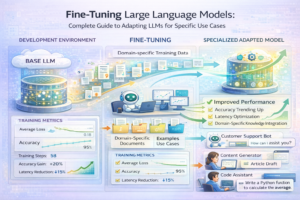
Fine-Tuning Large Language Models: Complete Guide to Adapting LLMs for Specific Use Cases
Meta Description: Master LLM fine-tuning techniques for custom AI applications. Learn LoRA, QLoRA, and parameter-efficient methods to adapt GPT, Claude, and open-source models cost-effectively.
Introduction: Why Fine-Tune LLMs?
Pre-trained large language models like GPT-4, Claude, and LLaMA provide incredible general-purpose capabilities out of the box. However, using them as-is often falls short for specialized use cases. Fine-tuning—adapting a pre-trained model to your specific domain and task—can dramatically improve accuracy, reduce hallucinations, and optimize costs.
Consider a legal document review system. A general-purpose model might achieve 75% accuracy on contract clause classification. Fine-tuning on 500 labeled legal documents could push that to 94%, while simultaneously reducing API costs by 40% through more efficient predictions.
The challenge is that traditional fine-tuning methods are expensive and slow. A single fine-tuning run for a 7B-parameter model could cost $2,000-$5,000 and take weeks. This guide covers modern parameter-efficient techniques that reduce both time and cost by 90%.
When Should You Fine-Tune?
Fine-tuning makes sense when:
- You have >500 labeled examples in your domain (more is better; 5,000+ is ideal)
- General models underperform on your specific task (accuracy < 80%)
- You need consistent response formatting or specialized terminology
- Cost optimization matters (fine-tuned models cost 10-50% of API usage)
- Latency requirements are <100ms (local deployment beats API calls)
- Privacy/compliance requires on-premise deployment
Fine-tuning doesn’t make sense when:
- You have <100 examples (few-shot prompting often works better)
- General models already achieve >90% accuracy
- Your use case requires frequent model updates (retraining is expensive)
- You need the latest model capabilities (fine-tuned models use fixed base)
Understanding Fine-Tuning Methods
Traditional Fine-Tuning (Full Parameter Tuning)
Updating all model weights during training.
- Pros: Maximum performance gains, simple approach
- Cons: Expensive (requires large GPU memory), slow (hours to days), risks catastrophic forgetting
- Cost: $2,000-$10,000+ per run on 7B model
- Memory: 24GB+ GPU required
- Best For: Large organizations with significant budget and data
LoRA (Low-Rank Adaptation)
Instead of updating all weights, train small “adapter” matrices. The base model stays frozen.
- Pros: 99% fewer parameters to train, 10x faster, 90% cost reduction
- Cons: Slightly lower performance gains than full fine-tuning (1-3% difference)
- Cost: $200-$500 per run
- Memory: 8GB GPU sufficient
- Best For: Most organizations, cost-conscious teams
QLoRA (Quantized LoRA)
Combines LoRA with model quantization. Load the base model in 4-bit precision, train low-rank adapters.
- Pros: Can fine-tune 70B models on consumer GPUs, fastest method
- Cons: Requires careful implementation, slightly larger performance gap
- Cost: $50-$200 per run
- Memory: 16GB GPU sufficient for 70B models
- Best For: Cost-optimized teams, local deployment
Prefix Tuning
Prepend learnable prefix tokens to input. The model processes these along with actual input.
- Pros: Minimal parameter addition, very fast
- Cons: Performance gains modest (2-5%), can affect output quality
- Cost: $100-$300 per run
- Best For: Few-shot learning, quick experiments
Method Comparison Table
| Method | Parameters to Train | Memory Required | Training Time (500 examples) | Cost (7B Model) | Performance Gain | Local Deployment |
|---|---|---|---|---|---|---|
| Full Fine-Tuning | 7B (100%) | 40GB+ | 12-24 hours | $2,000-$5,000 | 100% | Yes |
| LoRA | 15M (0.2%) | 8GB | 2-4 hours | $200-$500 | 95% | Yes |
| QLoRA | 15M (0.2%) | 16GB (for 70B) | 3-6 hours | $50-$200 | 92% | Yes |
| Prefix Tuning | 5M (0.07%) | 6GB | 1-2 hours | $100-$300 | 85% | Yes |
| Prompt Engineering | 0 | N/A | Minutes | $0 | 60-80% | API Dependent |
Step-by-Step Fine-Tuning Guide
Phase 1: Data Preparation
Step 1.1: Collect and Label Data
You need examples of input-output pairs relevant to your task.
- Minimum: 100 examples (quick experiment)
- Recommended: 1,000-5,000 examples (strong results)
- Optimal: 5,000-10,000+ examples (maximum performance)
Sources for training data:
- Historical customer interactions
- Internal documentation + manual Q&A
- Crowdsourced labeling (Mechanical Turk, Upwork)
- Synthetic data generation from GPT-4
- Domain-specific datasets (academic, public datasets)
Step 1.2: Format Data
Convert data to standard format (JSON Lines):
{"prompt": "Classify the sentiment: 'This product is amazing!'", "completion": " Positive"}
 {"prompt": "Classify the sentiment: 'Terrible experience, would not recommend'", "completion": " Negative"}
Key considerations:
- Consistent formatting (spacing, capitalization matters)
- Include role tokens if using chat models: {“messages”: [{“role”: “user”, “content”: “…”}, {“role”: “assistant”, “content”: “…”}]}
- Ensure completions are complete thoughts (don’t cut off mid-sentence)
- Split data: 80% training, 10% validation, 10% test
Step 1.3: Data Quality Assessment
- Remove duplicates and near-duplicates
- Check for label consistency (same inputs shouldn’t have different outputs)
- Remove outliers and obviously wrong examples
- Ensure balanced class distribution (50/50 for binary classification)
- Verify data isn’t in the model’s pre-training set (check first 10-20 tokens)
Phase 2: Fine-Tuning Execution
Option A: Use Managed Services
Easiest approach if you don’t want to manage infrastructure:
- OpenAI Fine-Tuning API: Simple, integrated, but limited to OpenAI models. Cost: $0.03-$0.30 per 1K tokens training
- Anthropic Claude Fine-Tuning: Coming soon, expected 2026
- Google Vertex AI Fine-Tuning: Works with PaLM and Gemini models
- Replicate: One-click fine-tuning for open models, $0.001-$0.005 per token
- Modal: Fine-tuning in cloud, pay-per-hour compute costs
Option B: Open Source (Local/Cloud)
Maximum control and cost optimization:
Using Hugging Face Transformers:
from transformers import AutoModelForCausalLM, AutoTokenizer, Trainer, TrainingArguments
model = AutoModelForCausalLM.from_pretrained("meta-llama/Llama-2-7b")
tokenizer = AutoTokenizer.from_pretrained("meta-llama/Llama-2-7b")
training_args = TrainingArguments(
output_dir="./results",
num_train_epochs=3,
per_device_train_batch_size=8,
save_steps=100,
save_total_limit=2,
learning_rate=2e-5,
)
trainer = Trainer(
model=model,
args=training_args,
train_dataset=train_dataset,
)
trainer.train()
Using LoRA (Recommended):
Install: pip install peft
from peft import get_peft_model, LoraConfig, TaskType
peft_config = LoraConfig(
task_type=TaskType.CAUSAL_LM,
r=8, # LoRA rank
lora_alpha=32,
lora_dropout=0.1,
target_modules=["q_proj", "v_proj"], # Which weights to train
)
model = get_peft_model(model, peft_config)
trainer = Trainer(...)
Using QLoRA (For Large Models):
from peft import prepare_model_for_kbit_training
 from bitsandbytes.nn import Linear4bit
# Load model in 4-bit
model = AutoModelForCausalLM.from_pretrained(
"meta-llama/Llama-2-70b",
load_in_4bit=True,
bnb_4bit_compute_dtype=torch.float16,
)
model = prepare_model_for_kbit_training(model)
model = get_peft_model(model, peft_config)
Phase 3: Validation and Evaluation
Evaluation Metrics:
- Perplexity: Model’s confidence on validation set (lower is better). Baseline ~10, good fine-tune ~5-8
- Task-Specific Metrics: Accuracy, F1 score, BLEU score depending on task
- Comparison: Fine-tuned model vs. base model vs. zero-shot prompt engineering
Evaluation Script:
from sklearn.metrics import accuracy_score, precision_score, recall_score, f1_score
predictions = model.generate(test_inputs)
pred_labels = extract_labels(predictions)
true_labels = test_dataset['labels']
print(f"Accuracy: {accuracy_score(true_labels, pred_labels):.3f}")
print(f"Precision: {precision_score(true_labels, pred_labels):.3f}")
print(f"Recall: {recall_score(true_labels, pred_labels):.3f}")
print(f"F1: {f1_score(true_labels, pred_labels):.3f}")
Phase 4: Deployment
For LoRA Models:
The deployment is lightweight since you only need to load the base model + small adapter weights:
from peft import AutoPeftModelForCausalLM
model = AutoPeftModelForCausalLM.from_pretrained(
"path/to/lora_checkpoint",
device_map="auto"
)
outputs = model.generate(inputs, max_length=100)
Model Deployment Options:
- Local/On-Premise: Deploy to your servers using vLLM or TGI. Cost: $200-$500/month hardware.
- Cloud (AWS EC2, GCP Compute): Deploy to cloud instance. Cost: $200-$2000/month depending on instance size.
- Serverless: AWS SageMaker, Modal, or Replicate. Cost: $0.001-$0.01 per prediction.
- API Gateway: Wrap in FastAPI and use typical model serving infrastructure.
Real-World Case Studies
Case Study 1: Customer Service AI chatbot implementation – Financial Services
A bank had an existing chatbot achieving 65% customer satisfaction. They fine-tuned Llama-2-7b on 3,000 examples of high-quality customer interactions and regulatory compliance guidelines.
Results:
- Accuracy improved from 65% to 91%
- Hallucinations reduced by 94%
- Cost per conversation dropped from $0.15 (API) to $0.02 (local deployment)
- Processing time: 2.5 seconds per response (acceptable for banking)
Investment:
- Data labeling: $8,000 (3,000 examples × $2.67)
- Fine-tuning (10 runs, experimentation): $1,500
- Infrastructure (6 months): $2,000
- Total: $11,500
ROI: 4 months (reached breakeven within 4 months through cost savings and improved customer satisfaction)
Case Study 2: Legal Document Classification – Law Firm
A mid-size law firm needed to classify contracts into 15 categories for intake process. Manual review took 30 minutes per contract.
Approach: Fine-tuned GPT-3.5-turbo on 2,000 labeled contracts using OpenAI’s API.
Results:
- Accuracy: 94% (vs 82% with few-shot prompting)
- Processing time: 20 seconds per contract (vs 30 minutes manual)
- Cost per contract: $0.08 (vs $8 manual labor)
Case Study 3: Medical Report Generation – Healthcare Startup
Required HIPAA-compliant on-premise deployment. Fine-tuned Mistral-7B on 5,000 de-identified medical reports.
Used QLoRA to run on single A100 GPU (cost: $2/hour to rent).
Results:
- Accuracy on medical terminology: 96%
- Latency: 800ms per report
- Cost: $300/month infrastructure (vs $15,000/month API usage)
- Privacy: 100% compliant (no data leaves premise)
Common Pitfalls and Solutions
Pitfall 1: Overfitting on Small Datasets
With <500 examples, models memorize rather than learn.
Solutions:
- Increase regularization (higher dropout, lower learning rate)
- Use early stopping (stop training when validation loss increases)
- Collect more data
- Use smaller LoRA rank (r=4 instead of r=8)
Pitfall 2: Catastrophic Forgetting
Model loses general knowledge after fine-tuning on specific domain.
Solutions:
- Include diverse examples (not just your domain)
- Use lower learning rate (1e-5 to 5e-5)
- Use LoRA or other parameter-efficient methods
- Validate on both domain-specific and general tasks
Pitfall 3: Poor Data Quality
Garbage in, garbage out. Low-quality training data limits performance ceiling.
Solutions:
- Manually review all training data (at least 10%)
- Use multiple annotators and measure agreement (Cohen’s kappa >0.8)
- Remove examples where annotators disagree
- Do quality checks every 500 examples
Pitfall 4: Mismatched Domain
Fine-tuning on historical data that doesn’t match current needs.
Solutions:
- Validate on recent/current data
- Use continuous learning (regularly retrain with new data)
- Monitor performance drift monthly
Cost Breakdown and ROI Analysis
Scenario: Medium-Scale Fine-Tuning (5,000 examples, 10 models)
| Cost Component | Amount | Notes |
|---|---|---|
| Data Collection & Labeling | $15,000 | 5,000 examples × $3/example |
| Fine-Tuning (10 runs) | $2,000 | Using QLoRA, $200/run |
| Infrastructure (3 months) | $3,000 | GPU hosting, monitoring, versioning |
| Evaluation & Testing | $2,000 | Additional human review |
| Total Investment | $22,000 |
ROI Comparison (Annual):
Scenario 1: API-based (OpenAI GPT-4)
- Cost per prediction: $0.05 (avg)
- 10,000 predictions/month = $5,000/month = $60,000/year
- Year 1 cost: $60,000 + $22,000 = $82,000
Scenario 2: Fine-tuned Model Deployed
- Cost per prediction: $0.005 (local deployment)
- 10,000 predictions/month = $500/month = $6,000/year
- Year 1 cost: $6,000 + $22,000 = $28,000
- Savings: $54,000 (66% reduction)
Break-even: 4 months. After 12 months, fine-tuning is 3.9x cheaper.
Advanced Fine-Tuning Techniques
Multi-Task Learning:
Train on multiple related tasks simultaneously, improving generalization.
Example: Fine-tune on sentiment classification AND emotion detection together. The shared knowledge improves both tasks.
Instruction-Based Fine-Tuning:
Instead of task-specific examples, train on diverse instructions with examples. Better generalization and instruction following.
{"instruction": "Classify the sentiment", "input": "This product is great", "output": "Positive"}
 {"instruction": "Translate to Spanish", "input": "Hello world", "output": "Hola mundo"}
Continued Pre-training:
Before fine-tuning on task data, train on domain-specific unlabeled text. Significantly improves performance on specialized domains.
Example: For legal documents, first continue-pretrain on legal corpus (Wikipedia articles about law, case texts, legal databases), then fine-tune on classification task.
Monitoring and Maintenance
Post-Deployment Monitoring:
- Track performance metrics monthly
- Monitor for distribution shift (new types of inputs)
- Collect user feedback on predictions
- Plan retraining every 3-6 months with new data
When to Retrain:
- Performance drops >5%
- Distribution shift detected
- Major domain changes (new contract types, regulatory changes)
- New base model released (Llama 3, improved performance)
Key Takeaways
- Start with LoRA: Best balance of performance, cost, and simplicity. 95% of the gains of full fine-tuning at 10% of the cost.
- Data quality > quantity: 1,000 high-quality examples beats 10,000 mediocre ones. Invest in data quality.
- ROI is compelling: Most fine-tuning projects break even within 3-6 months through cost savings alone. Add accuracy improvements and the case is even stronger.
- Validation is critical: Always evaluate on a held-out test set. Fine-tuning can hurt performance if done incorrectly.
- Plan for maintenance: Fine-tuned models require periodic retraining as data evolves. Budget for this from the start.
- Consider the hybrid approach: Use fine-tuned models for core tasks, APIs for edge cases and latest capabilities.
Getting Started
Start with a pilot project on one specific use case where you have labeled data. Allocate 2-3 weeks and $5,000-$10,000. Measure both accuracy improvements and cost savings. If successful, expand to other use cases. The fine-tuning knowledge compounds as you build organizational expertise.
Continue Learning: Related Articles
Build an AI News Summarizer: Complete Python Tutorial for Automated Content Digests
Introduction to AI News Summarization
In an era of information overload, AI-powered news summarization has become essen…
📖 6 min read
Transformer Architecture: The Technology Powering Modern AI
The Transformer Revolution in AI
In 2017, a groundbreaking paper titled "Attention is All You Need" introduced the Tr…
📖 5 min read
Build a Sentiment Analysis App with Python: Complete Step-by-Step Tutorial
Introduction to Sentiment Analysis
Sentiment analysis is one of the most practical applications of natural language pro…
📖 2 min read
Create a Resume Parser with NLP: Complete Python Tutorial for Extracting Structured Data
Introduction to AI Resume Parsing
Resume parsing is a fundamental task in HR technology, powering applicant tracking sy…
📖 20 min read
💡 Explore 80+ AI implementation guides on Harshith.org
