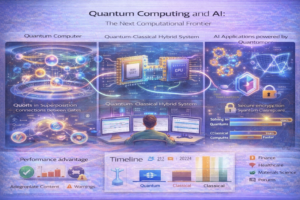
The Convergence of Quantum Computing and Artificial Intelligence
Quantum computing represents a fundamentally different computational paradigm from classical computers. Unlike classical bits that are either 0 or 1, quantum bits (qubits) can exist in superposition, simultaneously representing multiple states. When combined with AI, quantum computing promises to revolutionize problem-solving capabilities across multiple domains. Understanding this convergence requires exploring quantum computing principles, AI applications, and the challenges ahead.
Fundamentals of Quantum Computing
Superposition: Qubits can exist in a superposition of both 0 and 1 states simultaneously. When measured, they collapse to either 0 or 1, but during computation they exist in both states. This allows quantum computers to explore multiple solution paths simultaneously.
Entanglement: Qubits can become entangled, meaning the state of one qubit is correlated with others. Entanglement enables quantum computers to perform operations on multiple qubits simultaneously with exponential speedup compared to classical approaches.
Interference: Quantum algorithms exploit interference, amplifying the probability of correct answers while suppressing incorrect ones. This clever manipulation of probability amplitudes is key to quantum algorithm design.
Quantum Algorithms for AI
Grover’s Algorithm: This quantum algorithm searches unsorted databases quadratically faster than classical algorithms. For AI applications like feature search in large datasets, this speedup could be significant.
Variational Quantum Eigensolver (VQE): VQE finds ground state energies of quantum systems, useful for simulating molecular interactions. This has applications in drug discovery and materials science.
Quantum Machine Learning: Research is exploring quantum versions of machine learning algorithms. Quantum neural networks might exploit quantum properties for enhanced learning. However, theoretical advantages haven’t yet translated into practical speedups on current hardware.
Quantum Optimization: Many AI problems can be formulated as optimization problems. Quantum approaches to optimization might find better solutions faster than classical methods.
Potential Applications in AI
Machine Learning: Training machine learning models on massive datasets is computationally expensive. Quantum algorithms might accelerate training, enable exploration of higher-dimensional feature spaces, or discover patterns classical algorithms miss.
Drug Discovery: Simulating molecular interactions quantum-mechanically is challenging classically. Quantum computers could efficiently simulate quantum systems, accelerating drug discovery and materials development.
Optimization Problems: Many real-world problems—supply chain optimization, portfolio optimization, circuit design—are NP-hard optimization problems. Quantum approaches might find better solutions.
Cryptography and Security: Quantum computers threaten current encryption methods but could also enable quantum-resistant cryptography and quantum key distribution.
Current State of Quantum Computing
Quantum computers have advanced dramatically but remain in early stages. Current machines have on the order of 100-1000 qubits, while practical applications might require millions. More critically, qubits are fragile—they decohere due to environmental noise, introducing errors. Current quantum computers have error rates that limit computation depth.
This Noisy Intermediate-Scale Quantum (NISQ) era presents challenges. Algorithms must be error-tolerant. Near-term applications will likely be limited. Full-scale quantum computers with error correction and sufficient qubits remain years away.
Challenges in Quantum AI
Quantum-Classical Hybrid Systems: Current quantum computers must work alongside classical computers. Data preparation, result interpretation, and many computations remain classical. Efficiently interfacing quantum and classical components is challenging.
Scalability: Building quantum computers with sufficient qubits and low error rates is extraordinarily difficult. Different technologies (superconducting qubits, trapped ions, photonics, topological qubits) are being pursued, but scalability remains unproven.
Algorithm Development: Designing quantum algorithms that provide genuine speedups is difficult. Many proposed algorithms show theoretical speedups only for specific problem types.
Talent and Expertise: Quantum computing requires expertise in physics, mathematics, computer science, and engineering. Building quantum expertise globally will take time.
The Hype vs. Reality
Quantum computing has attracted enormous media attention and investment. While the potential is genuine, current capabilities are often overstated. Many popular articles suggest quantum computers will soon replace classical computers—not true. Quantum computers excel at specific problem types while classical computers remain superior for most tasks.
More realistic timelines suggest practical quantum advantage for AI applications may arrive in 5-15 years, with significant uncertainty. Near-term progress will likely be in simulating quantum systems and solving specific optimization problems.
Integration with AI
The most promising applications likely involve hybrid approaches combining quantum and classical computing. Quantum subroutines might handle specific computational bottlenecks while classical systems handle the rest. This division of labor plays to the strengths of each technology.
Some AI researchers are exploring quantum-inspired classical algorithms—algorithms inspired by quantum computing principles but implemented on classical hardware. These might provide practical improvements without requiring quantum hardware.
Future Outlook
As quantum computing matures, its impact on AI will depend on solving several challenges: building larger, more reliable quantum computers, developing better quantum algorithms, creating effective quantum-classical hybrid systems, and training a workforce with quantum expertise.
The intersection of quantum computing and AI represents a frontier of immense potential. While practical applications are likely years away, the eventual impact could be transformative. Understanding this technology’s possibilities and limitations is increasingly important for anyone working in AI or technology more broadly.
Continue Learning: Related Articles
Natural Language Processing: The Evolution from Rules to Neural Networks
The Journey of Natural Language Processing
Natural Language Processing (NLP) has undergone a remarkable transformation …
📖 5 min read
The ChatGPT Phenomenon and the Rise of Large Language Models
In November 2022, OpenAI released ChatGPT, sparking an AI revolution that captured global attention. Within five days, i…
📖 5 min read
Movie Recommendation System
Hands-On Project: Movie Recommendation System
Difficulty Level: Intermediate | Duration: 3-5 hours | Topics: Collaborati…
📖 7 min read
Autonomous Agents: Building Self-Learning Systems That Make Independent Decisions
Autonomous Agents: Building Self-Learning AI Systems That Make Independent Decisions
Artificial intelligence has evolve…
📖 6 min read
💡 Explore 80+ AI implementation guides on Harshith.org
