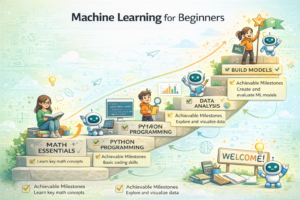
What is Machine Learning?
Machine Learning (ML) is a transformative subset of artificial intelligence that has revolutionized how computers learn and make decisions. Unlike traditional programming where developers write explicit rules for every scenario, machine learning enables systems to automatically learn patterns and improve their performance from experience, without being explicitly programmed for each specific task.
Think of it this way: instead of teaching a computer every single rule about identifying spam emails (checking for specific keywords, sender addresses, etc.), machine learning allows the computer to analyze thousands of examples of spam and legitimate emails, learning to identify patterns that distinguish one from the other. As it sees more examples, it gets better at making accurate predictions.
This fundamental shift in how we approach problem-solving with computers has enabled breakthroughs across virtually every industry, from healthcare diagnostics to autonomous vehicles, from personalized recommendations to fraud detection.
The Three Main Types of Machine Learning
Supervised Learning: Learning from Labeled Examples
Learn more: LLM guide
Supervised learning is like learning with a teacher. The algorithm is trained on a dataset where each example comes with the correct answer (called a “label”). The model learns to map inputs to outputs by finding patterns in these labeled examples.
For instance, if you want to build a system that identifies whether an image contains a cat or dog, you’d provide thousands of images labeled “cat” or “dog.” The algorithm learns features that distinguish cats from dogs—perhaps ear shape, whisker patterns, or facial structure—and uses these patterns to classify new, unseen images.
Common supervised learning applications include:
- Email spam detection: Learning from examples of spam and legitimate emails
- Medical diagnosis: Predicting diseases based on symptoms and test results
- Price prediction: Forecasting house prices, stock values, or product demand
- Credit scoring: Assessing loan default risk based on applicant information
- Image classification: Identifying objects, faces, or scenes in photos
- Speech recognition: Converting spoken words to text
Unsupervised Learning: Discovering Hidden Patterns
Unsupervised learning is like exploring data without a guide. The algorithm receives data without labels and must find interesting patterns or structures on its own. This is particularly valuable when you don’t know what you’re looking for or when labeling data would be prohibitively expensive.
Imagine giving an algorithm data about customer purchases without telling it anything about customer segments. Through clustering algorithms, it might discover that customers naturally group into categories like “budget shoppers,” “premium buyers,” and “occasional purchasers,” revealing insights you didn’t explicitly seek.
Popular unsupervised learning applications:
- Customer segmentation: Grouping customers by behavior for targeted marketing
- Anomaly detection: Identifying unusual transactions, network intrusions, or equipment failures
- Recommendation systems: Suggesting products based on user similarity patterns
- Data compression: Reducing data size while preserving important information
- Topic modeling: Discovering themes in document collections
- Dimensionality reduction: Simplifying complex datasets for visualization
Reinforcement Learning: Learning Through Trial and Error
Reinforcement learning mimics how humans and animals learn through interaction with their environment. An agent takes actions, receives feedback in the form of rewards or penalties, and learns strategies to maximize cumulative rewards over time.
This approach has achieved remarkable successes in complex domains. DeepMind’s AlphaGo, which defeated world champions at the ancient game of Go, learned by playing millions of games against itself, gradually discovering winning strategies through reinforcement learning.
Reinforcement learning powers:
- Game AI: Creating intelligent opponents and non-player characters
- Robotics: Teaching robots to walk, manipulate objects, or navigate environments
- Autonomous vehicles: Learning optimal driving policies through simulation and real-world experience
- Resource allocation: Optimizing energy consumption, traffic flow, or supply chains
- Financial trading: Developing adaptive trading strategies
- Personalization: Adapting user interfaces or content based on engagement
Essential Concepts Every Beginner Must Understand
Features, Labels, and Predictions
Features are the input variables your model uses to make predictions. In house price prediction, features might include square footage, number of bedrooms, location, age of the house, and school district ratings. Labels are the outputs you’re trying to predict—in this case, the sale price. The model learns relationships between features and labels to make predictions about new houses.
Training, Validation, and Testing
A critical concept in ML is properly splitting your data. The training set teaches your model, typically comprising 60-70% of your data. The validation set (10-20%) helps tune hyperparameters and make decisions during model development. Finally, the test set (10-20%) evaluates final model performance on completely unseen data, giving you an honest estimate of real-world accuracy.
This separation prevents overfitting—when a model memorizes training data rather than learning generalizable patterns. An overfit model performs excellently on training data but fails miserably on new examples, like a student who memorizes specific test questions but doesn’t truly understand the subject.
Model Evaluation Metrics
Different metrics measure different aspects of model performance:
- Accuracy: Percentage of correct predictions (works well for balanced datasets)
- Precision: Of predicted positives, how many were actually positive (important when false positives are costly)
- Recall: Of actual positives, how many were correctly identified (crucial when missing positives is dangerous, like disease detection)
- F1 Score: Harmonic mean of precision and recall, balancing both concerns
- Mean Squared Error: For regression problems, measures average squared difference between predictions and actual values
- ROC-AUC: Evaluates classification performance across different decision thresholds
Bias vs. Variance Trade-off
Models must balance two types of error. Bias error occurs when a model is too simple, missing important patterns (underfitting). Variance error happens when a model is too complex, learning noise as if it were signal (overfitting). The art of machine learning involves finding the sweet spot between these extremes.
Popular Machine Learning Algorithms Explained
Linear and Logistic Regression
Linear regression finds the best-fit line through data points to predict continuous values. It’s the foundation of many ML concepts and works well when relationships are roughly linear. Logistic regression extends this to classification problems, predicting probabilities of categorical outcomes like email spam vs. legitimate, or loan approval vs. denial.
Decision Trees and Random Forests
Decision trees create tree-like models of decisions, splitting data based on feature values. They’re intuitive and easy to visualize—like a flowchart of yes/no questions leading to a prediction. However, single trees often overfit. Random forests address this by creating many trees on random subsets of data and features, then averaging their predictions for more robust results.
Support Vector Machines (SVM)
SVMs find optimal boundaries between classes by maximizing the margin between different groups in your data. They work exceptionally well for binary classification problems and can handle non-linear relationships through the “kernel trick,” which transforms data into higher dimensions where linear separation becomes possible.
Neural Networks and Deep Learning
Inspired by biological neurons, artificial neural networks consist of layers of interconnected nodes that process and transform data. Deep learning uses neural networks with many layers, enabling them to learn hierarchical representations of increasing abstraction. Early layers might detect edges in images, middle layers recognize shapes, and final layers identify complete objects.
k-Nearest Neighbors (k-NN)
One of the simplest algorithms, k-NN classifies new examples based on the majority class among their k nearest neighbors in the feature space. While intuitive and effective for smaller datasets, it becomes computationally expensive with large datasets since it must compare new examples against all training data.
Tools and Technologies for Your ML Journey
Python: The ML Language of Choice
Python dominates machine learning due to its readable syntax, extensive libraries, and active community. Its simplicity allows you to focus on ML concepts rather than programming complexity. Most ML research and industry applications use Python, making it the clear choice for beginners.
Essential Libraries
NumPy and Pandas: Handle numerical computations and data manipulation efficiently. NumPy provides powerful array operations, while Pandas offers DataFrames for working with structured data.
Scikit-learn: The go-to library for traditional ML algorithms. It provides consistent APIs for dozens of algorithms, preprocessing tools, and evaluation metrics, making it perfect for learning fundamentals.
TensorFlow and PyTorch: Industry-standard frameworks for deep learning. TensorFlow, developed by Google, offers production-ready tools and deployment options. PyTorch, preferred in research, provides intuitive dynamic computation graphs.
Matplotlib and Seaborn: Visualization libraries for creating charts and graphs to understand your data and model performance.
Development Environments
Jupyter Notebooks: Interactive environments combining code, visualizations, and explanatory text. Perfect for experimentation and learning.
Google Colab: Free cloud-based Jupyter notebooks with GPU access, eliminating the need for powerful local hardware.
VS Code: Professional IDE with excellent Python support, debugging capabilities, and ML extensions.
Your Comprehensive Learning Roadmap
Phase 1: Foundations (2-3 months)
Master Python basics including data structures, functions, and object-oriented programming. Learn NumPy for array operations and Pandas for data manipulation. Study essential mathematics: linear algebra (vectors, matrices), calculus (derivatives, gradients), probability theory (distributions, Bayes’ theorem), and statistics (hypothesis testing, confidence intervals).
Build simple projects: predict house prices using linear regression, classify iris flowers, or analyze customer churn. These foundational projects teach core concepts without overwhelming complexity.
Phase 2: Core Machine Learning (3-4 months)
Deep dive into supervised and unsupervised learning algorithms. Understand when to use each algorithm, their strengths and limitations. Master data preprocessing: handling missing values, feature scaling, encoding categorical variables, and feature engineering.
Learn cross-validation, hyperparameter tuning with grid search and random search, and proper model evaluation. Complete intermediate projects: build a recommendation system, create a sentiment analysis classifier, or develop a fraud detection system.
Phase 3: Advanced Topics (Ongoing)
Explore deep learning: convolutional neural networks for computer vision, recurrent networks for sequences, transformers for NLP. Study ensemble methods, gradient boosting (XGBoost, LightGBM), and advanced optimization techniques.
Learn model deployment: converting notebooks to production code, creating APIs, containerization with Docker, and monitoring deployed models. Understand MLOps practices for managing ML systems at scale.
Common Pitfalls and How to Avoid Them
- Starting with complex problems: Begin with well-defined, simple datasets before tackling ambiguous real-world problems
- Ignoring data quality: Spend time understanding and cleaning your data; garbage in, garbage out applies strongly in ML
- Not performing exploratory data analysis: Always visualize and understand your data before modeling
- Leaking information from test to training data: Strictly separate test data to get honest performance estimates
- Chasing perfect accuracy: Focus on building robust, maintainable systems rather than squeezing out every percentage point
- Neglecting model interpretability: Especially in critical domains, understand why your model makes decisions
Recommended Free Learning Resources
- Andrew Ng’s Machine Learning Course: Comprehensive Stanford course covering fundamentals thoroughly
- Fast.ai: Practical, top-down approach to deep learning with excellent community
- Kaggle Learn: Interactive micro-courses with real datasets and competitions
- Google’s ML Crash Course: Quick, practical introduction with TensorFlow exercises
- StatQuest: YouTube channel explaining statistical concepts with exceptional clarity
- 3Blue1Brown: Beautiful visual explanations of neural networks and linear algebra
- Coursera ML Specializations: In-depth courses from top universities
Building Your First Complete ML Project
Choose a beginner-friendly dataset from Kaggle or UCI Machine Learning Repository. The Titanic survival prediction or iris flower classification are excellent starting points.
Follow this workflow: Load and explore data with Pandas. Visualize distributions and relationships. Clean data by handling missing values and outliers. Engineer features to create meaningful inputs. Split into train/validation/test sets. Try multiple algorithms. Evaluate using appropriate metrics. Tune hyperparameters on validation set. Test final model on test set. Document your process and findings.
This complete cycle teaches you the entire ML pipeline, not just algorithm application.
Conclusion: Your ML Journey Starts Now
Machine learning is an exciting, rapidly evolving field with tremendous opportunities. While the breadth of topics can seem daunting, remember that every expert started exactly where you are now. The key is consistent practice, building progressively more complex projects, and maintaining curiosity about how and why algorithms work.
Don’t get paralyzed by trying to learn everything at once. Start with fundamentals, build small projects, and gradually increase complexity. Join communities like Kaggle, participate in discussions, and learn from others’ code. Most importantly, don’t fear making mistakes—they’re essential learning opportunities.
The demand for ML skills continues to grow across industries. Whether you’re interested in research, software engineering, data science, or applying ML to domain-specific problems, the foundational concepts remain the same. Invest time in understanding these fundamentals deeply, and you’ll have the flexibility to adapt as the field evolves.
Your journey into machine learning begins with a single line of code. Start today, stay consistent, and you’ll be amazed at how quickly you progress from confused beginner to confident practitioner. Welcome to the world of machine learning!
Continue Learning: Related Articles
Real-Time Machine Learning: Streaming Data, Feature Stores, and Online Learning for Production Systems
Real-Time Machine Learning: Streaming Data, Feature Stores, and Online Learning for Production Systems
Meta Description…
📖 15 min read
Understanding Large Language Models: A Comprehensive Guide
What Are Large Language Models?
Large Language Models (LLMs) represent one of the most significant breakthroughs in art…
📖 9 min read
Build an AI Content Moderator: Complete Python Tutorial for Text and Image Moderation
Introduction to AI Content Moderation
Content moderation is one of the most critical applications of AI in the modern i…
📖 12 min read
Building AI-Powered Web Applications: A Complete Developer Guide
Building Modern AI-Powered Web Applications: A Complete Developer Guide
The integration of artificial intelligence into…
📖 13 min read
💡 Explore 80+ AI implementation guides on Harshith.org
