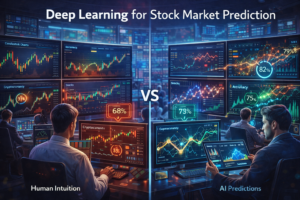
Applying deep learning to Financial Markets
Stock market prediction has long been a goal of investors, analysts, and researchers. The emergence of deep learning techniques has opened new avenues for financial forecasting, enabling more sophisticated analysis of market dynamics. This article explores how deep learning is applied to stock market prediction, the opportunities it presents, and the challenges that remain.
Why Deep Learning for Stock Prediction?
Traditional econometric models like ARIMA and GARCH have limitations in capturing complex nonlinear relationships in financial data. Deep learning excels at discovering intricate patterns in high-dimensional data, making it well-suited for financial prediction tasks. These models can process multiple types of data simultaneously—price history, trading volume, sentiment data, economic indicators—and learn complex interactions between these variables.
Deep Learning Architectures for Stock Prediction
Recurrent Neural Networks (RNNs) and LSTMs: These architectures are particularly well-suited for time-series prediction because they maintain memory of previous inputs. Long Short-Term Memory (LSTM) networks address the vanishing gradient problem inherent in basic RNNs, allowing them to learn long-term dependencies in stock price movements.
Convolutional Neural Networks (CNNs): While primarily known for image processing, CNNs can be applied to financial data. They excel at identifying local patterns and can be used to analyze technical patterns in price charts.
Transformer Networks: The success of Transformers in NLP has led to their application in financial prediction. Their attention mechanisms allow models to focus on relevant historical periods and relationships.
Hybrid Architectures: Modern approaches often combine multiple architectures, using CNNs to extract features from technical charts while LSTMs process time-series price data and sentiment information.
Data Sources and Feature Engineering
Successful stock prediction models typically incorporate multiple data sources. Historical price and volume data provide the foundation. Technical indicators like moving averages, RSI, and MACD capture market sentiment and momentum. Fundamental data including company earnings, revenue, and growth rates provide context. Alternative data such as social media sentiment, news analysis, and satellite imagery can provide additional signals. Macroeconomic indicators including interest rates, inflation, and GDP growth affect overall market conditions.
Feature engineering is critical in this domain. Raw data requires significant preprocessing and normalization. Creating lagged features, rolling statistics, and interaction terms helps the model learn meaningful patterns. Domain expertise plays an important role in identifying which features are likely to be predictive.
Opportunities in Deep Learning for Finance
Pattern Recognition: Deep learning can identify complex patterns that human analysts might miss, discovering subtle relationships between different market variables.
Sentiment Analysis: NLP-based models can analyze news, social media, and financial reports to quantify market sentiment and incorporate it into predictions.
Real-Time Processing: Deep learning models can process streaming data and update predictions in real-time, responding quickly to new information.
Portfolio Optimization: Beyond predicting individual stock movements, deep learning can optimize portfolio allocation to balance risk and return.
Anomaly Detection: Models trained on normal market behavior can identify unusual patterns that might signal trading opportunities or risks.
Challenges and Limitations
Market Efficiency: The efficient market hypothesis suggests that all available information is already reflected in prices, making prediction inherently difficult. While markets are not perfectly efficient, beating them consistently remains extraordinarily challenging.
Non-Stationarity: Stock market dynamics change over time. Models trained on historical data may not generalize well to future data, especially during regime changes or market dislocations.
Overfitting: With access to vast amounts of financial data and highly flexible deep learning models, overfitting is a significant risk. Models may learn spurious patterns that don’t represent genuine relationships.
Causality vs. Correlation: Markets are influenced by countless factors, many unknown or unmeasurable. Distinguishing causal relationships from mere correlations is extremely difficult.
Black Swan Events: Unprecedented market events fall outside the distribution of historical data. Models trained on normal conditions may fail catastrophically during crises.
Computational Requirements: Training sophisticated deep learning models on financial data requires substantial computational resources and expertise.
Practical Considerations
Successful practitioners combine deep learning with solid trading practices. Risk management is paramount—predictions should never drive strategy without consideration of downside risks. Multiple models with different architectures and feature sets often perform better than single models. Ensemble methods that combine predictions from multiple models can improve robustness. Regular retraining and model updates are essential to address changing market conditions.
Current State of the Art
Recent research has shown promising results using attention mechanisms and Transformers for stock prediction. Some studies report prediction accuracy exceeding 55-60% for directional movement prediction, which is better than random guessing. However, achieving consistently profitable returns after accounting for transaction costs remains challenging. The gap between academic performance metrics and real-world trading profitability remains substantial.
Future Directions
The field continues to evolve with incorporation of alternative data sources, improved architectures specifically designed for financial applications, integration of causal inference techniques, and better methods for handling market regime changes. Regulatory considerations around algorithmic trading will increasingly shape how these technologies are deployed.
While deep learning has enhanced our ability to analyze and predict market movements, investors should approach AI-driven trading with appropriate skepticism and robust risk management practices.
Learning Path: Python for AI/ML
Continue Learning: Related Articles
AI in Education: Personalized Learning Systems and Adaptive Assessment Transforming Classrooms
The Education Revolution
Education stands on the brink of its most significant transformation since the introduction of…
📖 8 min read
AI in Finance: How Machine Learning is Transforming Fraud Detection and Risk Management
Introduction to AI in Financial Services
The financial services industry stands at the forefront of artificial intellig…
📖 8 min read
AI Data Preparation and Feature Engineering Tools: Trifacta vs Alteryx vs DataRobot vs Dataiku
AI Data Preparation Tools: Comprehensive Comparison of Leading Solutions 2025
Data preparation and feature engineering …
📖 5 min read
AI in Retail: Customer Experience Optimization and Intelligent Inventory Management
The Retail Transformation
The retail industry is experiencing a fundamental transformation driven by artificial intelli…
📖 8 min read
💡 Explore 80+ AI implementation guides on Harshith.org
