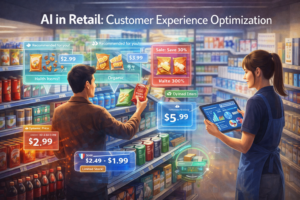
The Retail Transformation
The retail industry is experiencing a fundamental transformation driven by artificial intelligence. From personalized product recommendations to automated inventory management and cashierless stores, AI is reshaping how retailers operate and how consumers shop. This evolution has accelerated dramatically, with retailers recognizing that AI adoption is essential for competitive survival.
This comprehensive case study examines how leading retailers are deploying AI to optimize customer experiences, streamline operations, and create new business models. We explore real implementations from Amazon, Walmart, Starbucks, and innovative startups, revealing the strategies and technologies driving retail’s AI revolution.
The Imperative for AI in Retail
Retail faces unprecedented challenges including shifting consumer expectations, margin pressure from e-commerce competition, and the complexity of omnichannel operations. AI addresses these challenges by enabling:
- Personalization at scale across millions of customers
- Demand forecasting accuracy improvements of 20-50%
- Automated pricing optimization in real-time
- Reduced operational costs through intelligent automation
- Enhanced customer service through conversational AI
Personalization and Recommendation Engines
How Recommendation Systems Work
AI-powered recommendation engines analyze customer behavior, purchase history, browsing patterns, and contextual data to suggest relevant products. Modern systems combine collaborative filtering (learning from similar customers), content-based filtering (matching product attributes), and deep learning approaches for superior accuracy.
Case Study: Amazon
Amazon’s recommendation engine drives an estimated 35% of the company’s revenue—a staggering achievement for what began as a simple “customers who bought this also bought” feature. Today’s system incorporates:
- Real-time personalization across all touchpoints
- Deep learning models processing billions of data points
- Contextual recommendations based on time, location, and device
- Integration with Alexa for voice-based recommendations
- Anticipatory shipping based on predicted purchases
Case Study: Starbucks Deep Brew
Starbucks’ Deep Brew AI platform personalizes the customer experience across 400 million weekly customer transactions:
- Personalized menu suggestions based on weather, time, and history
- Mobile app recommendations driving 26% of orders
- Inventory optimization for each store’s unique demand
- Labor scheduling aligned with predicted traffic
- Equipment maintenance prediction to prevent service interruptions
Demand Forecasting and Inventory Optimization
The Inventory Challenge
Retailers lose an estimated $1 trillion annually to inventory distortion—having too much of the wrong products and too little of the right ones. AI-powered demand forecasting dramatically improves accuracy by incorporating hundreds of variables including weather, local events, social media trends, and economic indicators.
Case Study: Walmart
Walmart’s AI-powered supply chain represents one of the most sophisticated retail technology deployments in the world:
- Machine learning models forecast demand for 500 million item-store combinations weekly
- 20% improvement in forecast accuracy reducing both stockouts and overstock
- Automated replenishment orders generated in real-time
- Computer vision in distribution centers for inventory tracking
- Drone and robot deployment for warehouse operations
Fresh Product Optimization
Perishable products present unique challenges with short shelf lives and variable demand. AI systems optimize ordering quantities, markdown timing, and waste reduction for fresh categories, often reducing spoilage by 30% or more.
Dynamic Pricing
Real-Time Price Optimization
AI enables dynamic pricing that adjusts based on demand, competition, inventory levels, and customer willingness to pay. While common in travel and hospitality, retailers are increasingly adopting these techniques for faster-moving consumer goods.
Case Study: Kroger and Microsoft Partnership
Kroger’s partnership with Microsoft brings AI to grocery pricing and customer experience:
- Electronic shelf labels enabling real-time price updates
- Personalized pricing through loyalty programs
- Computer vision for shelf monitoring and compliance
- Digital displays with personalized promotions
- Scan-and-go technology reducing checkout friction
Computer Vision in Retail
Autonomous Checkout
Computer vision enables checkout-free shopping experiences where customers simply take items and leave, with AI automatically tracking products and charging their accounts.
Case Study: Amazon Go and Just Walk Out
Amazon Go stores pioneered autonomous checkout, and the technology is now licensed to other retailers:
- Hundreds of cameras track customer movements and product interactions
- Deep learning models identify products with high accuracy
- Sensor fusion combines vision, weight sensors, and RFID
- Technology now deployed in airports, stadiums, and third-party stores
- Reduces labor costs while eliminating checkout lines
Shelf Monitoring
Computer vision systems monitor shelf conditions in real-time, detecting out-of-stocks, misplaced products, and planogram compliance. Robots like Simbe’s Tally patrol store aisles, providing continuous shelf intelligence that was previously impossible.
Conversational Commerce
AI-Powered Customer Service
Chatbots and virtual assistants handle increasingly complex customer service interactions, from order status inquiries to product recommendations and returns processing.
Case Study: H&M’s Virtual Stylist
H&M’s AI-powered styling assistant helps customers discover outfits:
- Natural language understanding for style preference capture
- Visual AI for outfit composition and matching
- Integration with inventory for real-time availability
- Learning from feedback to improve recommendations
- Omnichannel experience across app, web, and stores
Voice Commerce
Voice-activated shopping through devices like Alexa and Google Home creates new retail channels. Retailers must optimize for voice search and create seamless voice purchasing experiences.
Supply Chain Optimization
Logistics and Delivery
AI optimizes the entire supply chain from supplier management to last-mile delivery:
- Route optimization for delivery vehicles
- Warehouse automation and robotics
- Predictive maintenance for fleet and equipment
- Demand-supply matching across distribution networks
- Supplier risk prediction and management
Case Study: Ocado
UK online grocer Ocado operates the world’s most automated grocery fulfillment:
- 3,000+ robots per warehouse picking orders
- AI orchestration of robot movements and task allocation
- 50 items picked per order in minutes
- Machine learning for demand forecasting and routing
- Technology licensed to retailers worldwide including Kroger
Customer Analytics and Insights
Understanding Customer Behavior
AI analyzes customer data to reveal insights about preferences, journey patterns, and lifetime value. These insights inform marketing, merchandising, and store design decisions.
Sentiment Analysis
Natural language processing analyzes customer reviews, social media, and support interactions to understand sentiment and identify emerging issues. Retailers can respond to problems before they become crises and identify product improvement opportunities.
In-Store Experience Enhancement
Smart Mirrors and Fitting Rooms
AI-powered smart mirrors in fitting rooms suggest complementary items, show alternative colors and sizes, and enable instant checkout without returning to the sales floor.
Case Study: Nike House of Innovation
Nike’s flagship stores showcase AI-enhanced retail experiences:
- Nike Fit uses computer vision for accurate shoe sizing
- RFID integration enables product information on demand
- Personalized recommendations through the Nike app
- Inventory visibility for online ordering with in-store pickup
- Member-exclusive areas with personalized experiences
Implementation Challenges
Data Infrastructure
Effective AI requires unified customer data platforms integrating information from e-commerce, stores, mobile apps, and customer service. Many retailers struggle with siloed legacy systems that prevent holistic customer understanding.
Privacy Concerns
AI-powered personalization requires customer data, raising privacy concerns. Retailers must balance personalization benefits with data protection, transparency, and regulatory compliance including GDPR and state privacy laws.
Change Management
AI implementation affects roles throughout the organization. Store associates, merchandisers, and supply chain professionals need training to work alongside AI systems. Cultural resistance can undermine even technically successful implementations.
Measuring ROI
Key Performance Indicators
Retailers measure AI impact through metrics including:
- Conversion rate improvements from personalization
- Inventory turnover and stockout reduction
- Customer satisfaction and Net Promoter Score
- Operational efficiency and cost reduction
- Revenue per customer and lifetime value
Future Trends
Generative AI in Retail
Large language models enable new retail applications including AI-generated product descriptions, conversational shopping assistants, and automated customer service that handles complex scenarios.
Unified Commerce
AI enables truly seamless experiences across channels—starting a purchase on mobile, continuing in-store, and completing online with AI maintaining context throughout the journey.
Sustainable Retail
AI helps retailers reduce environmental impact through better demand forecasting (reducing waste), optimized logistics (reducing emissions), and circular economy initiatives (predicting resale value and managing returns).
Conclusion
Artificial intelligence has become essential for retail competitiveness. From personalized recommendations driving sales to optimized supply chains reducing costs, AI creates value across the retail value chain. Leaders like Amazon, Walmart, and Starbucks demonstrate the transformative potential, while new entrants bring innovative approaches to specific challenges.
Success requires more than technology—it demands customer-centric strategy, unified data infrastructure, organizational change management, and continuous iteration. Retailers that master AI will thrive in an increasingly competitive landscape, while those that lag risk obsolescence in the face of AI-native competitors.
Continue Learning: Related Articles
AI in Education: Personalized Learning Systems and Adaptive Assessment Transforming Classrooms
The Education Revolution
Education stands on the brink of its most significant transformation since the introduction of…
📖 8 min read
AI in Healthcare: Revolutionizing Medical Diagnosis and Patient Care
The Transformation of Healthcare Through Artificial Intelligence
Artificial Intelligence is revolutionizing healthcare …
📖 8 min read
AI in Agriculture: Smart Farming, Crop Monitoring, and Yield Prediction Revolution
The Agricultural Transformation
Agriculture faces unprecedented challenges: feeding a growing global population while c…
📖 7 min read
AI in Finance: How Machine Learning is Transforming Fraud Detection and Risk Management
Introduction to AI in Financial Services
The financial services industry stands at the forefront of artificial intellig…
📖 8 min read
💡 Explore 80+ AI implementation guides on Harshith.org
