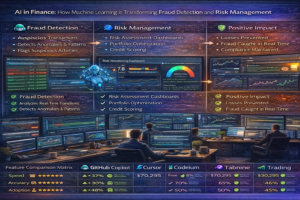
Introduction to AI in Financial Services
The financial services industry stands at the forefront of artificial intelligence adoption, leveraging machine learning and advanced analytics to transform everything from fraud detection to algorithmic trading. With global financial institutions processing billions of transactions daily, AI has become essential for maintaining security, reducing costs, and improving customer experiences.
This comprehensive case study explores how leading financial institutions are implementing AI solutions to detect fraud, assess credit risk, automate trading decisions, and personalize customer services. We examine real-world implementations, measurable outcomes, and the challenges organizations face when deploying AI in highly regulated environments.
The Scale of the Challenge
Financial fraud represents one of the most significant threats to the global banking system. According to industry reports, global fraud losses exceed $30 billion annually, with sophisticated criminals constantly evolving their techniques to bypass traditional detection systems. Rule-based fraud detection systems, while useful, struggle to keep pace with rapidly changing fraud patterns and generate excessive false positives that frustrate legitimate customers.
Traditional credit risk assessment relied heavily on credit scores and manual underwriting processes. This approach often excluded creditworthy individuals with thin credit files while failing to identify emerging risks in borrower populations. The need for more sophisticated, real-time risk assessment became critical as lending moved increasingly online.
Machine Learning for Fraud Detection
How AI Fraud Detection Works
Modern AI fraud detection systems analyze hundreds of variables in real-time to identify suspicious transactions. Unlike rule-based systems that flag transactions matching predefined patterns, machine learning models learn normal behavior patterns for each customer and identify anomalies that suggest fraudulent activity.
Key features analyzed by AI fraud detection systems include:
- Transaction amount, frequency, and timing patterns
- Geographic location and device fingerprinting
- Merchant category and purchase behavior
- Account velocity and balance changes
- Network analysis of connected accounts
- Behavioral biometrics during authentication
Case Study: JPMorgan Chase
JPMorgan Chase processes over 5 billion transactions annually and has invested heavily in AI-powered fraud detection. Their machine learning systems analyze transaction patterns in real-time, flagging suspicious activity within milliseconds while maintaining low false positive rates.
Results achieved include:
- 50% reduction in fraud losses within two years of implementation
- 40% decrease in false positive rates, improving customer experience
- Real-time detection capabilities processing thousands of transactions per second
- Adaptive models that automatically adjust to new fraud patterns
deep learning Approaches
Advanced fraud detection now employs deep learning techniques including autoencoders for anomaly detection, recurrent neural networks for sequence analysis, and graph neural networks for identifying fraud rings. These models can identify complex patterns invisible to traditional machine learning approaches.
AI-Powered Credit Risk Assessment
Beyond Traditional Credit Scores
Machine learning enables financial institutions to assess creditworthiness using thousands of data points beyond traditional credit bureau information. Alternative data sources include banking transaction history, employment verification, educational background, and even behavioral patterns in application completion.
Case Study: Upstart
Upstart, an AI-first lending platform, demonstrates the transformative potential of machine learning in credit assessment. By analyzing over 1,600 variables using advanced ML models, Upstart approves 27% more borrowers than traditional models while experiencing 16% lower default rates.
Key innovations include:
- Education and employment history as predictive variables
- Behavioral analytics during the application process
- Continuous model improvement through outcome feedback
- Explainable AI for regulatory compliance
Responsible AI in Lending
AI-powered lending must navigate complex regulatory requirements around fair lending. Organizations implement fairness constraints in their models, conduct regular bias audits, and maintain model interpretability to ensure compliance with regulations like ECOA and state fair lending laws.
Algorithmic Trading and Market Analysis
High-Frequency Trading
AI has revolutionized trading, with algorithms now responsible for over 70% of equity trading volume in US markets. Machine learning models analyze market data, news sentiment, social media, and alternative data sources to identify trading opportunities and execute trades in microseconds.
Case Study: Two Sigma
Quantitative hedge fund Two Sigma manages over $60 billion using AI-driven trading strategies. Their approach combines:
- Natural language processing for news and earnings call analysis
- Satellite imagery analysis for economic indicators
- Machine learning models trained on decades of market data
- Reinforcement learning for portfolio optimization
Sentiment Analysis
NLP models analyze millions of news articles, social media posts, and financial reports to gauge market sentiment. This alternative data provides early indicators of market movements before they appear in traditional financial metrics.
Customer Service and Personalization
AI-Powered Chatbots
Financial institutions deploy conversational AI to handle routine customer inquiries, reducing call center volume while providing 24/7 support. Advanced chatbots can handle account inquiries, transaction disputes, and even complex product recommendations.
Case Study: Bank of America’s Erica
Bank of America’s virtual assistant Erica has served over 32 million customers, handling more than 1 billion client interactions since launch. Erica provides:
- Proactive financial insights and spending alerts
- Bill payment and transfer assistance
- Credit score monitoring and improvement tips
- Personalized product recommendations
- Fraud alerts and security notifications
Hyper-Personalization
AI enables financial institutions to deliver personalized experiences at scale. Machine learning models analyze customer behavior to recommend relevant products, optimize pricing, and predict life events that trigger financial needs.
Regulatory Compliance and Risk Management
Anti-Money Laundering (AML)
AI dramatically improves AML effectiveness while reducing false positives that burden compliance teams. Machine learning models identify suspicious transaction patterns, flag high-risk customers, and prioritize alerts for investigation.
Case Study: HSBC
HSBC partnered with AI companies to transform their AML operations, achieving:
- 20% improvement in suspicious activity detection
- 60% reduction in false positive alerts
- Faster case resolution through automated evidence gathering
- Better risk prioritization focusing on highest-risk cases
Regulatory Technology (RegTech)
AI-powered RegTech solutions automate regulatory reporting, monitor compliance in real-time, and predict regulatory changes that may impact operations. Natural language processing analyzes regulatory documents to extract requirements and map them to internal controls.
Implementation Challenges
Data Quality and Integration
Financial institutions often struggle with fragmented data across legacy systems. Successful AI implementation requires significant investment in data infrastructure, including data lakes, APIs, and real-time streaming capabilities.
Model Governance
Regulated industries require robust model risk management frameworks. This includes model validation, ongoing monitoring, documentation, and clear accountability for model outcomes. Many organizations establish dedicated AI governance teams and model risk committees.
Talent and Culture
Building AI capabilities requires attracting data science talent while also upskilling existing employees. Cultural change is often the biggest challenge, requiring buy-in from business stakeholders and integration of AI insights into decision-making processes.
Explainability Requirements
Financial regulators increasingly require that AI decisions be explainable. Organizations must balance model performance with interpretability, often implementing explainable AI techniques like SHAP values and feature importance analysis.
Future Trends
Generative AI in Finance
Large language models are beginning to transform financial services, enabling natural language interfaces for data analysis, automated report generation, and enhanced customer service capabilities. However, concerns about accuracy and hallucination require careful implementation.
Federated Learning
Privacy-preserving machine learning techniques allow institutions to collaborate on fraud detection without sharing sensitive customer data. Federated learning enables model training across multiple institutions while keeping data decentralized.
Real-Time AI
The push toward instant payments and real-time banking requires AI systems that can make decisions in milliseconds. Edge computing and optimized inference engines enable complex model evaluation at transaction speed.
Key Success Factors
Based on successful AI implementations in financial services, key success factors include:
- Executive Sponsorship: C-suite support for AI initiatives and resource allocation
- Data Foundation: Investment in data infrastructure before model development
- Cross-Functional Teams: Collaboration between data scientists, business experts, and compliance
- Iterative Approach: Starting with pilot projects and scaling successful initiatives
- Governance Framework: Robust model risk management from the beginning
- Change Management: Training and communication to drive adoption
Conclusion
Artificial intelligence has become indispensable for modern financial services. From fraud detection and credit assessment to trading and customer service, AI drives competitive advantage while improving risk management and operational efficiency. However, successful implementation requires more than technology—it demands strategic vision, organizational change, and robust governance frameworks.
As AI capabilities continue advancing, financial institutions must stay current with emerging technologies while ensuring responsible deployment that maintains customer trust and regulatory compliance. The institutions that master this balance will lead the next era of financial services innovation.
Continue Learning: Related Articles
AI in Retail: Customer Experience Optimization and Intelligent Inventory Management
The Retail Transformation
The retail industry is experiencing a fundamental transformation driven by artificial intelli…
📖 7 min read
AI in Agriculture: Smart Farming, Crop Monitoring, and Yield Prediction Revolution
The Agricultural Transformation
Agriculture faces unprecedented challenges: feeding a growing global population while c…
📖 7 min read
AI in Education: Personalized Learning Systems and Adaptive Assessment Transforming Classrooms
The Education Revolution
Education stands on the brink of its most significant transformation since the introduction of…
📖 7 min read
AI in Healthcare: Revolutionizing Medical Diagnosis and Patient Care
The Transformation of Healthcare Through Artificial Intelligence
Artificial Intelligence is revolutionizing healthcare …
📖 8 min read
💡 Explore 80+ AI implementation guides on Harshith.org
