The Education Revolution
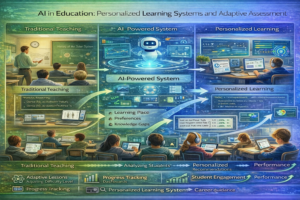
Education stands on the brink of its most significant transformation since the introduction of universal schooling. Artificial intelligence is enabling truly personalized learning experiences that adapt to each student’s needs, pace, and learning style. From intelligent tutoring systems to automated assessment and early intervention programs, AI is reshaping how we teach and learn.
This case study examines how educational institutions and EdTech companies are deploying AI to improve learning outcomes, support teachers, and make quality education more accessible. We explore successful implementations, measurable results, and the considerations necessary for responsible AI deployment in educational settings.
The Challenge of One-Size-Fits-All Education
Traditional classroom instruction, designed for the industrial age, struggles to meet the diverse needs of modern learners. Teachers managing 25-30 students cannot provide individualized attention to each learner. Students who fall behind often stay behind, while advanced students may disengage due to lack of challenge.
Research consistently shows that one-on-one tutoring dramatically improves learning outcomes—what educators call the “two sigma problem.” Students receiving individual tutoring perform two standard deviations better than those in traditional classrooms. AI-powered personalized learning aims to deliver these benefits at scale.
Intelligent Tutoring Systems
How AI Tutors Work
Intelligent tutoring systems (ITS) use machine learning to model student knowledge, identify misconceptions, and deliver targeted instruction. These systems continuously assess student understanding through interactions, adapting content difficulty, pacing, and instructional approach in real-time.
Key components of intelligent tutoring systems include:
- Student Model: Tracks what each student knows and doesn’t know
- Domain Model: Represents the knowledge being taught
- Pedagogical Model: Determines how to teach effectively
- Interface: Delivers content and captures student responses
Case Study: Carnegie Learning
Carnegie Learning’s MATHia platform demonstrates the effectiveness of AI-powered math tutoring. Developed based on cognitive science research from Carnegie Mellon University, MATHia provides personalized math instruction to millions of students.
Documented outcomes include:
- Students using MATHia show 30% greater improvement on standardized tests
- Struggling students benefit most, with gains of up to 50%
- Teachers report better ability to identify and support struggling students
- Engagement metrics show sustained student interaction over school years
Case Study: Duolingo
Duolingo has become the world’s most popular language learning platform, with over 500 million users. Their AI systems personalize the learning experience through:
- Spaced repetition algorithms optimized for long-term retention
- Difficulty adjustment based on error patterns
- Content selection targeting individual weak areas
- Gamification elements calibrated for user engagement
- A/B testing of instructional approaches at massive scale
Adaptive Assessment
Beyond Traditional Testing
AI enables assessment that adapts to student ability in real-time, providing more accurate measurement with fewer questions. Computerized adaptive testing (CAT) adjusts question difficulty based on previous responses, zeroing in on each student’s true ability level.
Case Study: Khan Academy and Khanmigo
Khan Academy’s AI tutor Khanmigo, powered by GPT-4, represents the next generation of educational AI. Rather than simply providing answers, Khanmigo guides students through problems with Socratic questioning, helping them discover solutions themselves.
Features include:
- Personalized tutoring across all subjects
- Writing feedback and coaching
- Debate practice on historical topics
- Career and academic counseling
- Teacher assistance for lesson planning
Learning Analytics
AI-powered learning analytics provide educators with insights into student progress, engagement, and potential struggles. Dashboards aggregate data across classes and schools, enabling data-driven instructional decisions and early intervention for at-risk students.
Early Warning Systems
Predicting Student Outcomes
Machine learning models can identify students at risk of failing, dropping out, or struggling academically—often before traditional indicators become apparent. These early warning systems enable proactive intervention when it can make the most difference.
Case Study: Georgia State University
Georgia State University implemented an AI-powered advising system that has dramatically improved graduation rates, particularly for underrepresented students. The system:
- Analyzes 800+ factors to predict student success
- Generates 200,000+ alerts per year for advisor follow-up
- Enables personalized outreach to struggling students
- Has improved four-year graduation rates by 7 percentage points
- Has eliminated the achievement gap between demographic groups
AI for Special Education
Personalization for Diverse Learners
AI shows particular promise for supporting students with learning differences. Adaptive systems can accommodate various learning styles, provide alternative content formats, and adjust pacing for individual needs.
Case Study: Microsoft Learning Tools
Microsoft’s Immersive Reader and other learning tools use AI to support students with dyslexia, visual impairments, and other learning differences:
- Text-to-speech with highlighting for reading support
- Picture dictionary for vocabulary understanding
- Line focus to reduce visual distraction
- Translation for English language learners
- Grammar and syllable breakdown tools
AI Teaching Assistants
Supporting Educators
Rather than replacing teachers, AI most effectively augments their capabilities. AI teaching assistants handle routine tasks like grading, answer common questions, and provide data insights—freeing teachers to focus on high-value interactions with students.
Case Study: Gradescope
Gradescope uses AI to streamline grading for STEM courses. The system:
- Groups similar answers for efficient batch grading
- Learns from instructor feedback to suggest grades
- Reduces grading time by 50-70% for many courses
- Provides detailed analytics on class performance
- Ensures more consistent grading across large courses
Automated Writing Feedback
AI writing assistants provide instant feedback on student writing, enabling more frequent writing practice without overwhelming teachers. Tools like Grammarly Education and Turnitin’s feedback features help students improve their writing iteratively.
Content Generation and Curation
Personalized Content Delivery
AI systems can curate and generate educational content tailored to individual student needs. This includes selecting appropriate reading materials, generating practice problems at the right difficulty level, and creating personalized study guides.
Case Study: Newsela
Newsela uses AI to adapt real-world articles to multiple reading levels, making current events accessible to all students:
- Articles available at 5 different reading levels
- AI assists in adapting content while preserving meaning
- Student performance data informs content recommendations
- Integration with classroom management systems
- Supports reading instruction across subject areas
Implementation Challenges
Digital Divide
AI-powered education requires technology access that isn’t universal. Schools must address device availability, internet connectivity, and digital literacy to ensure AI tools don’t widen existing achievement gaps.
Data Privacy
Educational AI systems collect sensitive data about students. Institutions must implement strong data governance, comply with regulations like FERPA and COPPA, and ensure algorithmic decisions don’t perpetuate bias.
Teacher Training
Effective AI implementation requires teacher training and buy-in. Educators need to understand how to integrate AI tools into instruction, interpret AI-generated insights, and maintain their central role in the learning process.
Algorithmic Bias
AI systems trained on historical data may perpetuate existing biases in education. Careful attention to training data, regular bias audits, and diverse development teams help mitigate these risks.
Measuring Impact
Evidence-Based Evaluation
Rigorous research is essential to understand which AI interventions actually improve learning. Organizations like the Institute of Education Sciences and J-PAL conduct randomized controlled trials to evaluate EdTech effectiveness.
Key Metrics
Successful AI education initiatives track multiple outcome measures:
- Learning gains on standardized assessments
- Course completion and graduation rates
- Student engagement and time-on-task
- Teacher satisfaction and workload reduction
- Equity outcomes across demographic groups
Future Directions
Generative AI in Education
Large language models create new possibilities for educational AI, including conversational tutoring, automated content creation, and natural language interfaces for learning platforms. However, concerns about accuracy, academic integrity, and appropriate use require careful navigation.
Immersive Learning
AI combined with VR/AR enables immersive learning experiences—virtual science labs, historical simulations, and language immersion environments. These technologies make experiential learning accessible regardless of physical location or resources.
Lifelong Learning
As workforce skills requirements evolve rapidly, AI-powered platforms will support continuous learning throughout careers. Personalized skill assessment, learning path recommendations, and micro-credentialing will help workers adapt to changing demands.
Best Practices for Implementation
Successful AI education initiatives follow key principles:
- Start with pedagogy: Technology should serve learning goals, not drive them
- Involve teachers: Educator input is essential for successful implementation
- Focus on equity: Ensure AI benefits all students, not just the privileged
- Maintain human connection: AI should augment, not replace, teacher-student relationships
- Evaluate rigorously: Measure actual learning outcomes, not just engagement
- Iterate continuously: Use data to improve implementation over time
Conclusion
Artificial intelligence offers unprecedented opportunities to personalize education at scale, support teachers, and improve outcomes for all learners. From intelligent tutoring systems to early warning systems and adaptive assessment, AI is already demonstrating significant impact in educational settings worldwide.
However, realizing AI’s potential in education requires thoughtful implementation that keeps learners at the center, supports rather than replaces teachers, and ensures equitable access to these powerful tools. As the technology continues evolving, the education sector must remain focused on evidence-based practices and the fundamental goal of helping every student reach their full potential.
Continue Learning: Related Articles
Deep Learning for Stock Market Prediction: Opportunities and Challenges
Applying deep learning to Financial Markets
Stock market prediction has long been a goal of investors, analysts, and re…
📖 5 min read
AI in Healthcare: Revolutionizing Medical Diagnosis and Patient Care
The Transformation of Healthcare Through Artificial Intelligence
Artificial Intelligence is revolutionizing healthcare …
📖 8 min read
AI in Agriculture: Smart Farming, Crop Monitoring, and Yield Prediction Revolution
The Agricultural Transformation
Agriculture faces unprecedented challenges: feeding a growing global population while c…
📖 7 min read
AI in Finance: How Machine Learning is Transforming Fraud Detection and Risk Management
Introduction to AI in Financial Services
The financial services industry stands at the forefront of artificial intellig…
📖 8 min read
💡 Explore 80+ AI implementation guides on Harshith.org
