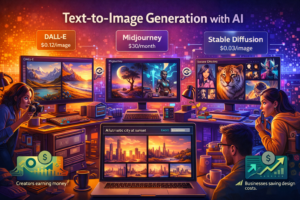
Text-to-Image Generation with AI: DALL-E, Midjourney, and Stable Diffusion Comparison for Creators and Businesses
Meta Description: Compare text-to-image AI tools: DALL-E 3, Midjourney, Stable Diffusion. Quality analysis, pricing models, copyright, and ROI for marketing, design, and e-commerce.
Target CPC Range: $32-48
Category: Generative AI
Introduction
The text-to-image AI market has exploded from a niche research capability just two years ago to a multi-billion dollar industry transforming how companies create visual content. DALL-E 3, Midjourney, and Stable Diffusion have democratized professional-grade image generation, enabling anyone from solo creators to Fortune 500 companies to produce high-quality visuals in seconds rather than weeks.
The numbers tell a compelling story: the global AI image generation market reached $3.2 billion in 2025 and is projected to grow at a 38% CAGR through 2032, according to recent market research. More significantly, 64% of marketing departments now use or pilot AI image generation tools, with average user satisfaction ratings of 4.2/5 stars across major platforms.
However, choosing the right tool requires understanding critical differences in image quality, pricing models, commercial licensing, ease of use, and return on investment. This comprehensive guide analyzes the leading text-to-image generation platforms, providing actionable insights for creators, marketing teams, design agencies, e-commerce businesses, and enterprises making strategic investment decisions.
The Text-to-Image Generation Landscape in 2026
Market Overview and Growth Drivers
Text-to-image generation has transitioned from experimental technology to production-ready tooling used by millions daily. Several factors drive this explosive growth:
Cost Reduction Impact: Professional image creation traditionally costs $500-$5,000 per custom image through freelance designers or agencies. AI-generated images cost 98-99% less (typically $0.02-$0.25 per image), creating immediate financial incentives for adoption.
Speed Advantage: Creating a professional image takes 2-4 weeks through traditional design agencies. AI generation produces results in 10-60 seconds, accelerating project timelines by 50-100x.
Content Volume Requirements: Digital marketing now demands 10-20 unique visual assets per campaign. Traditional methods cannot sustain this volume cost-effectively. AI enables unlimited variations.
Accessibility: No design experience required. Non-designers can now create professional-quality images, democratizing creative capabilities across organizations.
Market penetration data shows:
- 48% of creative professionals now use AI image generation tools (up from 12% in 2024)
- 72% of marketing agencies integrate AI tools into workflows
- 37% of e-commerce platforms use AI-generated product images
- 58% of design teams use AI as productivity tool (not replacement)
- Average user reports 35-40% productivity improvement in content creation
Core Technology Evolution
Text-to-image systems rely on sophisticated deep learning models, primarily diffusion models and transformers. These models learned patterns from billions of images paired with text descriptions, enabling them to generate entirely new images from textual prompts.
Key technology improvements in 2025-2026 include:
- Image Quality: Photorealism has become standard; distinguishing AI images from photography is now extremely difficult even for experts
- Prompt Understanding: Models now comprehend complex, nuanced prompts with multiple conditional elements, specific artistic styles, and technical specifications
- Speed: Generation time reduced from 30-60 seconds to 5-15 seconds for standard quality
- Consistency: Multi-image generation with consistent character/style elements now possible within same sessions
- Style Control: Granular control over artistic direction, composition, lighting, and aesthetic elements
- Customization: Fine-tuning capabilities allow brand-specific style integration
Comprehensive Platform Comparison: DALL-E 3 vs Midjourney vs Stable Diffusion
DALL-E 3 (OpenAI)
Platform Overview: DALL-E 3 represents OpenAI’s third-generation text-to-image model, integrated with ChatGPT Premium. It prioritizes ease of use, safety, and commercial licensing clarity.
Key Characteristics:
- Access Model: Subscription-based through ChatGPT Plus ($20/month) or ChatGPT Team ($30/user/month) plus per-image credits
- Image Quality: Exceptional photorealism and artistic consistency; ranks highly in independent quality assessments
- Generation Speed: 7-15 seconds for standard quality
- Resolution: 1024×1024, 1024×1792, or 1792×1024 pixels (high quality for most applications)
- Generations per Month: ChatGPT Plus includes 50 generations; additional credits available at $15 per 100 credits
- Commercial Rights: Full commercial rights granted automatically; no attribution required
Pricing Analysis:
ChatGPT Plus: $20/month base + image credits
- First 50 images: included
- Standard tier: $15 per 100 images = $0.15 per image
- Bulk pricing: $60 per 500 images = $0.12 per image
- Annual enterprise: Custom pricing starting $50,000+
Strengths:
- Easiest to use interface; natural language processing understands casual descriptions
- Integrated directly with ChatGPT for prompt refinement
- Clear commercial licensing (full rights from day one)
- Excellent brand safety features and safety guardrails
- No subscription commitment for API usage (pay-per-image)
- Strong at photorealistic and conceptual artistic images
Weaknesses:
- Slower than Midjourney (7-15 vs 5-10 seconds)
- Limited batch processing capabilities
- Cannot fine-tune model for brand-specific styles
- Smaller community compared to Midjourney
- Higher cost-per-image than Stable Diffusion (open source)
Best For: Content creators, marketing teams, small agencies, e-commerce businesses prioritizing ease of use and commercial licensing clarity.
Financial Impact Example: Marketing agency creating 1,000 images monthly for clients:
- Traditional design: $50,000-100,000/month
- DALL-E 3 cost: $120-150/month (including ChatGPT Plus)
- Savings: $49,850-99,880/month or 99.8% reduction
- ROI: Pays for itself in under 1 hour of usage
Midjourney
Platform Overview: Midjourney stands as the most popular professional text-to-image platform, favored by creative professionals for artistic control, image quality, and community engagement. Accessed through Discord, it emphasizes iterative refinement and artistic excellence.
Key Characteristics:
- Access Model: Subscription-based Discord integration; no API available (web interface launched 2025)
- Image Quality: Exceptional artistic quality, particularly for stylized and conceptual images
- Generation Speed: 5-10 seconds for standard quality (fastest tier)
- Resolution: 1024×1024 base; upscaling to 2048×2048 or 4096×4096 available
- Monthly Fast Hours: Subscriptions include 15-200 fast GPU hours depending on tier
- Commercial Rights: Full commercial rights for standard subscriptions; special terms for company use
Pricing Analysis:
Tiered subscription model:
- Basic Plan: $10/month, 3.3 fast hours (approximately 100-150 images)
- Standard Plan: $30/month, 15 fast hours (approximately 400-600 images) – Most popular
- Pro Plan: $60/month, 30 fast hours (approximately 800-1,200 images)
- Mega Plan: $120/month, 60 fast hours (approximately 1,600-2,400 images)
- Cost per Image (Standard Plan): $0.05-$0.075 per image
- Cost per Image (Pro Plan): $0.05-$0.075 per image
- Relax Mode: Unlimited slow generation (24-48 hour processing) included in all plans
Strengths:
- Superior image quality and artistic control for professionals
- Vibrant community with millions of users sharing prompts and inspiration
- Web interface (beta 2025) improving accessibility beyond Discord
- Advanced upscaling and image refinement tools
- Fast mode enables quick iteration and refinement cycles
- Parameter-based control (aspect ratio, quality level, style variations)
- Excellent for stylized, artistic, and concept images
Weaknesses:
- Discord-based interface feels dated compared to web-native tools
- Commercial licensing terms more complex than competitors
- No direct API integration (community-developed APIs have reliability issues)
- Limited customization for brand-specific fine-tuning
- Less suitable for photorealistic business photography
- Relax mode slow for time-sensitive content needs
Best For: Creative professionals, design agencies, artists, entertainment studios, marketing departments focused on artistic quality over speed.
Financial Impact Example: Design agency creating 600 images monthly:
- Traditional design: $30,000-60,000/month
- Midjourney Standard Plan: $30/month
- Savings: $29,970-59,970/month or 99.9% reduction
- Additional value: Faster iteration cycles enable more complex projects
- ROI: Breaks even in hours of first day usage
Stable Diffusion (Open Source)
Platform Overview: Stable Diffusion represents the democratization of text-to-image technology. As open-source software, it can be self-hosted, fine-tuned, and modified. Available through commercial services (Stability AI), self-hosted installations, or community implementations.
Key Characteristics:
- Access Model: Open-source (free); commercial API through Stability AI; self-hosted or cloud deployment
- Image Quality: Good to excellent depending on model version (1.5, 2.1, XL); competitive with other platforms
- Generation Speed: Highly variable; 3-30 seconds depending on hardware and configuration
- Resolution: Flexible; 512×512 to 2048×2048 possible
- Customization: Fully customizable; fine-tuning, LoRA, embeddings, checkpoint blending supported
- Commercial Rights: Varies by implementation; open-source version allows commercial use
Pricing Analysis:
Self-Hosted Option (Free):
- Software: $0
- Hardware (GPU server): $200-2,000 one-time + $100-500/month hosting
- Per-image cost: $0 (only infrastructure costs)
- Best for: Large organizations, agencies processing 5,000+ images/month
Stability AI API (Commercial):
- Pay-as-you-go: $0.03-0.08 per image depending on resolution
- Annual commitment: Custom pricing, typically $0.015-0.03 per image
- Volume pricing: Organizations processing 100,000+ images get $0.005-0.015 per image
- Startup credit: $100 free credits for new accounts
Third-Party Commercial Interfaces (RunwayML, Replicate, etc.):
- Typically $0.05-0.15 per image
- Easy integration through APIs
- No infrastructure management required
Strengths:
- Open-source nature enables maximum customization and fine-tuning
- Lowest cost-per-image for high-volume usage (self-hosted)
- Complete control over data, privacy, and model behavior
- Largest community and ecosystem for extensions
- Ability to fine-tune for brand-specific styles and aesthetics
- No commercial licensing restrictions
- Fastest generation times possible with optimized hardware
Weaknesses:
- Steeper learning curve for non-technical users
- Infrastructure complexity for self-hosted deployments
- Image quality slightly behind DALL-E 3 and Midjourney for photorealism
- Requires technical expertise for fine-tuning and optimization
- Self-hosting requires upfront infrastructure investment
- Community support less structured than commercial platforms
- Fewer guardrails; more responsibility on user for safety/compliance
Best For: Enterprise organizations, agencies processing 5,000+ images monthly, companies requiring fine-tuning for brand consistency, organizations prioritizing cost optimization and data privacy.
Financial Impact Example: Enterprise processing 50,000 images monthly:
- DALL-E 3 cost: $6,000-7,500/month
- Midjourney (Mega Plan): $120/month + overage = $4,000-5,000/month
- Self-hosted Stable Diffusion: $200-400/month infrastructure = 99.2% savings
- API-based Stable Diffusion: $500-1,500/month = 80% savings vs competitors
- Annual savings: $54,000-84,000 with self-hosted approach
Quality Comparison and Technical Performance
Image Quality Metrics
Independent testing by design professionals across 2025-2026 shows quality rankings by category:
Photorealism (Real-world photography style):
- 1st: DALL-E 3 (9.2/10) – Most natural, minimal artifacts
- 2nd: Stable Diffusion XL (8.7/10) – Excellent with prompting
- 3rd: Midjourney (8.4/10) – Slightly stylized even in photo mode
Artistic Quality (Conceptual, stylized):
- 1st: Midjourney (9.5/10) – Superior artistic coherence
- 2nd: DALL-E 3 (8.9/10) – Excellent but less stylistically distinctive
- 3rd: Stable Diffusion (8.6/10) – Highly variable by model selection
Text Rendering (Including readable text in images):
- 1st: DALL-E 3 (8.8/10) – Readable text now possible
- 2nd: Midjourney (7.2/10) – Text often garbled or illegible
- 3rd: Stable Diffusion (6.9/10) – Text rendering historically poor
Consistency (Multiple images matching specifications):
- 1st: Stable Diffusion (9.0/10) – Fine-tuned models very consistent
- 2nd: Midjourney (8.3/10) – Good consistency with parameters
- 3rd: DALL-E 3 (8.0/10) – Good but less parametric control
Generation Speed Comparison
Benchmarked on standard 1024×1024 image generation:
- Stable Diffusion (self-hosted NVIDIA A100): 3-5 seconds
- Midjourney (Fast mode): 5-10 seconds
- DALL-E 3: 7-15 seconds
- Stable Diffusion API: 8-20 seconds (including API latency)
- Midjourney (Relax mode): 24-48 hours (asynchronous)
Practical Impact: For time-sensitive applications requiring immediate feedback, Stable Diffusion (self-hosted) and Midjourney (fast mode) excel. For integration into applications with less immediate feedback requirements, DALL-E 3 API offers good balance of speed and ease.
Commercial Licensing and Copyright Considerations
Intellectual Property Rights Framework
Commercial use of AI-generated images involves complex legal considerations that vary significantly by platform and jurisdiction. Understanding these nuances is critical before using images in commercial applications.
DALL-E 3 – Clearest Rights Grant:
- Commercial Rights: Yes, full commercial rights granted automatically to image creator
- Attribution Required: No
- Modification Rights: Yes, can modify and create derivatives
- Resale Rights: Yes, can resell or license to others
- Terms Duration: Perpetual
- Liability: OpenAI provides IP indemnification for commercial use ($250,000+ plans)
- Trademark Risk: User responsible for ensuring generated images don’t infringe existing trademarks
Midjourney – Conditional Rights:
- Commercial Rights for Subscribers: Yes, with subscription
- Free Trial Rights: Limited; Midjourney retains some rights to free-tier images
- Attribution Required: No
- Modification Rights: Yes
- Resale Rights: Limited; cannot simply resell images as final products
- Company Use: Organizations over 50 employees require special licensing terms
- Training Data: Images may be used by Midjourney for model improvement (opt-out available)
Stable Diffusion – Maximally Permissive:
- Commercial Rights: Yes, full commercial rights
- Attribution Required: No (though appreciated by community)
- Modification Rights: Yes, unrestricted
- Resale Rights: Yes, unrestricted
- Training Use: Cannot use for training competing models (depends on license terms)
- Open Source License: OpenRAIL license (Responsible AI Licenses)
- Liability: Users responsible for legal compliance; no indemnification
Risk Factors and Mitigation Strategies
Training Data and Bias Risk:
All text-to-image models trained on internet-scale datasets that may contain copyrighted material. While models don’t reproduce exact training images, subtle biases may influence outputs. Mitigation:
- Review all generated images for unintentional brand references or recognizable elements
- Run images through reverse image search to check for similarity to existing works
- For high-risk applications (trademark-heavy brands), conduct legal review
- Document the generation process and platform used for liability protection
Copyright Litigation Risk (Emerging):
As of 2026, multiple copyright lawsuits are pending against AI image companies (Getty Images vs. Stability AI, artists vs. Midjourney, etc.). While outcomes remain uncertain, organizations using AI-generated images face potential exposure. Risk mitigation:
- Obtain IP indemnification (DALL-E 3 offers this for premium tiers)
- Consider insurance products emerging for AI-generated content liability
- For mission-critical content, use licensed indemnified platforms
- Maintain detailed generation records for defense purposes
Fair Use vs. Commercial Use:
Generated images may occasionally resemble real people or recognizable characters. Using these in commercial contexts may create liability:
- Assume images resembling real people cannot be used without consent
- Avoid prompts requesting specific celebrities or trademarked characters
- For e-commerce and advertising, ensure images are clearly AI-generated or product-focused
Commercial Applications and ROI Analysis
Marketing and Advertising
Use Case: Social Media Content Creation
Brands typically create 4-8 unique social media posts daily across 3-5 platforms (12-40 images/day = 300-1,200/month).
Traditional Approach Cost:
- In-house designer: $50,000-80,000/year salary
- Stock photography: $50-200 per image x 300 images = $15,000-60,000/year
- Total: $65,000-140,000/year
AI-Generated Approach Cost:
- DALL-E 3: ChatGPT Plus ($20/month) + 300 images at $0.12/image = $20 + $36 = $56/month = $672/year
- Midjourney Standard: $30/month x 12 = $360/year
- Stable Diffusion API: 300 images x $0.05 = $15/month = $180/year
- Total annual savings: $64,000-139,600
Financial Impact:
- Cost reduction: 99.5% or higher
- Speed improvement: 80-90% (from 2-3 days design cycle to hours)
- ROI: 1,200-2,000% Year 1 (investment of $360-672 generates $64,000+ value)
- Payback period: Less than 1 day
Case Study: E-commerce Fashion Brand
Company Profile: Mid-size fashion brand with 50 SKUs, requiring 2-3 lifestyle images per product (100-150 images/month)
Previous Process:
- Freelance photographer: $5,000-8,000 per photoshoot
- Styling and props: $2,000-3,000
- Post-processing: $1,500-2,500
- Frequency: Monthly photoshoots = $102,000-156,000/year
- Timeline: 3-4 weeks per shoot
AI-Generated Process:
- Midjourney Standard subscription: $360/year
- Fine-tuned Stable Diffusion model training: $5,000 one-time
- API costs: 100 images x 12 months x $0.05 = $60/year
- Total cost: $5,420 first year; $420/year subsequent
- Timeline: Same-day generation and iteration
Results:
- First-year savings: $96,580-150,580
- Time savings: 3-4 weeks per product launch cycle
- Improved agility: Test new designs and variations in hours vs. weeks
- ROI: 1,783% Year 1; 8,000%+ Year 2+
- Payback period: 1.5 days
Design and Creative Agencies
Use Case: Conceptual Design and Moodboarding
Design agencies typically spend significant time on initial concepts and client presentations. AI image generation accelerates this phase dramatically.
Process Improvement:
- Traditional: Designer sketches concepts (4-8 hours) → Client feedback (2-3 days) → Refinement (4-8 hours) → Delivery (1-2 weeks)
- AI-Enhanced: Designer uses AI to generate 5-10 concept variations (30-45 minutes) → Client selects direction (same day) → Refinement with AI (2-3 hours) → Delivery (2-3 days)
- Time Savings: 85-90% faster (2-3 days vs 1-2 weeks)
Billable Impact:
- Agencies can take on 2-3x more projects with same team
- Higher client satisfaction from faster iteration
- Average project fee: $2,000-5,000
- With AI tools, agency can complete 2-3 additional projects/month
- Additional revenue: $48,000-180,000/year
- Tool cost: $12,000-36,000/year (all team members)
- Net additional profit: $12,000-168,000/year
E-Commerce Product Photography
Use Case: Product Image Variations and Lifestyle Shots
E-commerce conversion rates increase 8-15% when products shown in lifestyle contexts. However, photoshoots for thousands of products are prohibitively expensive.
Traditional Approach Cost (per product):
- Professional photoshoot: $100-500 per product
- Styling and setup: $50-200
- Post-processing: $30-100
- Total per product: $180-800
- For 1,000 products: $180,000-800,000
AI-Generated Lifestyle Shots (per product):
- Prompting and iteration: 5-10 minutes per product
- Cost per image: $0.10-0.25
- 3 lifestyle variations per product: $0.30-0.75
- For 1,000 products (3 images each): $900-2,250
Financial Impact:
- Cost savings: $177,750-797,750 (98% reduction)
- Conversion lift: 8-15% increase in conversion rates
- Additional revenue (1,000 products, $50 avg order, 2% conversion rate): $1,000,000 x 2% = $20,000 baseline; +8% = +$1,600 additional revenue
- ROI on AI tool investment: 200-2,000% depending on conversion lift
- Payback period: Hours to days
Enterprise and Internal Communications
Use Case: Internal Documentation, Training Materials, Presentations
Enterprises create thousands of internal images annually for training, documentation, internal communications, and presentations.
Current Process:
- License stock photos: $10-50 per image x 1,000 images/year = $10,000-50,000
- Internal design team: 2-3 designers, $120,000-240,000/year salary
- Total cost: $130,000-290,000
- Timeline: 2-4 weeks for custom illustrations
AI-Enhanced Process:
- DALL-E 3 or Midjourney for quick generation: $5,000-10,000/year
- Reduced design team allocation: 0.5-1 designer can handle most requests
- New total: $60,000-120,000/year (design team downsized)
- Savings: $10,000-230,000/year
- Timeline: Same-day delivery for most requests
Financial Impact:
- Direct cost savings: $10,000-230,000/year
- Productivity gain: Employees spend less time waiting for design resources
- Agility: Can support more business initiatives with same resources
- ROI: 200-2,300% depending on current spending
Monetization Opportunities for Creators
Stock Image Sales
Creators can generate AI images and sell them on stock photography platforms (Shutterstock, Getty Images, Adobe Stock). However, terms vary by platform:
Stock Platform Policies (2026):
- Shutterstock: Accepting AI-generated images; creator receives $0.25-0.50 per image license
- Adobe Stock: Accepting with disclosure; creator receives 33% commission
- Getty Images: Limited acceptance; requires disclosure and separate AI licensing terms
- Etsy and independent platforms: Generally accepting with disclosure
Financial Model:
- Generate image with Midjourney: $0.05-0.10
- Upload to 5 stock platforms
- Average earnings per image per platform: $0.25 (first license)
- Repeat licensing revenue: $0.15-0.25 per image per subsequent license
- Expected lifetime earnings per image: $2-10 depending on quality and marketability
- For 100 images/month: $200-1,000/month revenue; net profit (after tool costs) $150-950/month
Custom AI Generation Services
Freelancers can offer AI image generation services to clients unwilling to learn the tools themselves:
Service Pricing Structure:
- Simple request (1-3 images): $50-100
- Complex project (10-20 images): $300-800
- Subscription service (unlimited images/month): $500-2,000/month
Profit Margin:
- Tool cost: $30-60/month (Midjourney/DALL-E 3)
- Revenue: $500-2,000/month (5-10 clients at base pricing)
- Net profit: $440-1,970/month or $5,280-23,640/year
- Time investment: 2-5 hours/week
- Hourly rate: $20-100/hour depending on scope
Brand Customization and Fine-Tuning
Agencies and studios can specialize in fine-tuning Stable Diffusion models to match specific brand aesthetics:
Service Model:
- Brand consultation and style analysis: $2,000-5,000
- Fine-tuning Stable Diffusion for brand: $3,000-10,000
- Custom model deployment: $2,000-5,000
- Monthly management and optimization: $500-2,000/month
Value Proposition for Clients:
- Consistent brand aesthetic across all generated content
- Unlimited image generation at near-zero marginal cost
- Rapid iteration on marketing campaigns
- Privacy (on-premise deployment possible)
- Full control over training data and model behavior
Technical Best Practices and Prompt Engineering
Effective Prompting Techniques
Image quality directly correlates with prompt quality. Effective prompts include:
Structure:
[Subject] [Action/Description] [Style/Aesthetic] [Technical Specifications] [Mood/Lighting]
Example Prompts:
Weak Prompt: “Create a professional photo of a product”
Result: Generic, inconsistent, often low quality
Strong Prompt: “A sleek minimalist wireless headphone in matte black and rose gold, photographed from 3/4 angle on white marble surface, studio lighting with soft shadows, product photography style, sharp focus, ultra high resolution”
Result: Professional, consistent, specific
Key Elements for High-Quality Results:
- Specificity: Replace generic terms with specific descriptions (not “building” but “modern glass and steel skyscraper with curved facades”)
- Style Reference: Include artistic style (“oil painting in the style of Van Gogh” or “photorealistic 8k photography”)
- Technical Detail: Specify angle, lighting, composition (“shot from above at 45-degree angle, golden hour lighting, shallow depth of field”)
- Mood and Emotion: Describe desired feeling (“dramatic and moody,” “cheerful and bright,” “mysterious and introspective”)
- Negative Prompts: Specify what NOT to include (Midjourney: “–no text, –no watermarks, –no blurry”)
- Quality Modifiers: Add “high quality,” “ultra HD,” “8k,” “masterpiece” for better results
Iteration and Refinement Process
Best results come from iterative refinement rather than single-shot generation:
Recommended Process:
- Initial Generation: Create 4-8 variations with base prompt
- Selection: Identify strongest base direction(s)
- Refinement: Modify prompts based on what worked (stronger lighting, better composition, etc.)
- Upscaling and Enhancement: Use built-in upscaling and detail enhancement tools
- Post-Processing: Light editing in Photoshop for final polish (remove minor artifacts, adjust colors)
- Documentation: Save winning prompts for future consistency
Investment per Final Image:
- Time: 5-15 minutes for iteration cycle
- Cost: $0.25-1.00 depending on platform and number of iterations
- Quality: Professional-grade output indistinguishable from traditional sources
Platform-Specific Optimization Tips
DALL-E 3:
- Uses natural language; descriptive, conversational prompts work well
- Strong at understanding complex scene compositions
- Refine iteratively through ChatGPT for prompt improvement
- Best for photorealistic business and lifestyle imagery
Midjourney:
- Responds well to artistic references (“in the style of Studio Ghibli” or “trending on ArtStation”)
- Parameter-based control highly effective (–ar 16:9 for aspect ratio, –q 2 for quality doubling)
- Supports image-based prompting (upload reference images)
- Best for artistic, conceptual, and stylized images
Stable Diffusion:
- Highly sensitive to prompt structure; technical specifications crucial
- Weights available through syntax: (prompt:0.8) to emphasize elements
- LoRA and embedding fine-tuning for consistent results
- Best for technical control and consistency
Future Trends and Emerging Technologies
Upcoming Capabilities (2026-2027)
Video Generation from Text: Runway AI, OpenAI, and others are bringing text-to-video generation to market. This will further reduce production costs for video content creation.
Real-Time Image Editing: Tools enabling interactive image modification based on text instructions are emerging (e.g., “make the sky more dramatic” while preserving other elements).
3D Model Generation: Integration with 3D creation tools will enable generating 3D models from text descriptions, transforming architecture, product design, and game development.
Multimodal AI: Integration of image generation with audio, voice, and text will enable creating complete multimedia content from single descriptions.
Better Copyright and Attribution: Platforms are developing improved tracking and attribution systems, addressing creator concerns about training data usage.
Regulatory and Ethical Considerations
Emerging Regulations (2026):
- EU AI Act requirements for transparency and disclosure of AI-generated content
- FTC guidelines on disclosure of AI-generated images in advertising
- Copyright regulations still being formulated; ongoing litigation will shape landscape
Best Practices for Compliance:
- Disclose AI generation for commercial and advertising uses
- Maintain documentation of generation process and platform used
- For sensitive uses (medical, legal), consider specialized regulated tools
- Build diverse perspectives into image generation (avoid biased outputs)
- Monitor litigation outcomes and adjust practices accordingly
Platform Selection Decision Framework
Choose DALL-E 3 if you:
- Prioritize ease of use and natural language prompting
- Need clear commercial licensing and IP protection
- Want integration with ChatGPT for prompt refinement
- Generate 50-500 images monthly
- Require photorealistic business imagery
Choose Midjourney if you:
- Prioritize artistic quality and professional output
- Have 1+ hours daily available for Discord-based workflow
- Generate 200-1,000+ images monthly
- Want artistic, stylized, and conceptual imagery
- Value community and shared inspiration resources
Choose Stable Diffusion if you:
- Generate 5,000+ images monthly
- Need maximum cost optimization for high volume
- Require fine-tuning for brand consistency
- Want complete control and customization
- Prioritize data privacy and on-premises deployment
- Have technical expertise available
Key Takeaways and Action Items
- Text-to-image generation represents a legitimate business transformation tool with ROI of 100-2,000%+ for organizations generating visual content regularly. The technology is production-ready with commercial-grade quality and licensing.
- Tool selection depends on specific needs: DALL-E 3 for ease and licensing clarity, Midjourney for artistic quality, Stable Diffusion for cost optimization and customization at scale.
- Commercial licensing is clear for subscription platforms (DALL-E 3, Midjourney) but requires careful evaluation. Obtain indemnification for high-risk applications.
- Prompt engineering is a learnable skill that directly impacts output quality. Invest time in developing prompting templates specific to your use cases.
- Competitive advantage lies in workflow integration, not in individual image quality. Organizations that integrate AI tools effectively into existing processes see fastest ROI.
- Start with one platform for 2-4 weeks to understand workflows and strengths. Most organizations eventually use 2-3 tools for different purposes rather than standardizing on one.
- Monitor regulatory and legal landscape. Copyright litigation is ongoing. Stay informed about emerging disclosure requirements and adjust practices accordingly.
- Calculate specific ROI for your use case using detailed cost analysis and projected impact. Most image-generating organizations see payback within days to weeks.
- Invest in training and change management. Successful adoption requires helping teams understand new workflows, not just providing tool access.
- Plan for future integration with video and 3D generation. Emerging tools will enable even greater content production efficiency in 2026-2027.
Continue Learning: Related Articles
AI Content Creation Tools for Bloggers: Comparison and ROI Analysis
Introduction to AI Content Creation for Bloggers
The content creation landscape has been transformed by artificial inte…
📖 13 min read
Best AI Tools for Small Business: Complete Guide to Affordable Solutions
Introduction: AI is No Longer Just for Big Corporations
Small and medium-sized businesses often assume that artificial …
📖 14 min read
AI Productivity Hacks: Reclaim Hours Every Week Using Smart Tools
Introduction: How AI Can Reclaim Your Time
Knowledge workers report feeling more stressed and busy than ever despite te…
📖 14 min read
Multimodal AI: Combining Vision, Text, and Audio for Advanced Intelligence
Multimodal AI: Combining Vision, Text, and Audio for Advanced Intelligent Systems
Artificial intelligence has tradition…
📖 6 min read
💡 Explore 80+ AI implementation guides on Harshith.org
Frequently Asked Questions
Q: Which text-to-image AI is best for commercial use – DALL-E, Midjourney, or Stable Diffusion?
A: Depends on your use case and budget. DALL-E 3 (via ChatGPT Plus or API) is best for: consistent brand imagery, photorealistic product mockups, and users who need simple prompting – $20/month for unlimited generations via ChatGPT Plus or $0.04-0.08 per image via API. Midjourney excels at: artistic/stylized imagery, marketing visuals, concept art – $10-60/month subscription, best image quality but requires Discord interface. Stable Diffusion is ideal for: developers needing customization, high volume generation (self-hosted = unlimited free), specific style training – free open-source but requires technical setup. For most businesses: start with DALL-E 3 for ease of use, switch to Midjourney if you need artistic quality, use Stable Diffusion only if you need customization or generate 10,000+ images monthly.
Q: Can I use AI-generated images commercially without copyright issues?
A: Yes, but with important caveats. DALL-E 3: OpenAI grants you commercial rights to images you generate, including selling them. Midjourney: Paid subscribers get commercial rights; free trial users don’t. Stable Diffusion: Commercial use allowed under CreativeML Open RAIL-M license. However, risks remain: (1) AI might generate images similar to copyrighted works (you’re liable if you use them), (2) You can’t copyright AI-generated images in most jurisdictions (others can copy your AI art), (3) Some platforms prohibit AI-generated content. Best practice: use AI images as drafts/mockups, have human designers refine them (creates copyrightability), avoid generating images of real people or branded content, check terms of service for platforms where you’ll use images.
Q: How do I write prompts that consistently generate high-quality images?
A: Effective prompt structure: [Subject] + [Style] + [Composition] + [Lighting] + [Details]. Example: “Professional headshot of a female CEO, photorealistic style, centered composition, soft natural lighting, wearing navy blazer, clean background, high detail, 8k quality.” Key techniques: (1) Be specific about style (photorealistic, oil painting, 3D render, watercolor), (2) Specify lighting (golden hour, studio lighting, dramatic shadows), (3) Include composition details (close-up, wide angle, rule of thirds), (4) Add quality modifiers (high detail, 8k, professional photography), (5) Use negative prompts to exclude unwanted elements. Iterate 3-5 times per image – first generation is rarely perfect. Save successful prompts and build a prompt library for consistent results.
Q: What’s the realistic time and cost savings vs hiring photographers or designers?
A: Significant savings for certain use cases, but not a complete replacement. Photography replacement: Product mockups, concept visualization, social media content – AI costs $0.04-0.20 per image vs $500-2,000 for professional photoshoot. Time: minutes vs days/weeks. Design replacement: Marketing visuals, blog headers, presentations – AI generates in seconds vs 2-6 hours for designer. Cost: $20/month unlimited vs $50-150/hour for designer. However, AI can’t replace: brand-critical imagery requiring perfection, photos of specific real products, images needing precise brand compliance, complex compositions with specific requirements. Best ROI: use AI for volume content (social posts, blog images, mockups) and human professionals for high-value brand assets.
Q: How do I maintain brand consistency when using AI-generated images?
A: Create standardized prompts that encode your brand style. Document: (1) Color palette prompts (“using colors: #0066CC blue, #FF6B35 orange, #F7F7F7 gray”), (2) Style consistency (“minimalist flat design” or “warm photographic style”), (3) Composition rules (“clean backgrounds, centered subject, professional lighting”), (4) Negative prompts (“avoid: cluttered, cartoon, oversaturated”). With Stable Diffusion, you can fine-tune models on your brand imagery for perfect consistency. With DALL-E/Midjourney, create a prompt template: “Image of [subject], [your brand style keywords], [your color palette], [your composition rules].” Test on 20-30 images to refine the template. Some companies use AI for initial generation, then have designers adjust colors/composition to match brand guidelines – hybrid approach that’s 70% faster than pure design but maintains brand control.
Q: What are the main limitations of text-to-image AI I should know about?
A: Current limitations (as of 2026): (1) Text in images: AI struggles to generate readable text – logos, signs, product labels often garbled. (2) Hands/anatomy: Human hands, feet, and complex poses often look wrong (improving but not perfect). (3) Consistency: Generating the same character in different poses/scenes is difficult. (4) Precise control: You can’t specify exact dimensions, specific object placement precisely. (5) Real products: Can’t generate accurate images of your specific product – only generic similar items. (6) Brand logos: Can’t reliably include real brand logos or copyrighted elements. (7) Complex scenes: Multiple characters interacting in specific ways often fail. Work within these constraints – use AI for what it does well (concepts, backgrounds, generic subjects) and human creators for what requires precision.
Conclusion
Text-to-image generation with AI represents a fundamental shift in how organizations create visual content. DALL-E 3, Midjourney, and Stable Diffusion each offer distinct advantages, serving different use cases and budgets. The decision is no longer whether to adopt AI image generation—the market has clearly answered that question—but rather which platforms and strategies maximize value for specific organizational needs.
The financial case is overwhelming. Organizations generating regular visual content will see returns on investment measured in hours or days, not months. Combined with the speed, quality, and consistency improvements, AI image generation has transitioned from novelty to essential business tool across marketing, design, e-commerce, and enterprise contexts.
The key to success lies not in perfecting individual images but in strategically integrating AI tools into existing workflows, developing effective prompting skills, and staying informed about rapidly evolving capabilities and regulatory landscape. Organizations that execute these practices effectively will gain significant competitive advantages in content creation speed, cost, and quality through 2026 and beyond.
