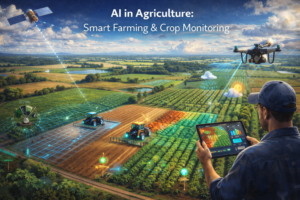
The Agricultural Transformation
Agriculture faces unprecedented challenges: feeding a growing global population while confronting climate change, water scarcity, and labor shortages. Artificial intelligence offers solutions to these challenges, enabling precision agriculture that optimizes every aspect of farming—from planting to harvest. Smart farming technologies are transforming one of humanity’s oldest industries into a data-driven, sustainable enterprise.
This case study examines how AI is revolutionizing agriculture through crop monitoring, yield prediction, autonomous machinery, and resource optimization. We explore implementations from technology leaders, agricultural giants, and innovative startups, revealing how AI is creating a more sustainable and productive food system.
The Imperative for Agricultural AI
The world must increase food production by 70% by 2050 to feed a projected 9.7 billion people. Yet agriculture faces mounting constraints:
- Climate change increasing weather volatility and pest pressure
- Declining availability of arable land and fresh water
- Rising costs of labor, fuel, and inputs
- Growing demand for sustainable farming practices
- Aging farmer population and knowledge transfer challenges
AI addresses these challenges by enabling more with less—higher yields from fewer inputs through precision application of water, fertilizers, and pesticides exactly where and when needed.
Crop Monitoring and Analysis
Satellite and Drone Imagery
AI-powered analysis of satellite and drone imagery provides unprecedented visibility into crop health. Computer vision algorithms detect plant stress, disease, and nutrient deficiencies before visible to the human eye, enabling early intervention.
Case Study: Planet Labs and Farmers Edge
Planet Labs operates the largest constellation of Earth-imaging satellites, capturing daily images of every field on Earth. Combined with Farmers Edge’s analytics platform:
- Daily satellite imagery covering millions of acres
- AI detection of crop stress with 90%+ accuracy
- Automatic field boundary detection and classification
- Integration with farm management systems
- Historical analysis for trend identification
Case Study: John Deere See & Spray
John Deere’s See & Spray technology uses computer vision to identify weeds in real-time:
- Cameras capture 20+ images per second at highway speeds
- AI distinguishes crops from weeds with 98%+ accuracy
- Precision sprayers apply herbicide only where needed
- Reduces herbicide use by up to 77%
- Decreases input costs while improving sustainability
Yield Prediction and Forecasting
machine learning for Yield Estimation
AI models predict crop yields months before harvest by analyzing weather patterns, soil conditions, satellite imagery, and historical data. Accurate yield forecasts enable better planning for farmers, commodity traders, and food system stakeholders.
Case Study: aWhere
aWhere’s agricultural intelligence platform combines weather data, satellite imagery, and agronomic models:
- Global weather monitoring at 9-kilometer resolution
- Crop models for 15+ major crops worldwide
- Yield forecasts updated daily throughout growing season
- Integration with commodity trading and food security systems
- Used by governments, NGOs, and agricultural companies globally
Case Study: Indigo Agriculture
Indigo uses AI to analyze satellite imagery for carbon credit verification and yield prediction:
- Machine learning estimates soil carbon from satellite data
- Enables carbon credit programs for regenerative farming
- Yield prediction supports carbon measurement and trading
- Connecting farmers with buyers seeking sustainable grain
Autonomous Farming Equipment
Self-Driving Tractors
AI enables autonomous operation of tractors, combines, and other farm equipment. GPS guidance combined with computer vision allows 24/7 operation with precision impossible for human operators.
Case Study: John Deere Autonomous Tractor
John Deere’s fully autonomous tractor represents a milestone in agricultural automation:
- 360-degree cameras and AI for obstacle detection
- GPS guidance with centimeter-level accuracy
- Remote monitoring and control via smartphone
- Automatic adjustment for field conditions
- Enables 24/7 operation during critical planting windows
Case Study: Monarch Tractor
Monarch’s electric, autonomous tractors combine sustainability with intelligence:
- Fully electric operation reducing carbon footprint
- Autonomous or driver-assist operation modes
- Computer vision for implement guidance
- Data collection during every field operation
- Integration with farm management platforms
Precision Irrigation
AI-Optimized Water Management
Agriculture accounts for 70% of global freshwater use, making irrigation efficiency critical. AI optimizes water application based on weather forecasts, soil moisture, crop water needs, and economic factors.
Case Study: CropX
CropX combines soil sensors with AI for precision irrigation:
- Wireless soil sensors measuring moisture, temperature, and conductivity
- AI recommendations for irrigation timing and amounts
- Integration with irrigation control systems
- Typical water savings of 20-30%
- Improved yields through optimal moisture management
Case Study: Netafim
Drip irrigation leader Netafim incorporates AI throughout its systems:
- Machine learning optimizes irrigation schedules
- Predictive maintenance for irrigation equipment
- Fertigation optimization based on crop needs
- Remote monitoring and control capabilities
- Integration with broader farm management systems
Disease and Pest Detection
Early Warning Systems
AI enables early detection of plant diseases and pest infestations, allowing targeted treatment before problems spread. Computer vision analyzes images from drones, sensors, or smartphones to identify issues.
Case Study: Plantix
Plantix’s smartphone app uses AI to diagnose plant diseases:
- Camera-based disease identification from leaf images
- Database of 400+ diseases affecting major crops
- Treatment recommendations and prevention tips
- Used by millions of farmers in developing countries
- Offline capability for areas without connectivity
Case Study: Climate Corporation
The Climate Corporation (owned by Bayer) provides AI-powered disease forecasting:
- Predictive models for disease pressure based on weather
- Integrated pest management recommendations
- Field-specific risk assessment and alerting
- Integration with Climate FieldView platform
- Enables proactive rather than reactive pest management
Livestock Management
AI for Animal Health
AI monitors livestock health, behavior, and productivity. Computer vision and sensor data detect health issues, optimize feeding, and improve animal welfare.
Case Study: Connecterra
Connecterra’s Ida platform uses AI for dairy herd management:
- Sensors on cattle track activity, rumination, and eating
- AI detects health issues days before visible symptoms
- Estrus detection for optimal breeding timing
- Integration with milking systems and herd management
- Improved productivity and animal welfare outcomes
Case Study: Cainthus
Cainthus uses computer vision for livestock monitoring:
- Cameras identify individual animals by facial recognition
- Behavior analysis detects health and welfare issues
- Feed intake monitoring and optimization
- Integration with farm management systems
- Reducing need for physical animal handling
Supply Chain and Market Intelligence
Price Forecasting
AI analyzes market data, weather patterns, and supply chain information to forecast commodity prices. This intelligence helps farmers make better planting decisions and marketing strategies.
Case Study: Gro Intelligence
Gro Intelligence provides AI-powered agricultural market analysis:
- Real-time data from millions of sources globally
- Machine learning for supply and demand forecasting
- Price predictions for major agricultural commodities
- Climate impact analysis on agricultural production
- Used by traders, governments, and food companies
Implementation Challenges
Connectivity
Many farms lack reliable internet connectivity required for cloud-based AI. Solutions include edge computing, satellite connectivity, and mesh networks, but the digital divide remains significant.
Data Standards
Agricultural data often lacks standardization, making integration difficult. Industry initiatives work toward common data standards, but progress is slow.
Farmer Adoption
Technology adoption varies widely among farmers. Successful implementations require farmer-friendly interfaces, clear ROI demonstration, and support from agronomists and advisors.
Cost and ROI
Advanced agricultural AI can be expensive, and ROI varies by crop, region, and farm size. Solutions must demonstrate clear value to drive adoption.
Sustainability Impact
Environmental Benefits
AI-powered precision agriculture reduces environmental impact:
- Reduced chemical use through precision application
- Water conservation through optimized irrigation
- Lower carbon footprint through efficiency gains
- Improved soil health through better management
- Reduced food waste through better forecasting
Future Trends
Vertical Farming
AI enables fully controlled vertical farming environments with optimized lighting, nutrients, and climate for year-round production near urban consumers.
Carbon Farming
AI verification of carbon sequestration enables farmers to participate in carbon credit markets, creating new revenue streams for sustainable practices.
Robotic Harvesting
AI-powered robots are beginning to harvest high-value crops like strawberries and tomatoes, addressing labor shortages while reducing food waste through optimal timing.
Conclusion
Artificial intelligence is transforming agriculture from an art to a science, enabling precision farming that optimizes every input for maximum sustainable productivity. From satellite-based crop monitoring to autonomous tractors and AI-powered irrigation, technology is revolutionizing how we grow food.
The stakes could not be higher—feeding a growing world population while protecting the environment requires the productivity gains that AI enables. As technology costs decrease and capabilities improve, AI will become standard across agriculture, from small farms in developing countries to large commercial operations worldwide.
Success requires not just technology but ecosystem development including connectivity infrastructure, data standards, farmer training, and supportive policies. Organizations that invest in agricultural AI today are building the sustainable food systems of tomorrow.
Continue Learning: Related Articles
Deep Learning for Stock Market Prediction: Opportunities and Challenges
Applying deep learning to Financial Markets
Stock market prediction has long been a goal of investors, analysts, and re…
📖 5 min read
AI in Finance: How Machine Learning is Transforming Fraud Detection and Risk Management
Introduction to AI in Financial Services
The financial services industry stands at the forefront of artificial intellig…
📖 8 min read
AI Data Preparation and Feature Engineering Tools: Trifacta vs Alteryx vs DataRobot vs Dataiku
AI Data Preparation Tools: Comprehensive Comparison of Leading Solutions 2025
Data preparation and feature engineering …
📖 5 min read
AI in Healthcare: Revolutionizing Medical Diagnosis and Patient Care
The Transformation of Healthcare Through Artificial Intelligence
Artificial Intelligence is revolutionizing healthcare …
📖 8 min read
💡 Explore 80+ AI implementation guides on Harshith.org
