The Fourth Industrial Revolution
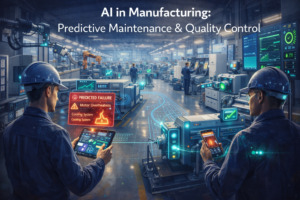
Manufacturing is experiencing its most significant transformation since the assembly line—the Fourth Industrial Revolution, or Industry 4.0. Artificial intelligence sits at the heart of this revolution, enabling predictive maintenance that prevents costly breakdowns, quality control systems that detect defects invisible to human inspectors, and autonomous systems that optimize production in real-time.
This case study examines how leading manufacturers are deploying AI to transform their operations, reduce costs, and achieve unprecedented levels of quality and efficiency. We explore implementations from companies like Siemens, General Electric, BMW, and innovative manufacturing startups, revealing the strategies and technologies driving manufacturing’s AI transformation.
The Manufacturing Challenge
Manufacturing faces intense pressure to improve quality, reduce costs, and increase flexibility simultaneously. Traditional approaches struggle to meet these demands:
- Unplanned downtime costs manufacturers an estimated $50 billion annually
- Quality defects lead to recalls, warranty costs, and reputation damage
- Skilled labor shortages threaten production capacity
- Supply chain volatility requires greater operational agility
- Sustainability requirements demand more efficient resource use
Predictive Maintenance
From Reactive to Predictive
Traditional maintenance follows either reactive approaches (fixing equipment when it breaks) or preventive schedules (replacing parts at fixed intervals). Both are inefficient—reactive maintenance causes costly unplanned downtime, while preventive maintenance often replaces parts with useful life remaining.
AI-powered predictive maintenance analyzes sensor data to predict equipment failures before they occur, enabling maintenance at the optimal time. This typically reduces maintenance costs by 10-40% while nearly eliminating unplanned downtime.
How Predictive Maintenance Works
Machine learning models analyze data from sensors monitoring vibration, temperature, pressure, current, and other parameters. By learning normal operating patterns, these models detect subtle anomalies that indicate developing problems—often weeks before failure would occur.
Key technologies include:
- IoT sensors capturing high-frequency machine data
- Edge computing for real-time analysis
- Machine learning models for anomaly detection
- Digital twins for simulation and prediction
- Integration with maintenance management systems
Case Study: Siemens
Siemens has deployed predictive maintenance across its manufacturing operations and offers the technology to customers through its MindSphere platform:
- Reduced unplanned downtime by 50% in gas turbine operations
- Improved maintenance efficiency by 20%
- Extended asset lifespan through optimized maintenance
- Deployed across hundreds of thousands of connected assets
- Continuously improving models through federated learning
Case Study: General Electric
GE’s Predix platform powers predictive maintenance for industrial equipment worldwide:
- Aviation: Predicts jet engine maintenance needs, reducing airline delays
- Power: Optimizes gas turbine operations for utilities
- Healthcare: Ensures medical imaging equipment availability
- Oil & Gas: Prevents costly offshore platform failures
- Models trained on decades of equipment performance data
AI-Powered Quality Control
Beyond Human Inspection
Computer vision systems inspect products at speeds and accuracy levels impossible for human inspectors. AI can detect microscopic defects, ensure consistency across millions of units, and operate continuously without fatigue.
Case Study: BMW
BMW has deployed AI quality control throughout its manufacturing operations:
- Computer vision inspects vehicle paint for defects smaller than a millimeter
- AI analyzes engine sounds to detect assembly problems
- Automated optical inspection for electronic components
- Real-time quality dashboards for production managers
- Defect reduction of over 30% in implemented areas
Case Study: Foxconn
Electronics manufacturer Foxconn uses AI extensively for quality control:
- Computer vision inspects smartphone components at scale
- AI identifies soldering defects invisible to human eye
- Automated testing of display quality and functionality
- Machine learning predicts quality issues from process parameters
- Integration with robotic handling for fully automated inspection
Inline Quality Monitoring
AI enables real-time quality monitoring during production, not just final inspection. By analyzing process parameters, AI can predict quality outcomes and adjust parameters before defects occur—moving from detection to prevention.
Process Optimization
Digital Twins
Digital twins—virtual replicas of physical manufacturing systems—enable AI optimization without disrupting production. Machine learning models can be trained on digital twins, with optimal parameters then transferred to physical systems.
Case Study: Procter & Gamble
P&G uses digital twins and AI across its manufacturing operations:
- Digital twins of manufacturing lines for simulation and optimization
- AI-powered scheduling optimizing production across plants
- Machine learning for formulation optimization
- Predictive quality ensuring product consistency
- Real-time visibility across global operations
Energy Optimization
AI optimizes energy consumption in manufacturing facilities, reducing costs and carbon footprint. Machine learning models balance production demands with energy efficiency, often achieving 10-20% reductions in energy use.
Autonomous Manufacturing
Robotic Automation
AI enables more capable and flexible robotic systems that can adapt to variations, work safely alongside humans, and perform tasks previously requiring human judgment.
Case Study: Tesla
Tesla’s Gigafactories represent some of the most advanced automated manufacturing:
- Hundreds of robots performing assembly, welding, and material handling
- Computer vision for quality control and guidance
- AI optimization of production flow and scheduling
- Machine learning for continuous process improvement
- Integration of manufacturing data with vehicle performance
Collaborative Robots (Cobots)
AI-powered cobots work safely alongside humans, combining robotic precision with human flexibility. Vision systems and force sensors enable cobots to adapt to their environment and respond safely to human presence.
Supply Chain Intelligence
Demand Forecasting
AI improves demand forecasting accuracy, enabling better production planning and inventory management. Machine learning models incorporate diverse data sources including market trends, weather, and economic indicators.
Case Study: Unilever
Unilever’s AI-powered supply chain optimization:
- Machine learning improves demand forecasting by 20%
- AI optimizes production scheduling across global plants
- Predictive analytics for supplier risk management
- Dynamic inventory optimization reducing working capital
- Real-time visibility across complex supply networks
Implementation Challenges
Legacy Equipment
Many manufacturers operate equipment decades old that lacks modern sensors and connectivity. Retrofitting legacy assets with IoT capability requires careful planning and investment.
Data Infrastructure
AI requires robust data infrastructure connecting machines, systems, and cloud platforms. Many manufacturers struggle with data silos, inconsistent formats, and inadequate network capacity.
Skills Gap
Manufacturing organizations need new skills including data science, software engineering, and AI implementation. Training existing workers while recruiting new talent is a significant challenge.
Cybersecurity
Connected manufacturing creates cybersecurity risks. Attacks on operational technology can disrupt production or even cause safety incidents. Robust security is essential for AI-enabled manufacturing.
Measuring ROI
Key Metrics
Manufacturers measure AI impact through:
- Overall Equipment Effectiveness (OEE) improvement
- Reduction in unplanned downtime
- Quality metrics including defect rates and scrap
- Energy consumption and sustainability metrics
- Labor productivity and safety improvements
- Time to market for new products
Future Trends
Autonomous Factories
The vision of “lights out” manufacturing—fully autonomous factories requiring no human presence—is becoming reality in some applications. AI enables coordination of robotic systems, quality control, and logistics without human intervention.
Generative Design
AI-powered generative design creates optimized product designs that meet requirements while minimizing material use and manufacturing complexity. These designs often exceed human-created alternatives in performance.
Sustainable Manufacturing
AI helps manufacturers reduce environmental impact through optimized resource use, waste reduction, and circular economy initiatives. Machine learning identifies opportunities for efficiency improvements and tracks sustainability metrics.
Best Practices
Successful AI manufacturing implementations follow key principles:
- Start with clear business objectives: Focus AI on specific, measurable problems
- Build data foundation first: Ensure data quality and infrastructure before advanced analytics
- Pilot before scaling: Prove value in limited deployment before enterprise rollout
- Engage operations teams: Success requires buy-in from production personnel
- Plan for change management: New skills and processes are as important as technology
- Measure and iterate: Continuous improvement based on outcome data
Conclusion
Artificial intelligence is transforming manufacturing from reactive to predictive, from manual to autonomous, and from rigid to agile. Predictive maintenance prevents costly downtime, computer vision ensures unprecedented quality, and AI optimization improves efficiency across operations.
Leading manufacturers like Siemens, GE, BMW, and Tesla demonstrate the transformative potential, while innovative startups bring new approaches to specific challenges. Success requires not just technology adoption but organizational transformation—new skills, processes, and cultures that embrace data-driven decision-making.
As AI capabilities continue advancing, manufacturing will become increasingly intelligent and autonomous. Organizations that build AI capabilities today will lead the future of industrial production.
Continue Learning: Related Articles
AI in Education: Personalized Learning Systems and Adaptive Assessment Transforming Classrooms
The Education Revolution
Education stands on the brink of its most significant transformation since the introduction of…
📖 8 min read
AI Data Preparation and Feature Engineering Tools: Trifacta vs Alteryx vs DataRobot vs Dataiku
AI Data Preparation Tools: Comprehensive Comparison of Leading Solutions 2025
Data preparation and feature engineering …
📖 5 min read
Deep Learning for Stock Market Prediction: Opportunities and Challenges
Applying deep learning to Financial Markets
Stock market prediction has long been a goal of investors, analysts, and re…
📖 5 min read
AI in Healthcare: Revolutionizing Medical Diagnosis and Patient Care
The Transformation of Healthcare Through Artificial Intelligence
Artificial Intelligence is revolutionizing healthcare …
📖 8 min read
💡 Explore 80+ AI implementation guides on Harshith.org
