The Journey of Natural Language Processing
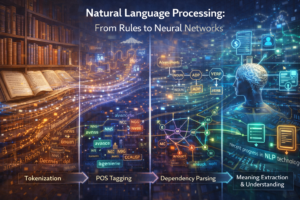
Natural Language Processing (NLP) has undergone a remarkable transformation over the past few decades. From rule-based systems that rely on manually crafted linguistic rules to modern neural networks that learn directly from text data, NLP has evolved dramatically. This evolution mirrors broader developments in AI, reflecting our growing understanding of language and our increasing computational capabilities.
The Rule-Based Era (1950s-1990s)
Learn more: chatbot development
Learn more: prompt engineering techniques
Early NLP systems were entirely rule-based. Linguists would develop formal grammars and manually encode rules about language structure. These systems would parse sentences according to these rules, attempting to extract meaning. While this approach had limitations, it successfully enabled some basic NLP tasks.
Expert systems in NLP represented the state of the art in the 1980s. These systems combined linguistic rules with domain-specific knowledge to perform tasks like information extraction and question answering. However, they were brittle, requiring extensive manual effort to extend to new domains, and they failed gracefully when encountering language outside their anticipated rules.
The Statistical Revolution (1990s-2010s)
The advent of digital text corpora and increased computational power enabled a shift toward statistical approaches. Instead of hand-coding rules, researchers trained models on large amounts of text data. These statistical models learned patterns from data, enabling generalization to new examples.
Bag-of-Words Models: Early statistical approaches represented documents as unordered collections of words. While losing word order information, this simple representation enabled effective text classification and information retrieval.
N-gram Models: These models captured local word order by learning the probabilities of word sequences. N-gram models powered early machine translation and speech recognition systems.
Hidden Markov Models: These probabilistic models were particularly effective for sequence labeling tasks like part-of-speech tagging and named entity recognition, where the goal is to assign labels to each word in a sequence.
Maximum Entropy and Support Vector Machines: These discriminative models competed with generative models, often achieving better performance on specific tasks. They enabled more sophisticated feature engineering and model tuning.
The Distributed Representation Revolution
A crucial insight emerged in the late 2000s: representing words as dense numerical vectors rather than discrete symbols dramatically improved model performance. Word2vec, developed at Google, introduced efficient methods for learning word embeddings from large corpora. Words with similar meanings ended up with similar vector representations, and the relationships between words were captured in vector geometry.
This innovation enabled more powerful models. Rather than treating words as atomic units, models now worked with rich representations that captured semantic and syntactic properties. This approach proved vastly more effective than one-hot encodings used in previous statistical methods.
Deep Learning and Neural Networks (2010s-Present)
Recurrent Neural Networks: RNNs and their variants (LSTM, GRU) enabled processing of variable-length sequences while maintaining context. These networks could be stacked in layers and trained end-to-end on NLP tasks.
Convolutional Neural Networks: Surprisingly effective for NLP, CNNs could identify important local patterns (like N-gram features) through learned convolution operations. This representation learning was more effective than hand-crafted features.
Attention Mechanisms: The attention mechanism revolutionized sequence-to-sequence models, enabling neural machine translation and many other sequence processing tasks. Attention allows models to focus on relevant parts of the input.
Transformers: The Transformer Architecture, based entirely on attention mechanisms, eliminated recurrence entirely. This architectural innovation enabled training on larger datasets more efficiently and achieved state-of-the-art results across NLP tasks.
Pre-training and Transfer Learning
Modern NLP is dominated by pre-training approaches. Large Language Models are first trained on massive amounts of unlabeled text data to learn general linguistic properties. This pre-training is followed by fine-tuning on specific downstream tasks with smaller labeled datasets. This transfer learning approach has become standard practice, enabling even modest-sized datasets to achieve strong performance through pre-trained representations.
Current State-of-the-Art
Modern language models like BERT, GPT, and others have achieved unprecedented performance across virtually all NLP benchmarks. These models demonstrate remarkable capabilities including:
Text Classification: Assigning documents to predefined categories with high accuracy, useful for sentiment analysis, topic categorization, and content moderation.
Named Entity Recognition: Identifying and classifying named entities (persons, organizations, locations) in text with strong performance even on new entity types.
Machine Translation: Translating between languages with quality approaching human translation in many language pairs.
Question Answering: Extracting answers from documents or generating answers to natural language questions.
Semantic Similarity: Measuring similarity between sentences or documents based on semantic content rather than surface-level similarity.
Text Generation: Generating coherent, contextually appropriate text across various domains and writing styles.
Remaining Challenges
Contextual Understanding: While neural models excel at learning statistical patterns, truly understanding meaning, context, and pragmatics remains elusive.
Reasoning: NLP systems struggle with tasks requiring complex reasoning or world knowledge beyond what was in their training data.
Common Sense: Humans use vast amounts of commonsense knowledge in understanding language. Building this into NLP systems remains challenging.
Low-Resource Languages: Most NLP advances benefit high-resource languages with abundant training data. Extending capabilities to languages with less digital text remains an open challenge.
The Future of NLP
The field continues to advance rapidly. Multimodal models combining text with images and other modalities are emerging. Integration of external knowledge sources is improving reasoning capabilities. More efficient models are enabling deployment in resource-constrained environments. Techniques for aligning model behavior with human values are advancing.
The evolution from rules to neural networks represents more than just a change in implementation—it reflects a fundamental shift in how we approach language understanding. As NLP continues to advance, its applications will expand to transform communication, information access, and human-computer interaction across all domains.
Learning Path: Python for AI/ML
Continue Learning: Related Articles
Structured Learning Paths for AI & ML
Structured Learning Paths for AI & ML
Complete progressions from beginner to advanced in different specializations
…
📖 3 min read
Understanding Neural Networks: A Comprehensive Guide for Beginners
Introduction to Neural Networks
Neural networks are the backbone of modern artificial intelligence and deep learning….
📖 4 min read
Build a Document Q&A System with RAG: Complete Python Tutorial
Introduction to RAG-Based Document Q&A
Retrieval-Augmented Generation (RAG) has revolutionized how we interact with…
📖 18 min read
Stock Price Prediction with LSTM Neural Networks
Hands-On Project: Stock Price Prediction with LSTM Neural Networks
Difficulty Level: Intermediate | Duration: 4-6 hours …
📖 9 min read
💡 Explore 80+ AI implementation guides on Harshith.org
