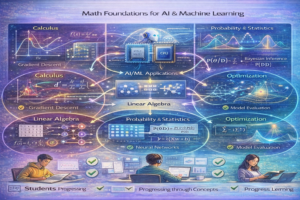
Math Foundations for AI & machine learning
Master the mathematical concepts essential for artificial intelligence and machine learning
Success in AI and machine learning requires a solid understanding of mathematical concepts. This guide provides beginner-friendly explanations of the math you need to master deep learning, neural networks, and advanced ML algorithms.
Why Math Matters for AI/ML
Mathematics is the foundation of machine learning. Understanding these concepts will help you:
- Understand how algorithms work internally
- Debug machine learning models effectively
- Optimize neural networks for better performance
- Implement custom machine learning solutions
- Make informed decisions about hyperparameters
- Develop better intuition for model behavior
Learning Paths by Skill Level
Beginner Level (Start Here)
- Linear Algebra Basics: Vectors, matrices, and matrix operations
- Probability & Statistics Fundamentals: Basic probability, distributions, hypothesis testing
- Calculus Essentials: Derivatives, gradients, chain rule
Intermediate Level
- Advanced Linear Algebra: Eigenvalues, matrix decomposition, tensor operations
- Statistical Methods: Hypothesis testing, confidence intervals, bayesian inference
- Multivariable Calculus: Partial derivatives, optimization, gradient descent
Advanced Level
- Optimization Theory: Convex optimization, backpropagation mathematics
- Advanced Statistics: Bayesian networks, Markov chains, probabilistic models
- Information Theory: Entropy, KL divergence, mutual information
Core Mathematical Topics
| Topic | Why It Matters | Where It’s Used |
|---|---|---|
| Linear Algebra | Foundation of neural networks and matrix operations | Data representation, transformations, embeddings |
| Probability | Understanding uncertainty and randomness | Bayesian methods, generative models, reinforcement learning |
| Statistics | Analyzing data and evaluating models | Model evaluation, hypothesis testing, feature engineering |
| Calculus | Optimization of loss functions | Gradient descent, backpropagation, optimization algorithms |
| Information Theory | Understanding information and compression | Loss functions, entropy, divergence measures |
Detailed Learning Resources
1. Linear Algebra Foundations
Learn the fundamentals of vectors, matrices, and matrix operations
2. Probability & Statistics
Understand probability distributions, Bayes’ theorem, and statistical testing
3. Calculus for ML
Quick Reference Formulas
Linear Algebra Quick Reference
- Matrix Multiplication: (m×n) × (n×p) = (m×p)
- Dot Product: a·b = Σ(a_i × b_i)
- Transpose: (A^T)_ij = A_ji
- Matrix Inverse: A × A^(-1) = I
- Eigenvalue Equation: A×v = λ×v
Calculus Quick Reference
- Derivative Power Rule: d/dx(x^n) = n×x^(n-1)
- Chain Rule: d/dx(f(g(x))) = f'(g(x)) × g'(x)
- Partial Derivative: ∂f/∂x (with respect to x, holding y constant)
- Gradient: ∇f = [∂f/∂x₁, ∂f/∂x₂, …, ∂f/∂xₙ]
- Gradient Descent Update: θ_new = θ_old – α × ∇L(θ)
Probability Quick Reference
- Probability Rules: 0 ≤ P(A) ≤ 1, P(A or B) = P(A) + P(B) – P(A and B)
- Conditional Probability: P(A|B) = P(A and B) / P(B)
- Bayes’ Theorem: P(A|B) = P(B|A) × P(A) / P(B)
- Expected Value: E[X] = Σ(x_i × P(x_i))
- Variance: Var(X) = E[X²] – (E[X])²
Self-Assessment
Can You Answer These Questions?
- What is the difference between a vector and a matrix?
- Why is the chain rule important for backpropagation?
- What is the relationship between probability and likelihood?
- How does gradient descent use derivatives to optimize?
- What is the difference between variance and standard deviation?
If you can’t confidently answer these questions, start with the beginner-level resources above.
Study Tips
- Start Simple: Begin with 2D examples before moving to higher dimensions
- Use Visualizations: Always try to visualize mathematical concepts geometrically
- Practice Calculations: Work through examples by hand, don’t just read formulas
- Connect to ML: For each concept, understand how it applies to machine learning
- Review Regularly: Mathematics builds on previous concepts; review frequently
- Use Multiple Resources: Different explanations can help clarify difficult concepts
Recommended Tools & Libraries
- Python NumPy: Numerical computing and linear algebra
- Matplotlib/Seaborn: Visualization of mathematical concepts
- SciPy: Advanced scientific computing and statistics
- SymPy: Symbolic mathematics and calculus
- Jupyter Notebooks: Interactive mathematical exploration
Next Steps
Choose your starting point based on your current knowledge level:
- 👶 Complete Beginner? Start with Linear Algebra Basics
- 🎯 Some Background? Jump to Probability & Statistics
- 🚀 Ready for Calculus? Go to Calculus for ML
Continue Learning: Related Articles
Create a Resume Parser with NLP: Complete Python Tutorial for Extracting Structured Data
Introduction to AI Resume Parsing
Resume parsing is a fundamental task in HR technology, powering applicant tracking sy…
📖 20 min read
Build an Intelligent Chatbot with NLP
Hands-On Project: Build an Intelligent Chatbot with NLP
Difficulty Level: Intermediate | Duration: 4-6 hours | Topics: N…
📖 6 min read
Learning Path: Python for AI/ML
Learning Path: Python for AI/ML
Duration: 8-10 weeks | Weekly Commitment: 15-20 hours | Target Audience: Beginners with …
📖 4 min read
ChatGPT Prompt Engineering: 15 Advanced Techniques to Get Better Results
Why Prompt Engineering Matters
Prompt engineering has emerged as one of the most valuable skills in the age of artifici…
📖 11 min read
💡 Explore 80+ AI implementation guides on Harshith.org
