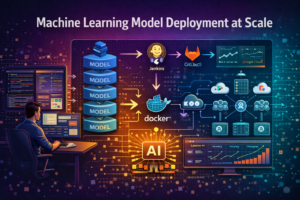
machine learning Model Deployment at Scale: Production Strategies, Monitoring, and Optimization
Introduction: The Gap Between Model Development and Production
Creating an accurate machine learning model is only half the battle. According to a 2024 McKinsey report, 70% of machine learning projects never make it to production, and of those that do, 50% fail within the first year. The real challenge isn’t building models—it’s deploying, scaling, and maintaining them reliably in production environments.
The journey from Jupyter notebook to serving predictions to thousands of concurrent users requires sophisticated infrastructure, robust monitoring systems, and continuous optimization strategies. Organizations like Netflix, Amazon, and Google spend millions annually managing machine learning infrastructure, yet most enterprises lack the frameworks to deploy models efficiently.
This comprehensive guide covers everything you need to deploy machine learning models at scale, from containerization strategies to real-time monitoring, A/B testing frameworks, and cost optimization techniques that reduce operational expenses by 40-60%.
Understanding ML Deployment Challenges at Scale
The Three Phases of ML Deployment
Successful ML deployment follows three distinct phases, each with unique challenges:
Phase 1: Pre-Production – Model validation, testing, and containerization. This phase typically takes 2-4 weeks and involves ensuring your model meets accuracy, latency, and reliability requirements before any production traffic touches it.
Phase 2: Initial Deployment – Canary deployments, shadow deployment, or A/B tests with small traffic percentages. Organizations typically allocate 5-10% of traffic to new models initially, monitoring performance metrics before full rollout.
Phase 3: Stable Production – Continuous monitoring, drift detection, retraining pipelines, and performance optimization. This phase is ongoing and requires infrastructure investment that often exceeds model development costs by 3-5x.
Common Deployment Failures and Their Costs
Data scientists frequently cite these deployment challenges (Kaggle 2023 survey):
- Model Drift (35% of failures): Models degrade over time as production data diverges from training data. A recommendation engine at a major e-commerce platform lost 8% accuracy within six months of deployment.
- Latency Issues (28% of failures): Models that run in seconds during development take minutes in production due to data preprocessing, feature engineering, and API calls.
- Infrastructure Scaling (22% of failures): Unexpected traffic spikes cause inference servers to crash, leading to service outages and lost revenue.
- Data Quality Problems (15% of failures): Production data contains edge cases, missing values, and anomalies not present in training data.
The financial impact is substantial. A one-hour ML service outage for a mid-size fintech company costs approximately $15,000-25,000 in lost transactions and reputational damage. This underscores why robust deployment practices aren’t optional—they’re business-critical.
Containerization and Orchestration: Building the Foundation
Docker for ML Model Packaging
Docker containers have become the industry standard for ML deployment, offering consistency, reproducibility, and portability. Unlike traditional software deployment, ML models require specific dependencies: Python versions, CUDA libraries for GPU acceleration, system-level packages, and exact library versions.
A minimal ML Docker image typically includes:
FROM python:3.11-slim
WORKDIR /app
COPY requirements.txt .
RUN pip install -r requirements.txt
COPY model.pkl .
COPY inference_server.py .
EXPOSE 8000
CMD ["python", "inference_server.py"]
Optimized for production, your Docker image should:
- Use multi-stage builds – Separate build dependencies from runtime dependencies, reducing image size from 2GB to 400MB
- Include health checks – Kubernetes uses these to detect failed containers and restart them automatically
- Implement graceful shutdown – Allow in-flight requests to complete before terminating
- Set resource limits – Prevent runaway containers from consuming all cluster resources
Kubernetes Orchestration for Scalability
Kubernetes has become the de facto standard for container orchestration in enterprises, managing over 90% of containerized ML workloads (CNCF 2023). Here’s why it’s essential for ML deployment at scale:
Auto-Scaling: Kubernetes automatically scales your inference servers based on CPU/memory usage or custom metrics. If request latency exceeds 500ms, Kubernetes adds additional replicas. During off-peak hours, it scales down, reducing costs by 30-50%.
Rolling Updates: Deploy new model versions without downtime. Kubernetes gradually shifts traffic from old to new model versions, enabling instant rollback if issues occur.
Resource Optimization: Place CPU-bound and GPU-heavy models on appropriate hardware. A single Kubernetes cluster can handle models with different resource requirements, maximizing hardware utilization.
A typical Kubernetes deployment for an ML model looks like:
apiVersion: apps/v1
kind: Deployment
metadata:
  name: recommendation-model
spec:
  replicas: 3
  selector:
    matchLabels:
      app: recommendation-model
  template:
    metadata:
      labels:
        app: recommendation-model
    spec:
      containers:
      - name: model-server
        image: myregistry.azurecr.io/recommendation:v2.1
        ports:
        - containerPort: 8000
        resources:
          requests:
            memory: "2Gi"
            cpu: "1"
          limits:
            memory: "4Gi"
            cpu: "2"
        livenessProbe:
          httpGet:
            path: /health
            port: 8000
          initialDelaySeconds: 30
          periodSeconds: 10
Production Pipelines: From Data to Predictions
Feature Engineering at Scale
Feature engineering accounts for 40-60% of machine learning project time, yet most organizations lack systematic approaches to this critical component. At scale, you need:
Feature Stores: Centralized repositories for features used across models. Tools like Feast, Tecton, and Databricks Feature Store serve pre-computed features to inference servers, reducing latency from 5+ seconds to 50-200ms. Feature stores also ensure consistency between training and serving, eliminating a major source of production bugs.
Cost Comparison: Building a feature store infrastructure costs $50,000-150,000 initially but saves $200,000+ annually in engineering time and model accuracy improvements.
Real-Time Feature Computation: Some features must be computed in real-time (e.g., user behavior in the last hour). Stream processing frameworks like Apache Kafka and Flink compute these features milliseconds after events occur. A major social media platform uses real-time features to personalize feeds, improving engagement by 23%.
Batch vs. Real-Time Prediction Pipelines
Different use cases require different architectures:
Batch Prediction Pipeline: Pre-compute predictions for all entities (e.g., next-day product recommendations for all users). Cost-effective for non-urgent predictions. Processing 10 million users takes 2-4 hours on a 32-core server, costing $15-30 per run. Best for email campaigns, inventory forecasting, and overnight recommendations.
Real-Time Prediction (Online Serving): Generate predictions synchronously when requested. Requires sub-500ms latency to avoid degrading user experience. Processing costs scale with request volume: ~$0.0001 per prediction on optimized infrastructure. Essential for web applications, AI fraud detection, and personalized search results.
Hybrid Approach: Pre-compute candidate recommendations in batch, then rank/personalize them in real-time. This combines cost efficiency with personalization, used by Netflix, Spotify, and Amazon.
Monitoring, Drift Detection, and Retraining Strategies
Comprehensive ML Monitoring Framework
Traditional software monitoring tracks system metrics (CPU, memory, latency). ML monitoring requires additional layers:
Data Monitoring: Track statistics of incoming data for anomalies that indicate distribution shift. Monitor:
- Feature value ranges and distributions
- Missing value percentages
- Categorical cardinality (unexpected new categories)
- Feature correlation changes
Model Performance Monitoring: Track prediction quality metrics in production:
- Classification models: Precision, recall, F1-score updated hourly/daily
- Regression models: RMSE, MAE, quantile metrics
- Ranking models: NDCG, MRR, click-through rate
A major financial services company monitors model performance across 150+ models. They detected a 15% accuracy drop in a credit risk model within 2 hours of a data source schema change, preventing estimated losses of $2.3 million.
System Performance Monitoring:
- Inference latency (p50, p95, p99)
- Throughput (predictions per second)
- Error rates and exception types
- Model freshness (time since last retraining)
Detecting and Responding to Model Drift
Model drift occurs when model performance degrades due to changes in the data distribution or the relationship between features and targets. Four types require different responses:
Covariate Shift: Feature distributions change but feature-target relationships remain stable. A recommendation model trained on summer user behavior performs poorly in winter. Response: Retrain with recent data or use domain adaptation techniques.
Label Shift: Target distribution changes. A spam classifier trained when 2% of emails were spam now faces 8% spam. Response: Adjust classification thresholds or retrain with balanced sampling.
Concept Drift: Feature-target relationships change fundamentally. Consumer preferences shift, fraud patterns evolve. Response: Implement continuous retraining pipelines or switch to online learning algorithms.
Seasonal Drift: Predictable patterns repeat annually. Traffic surges during holidays, revenue patterns change quarterly. Response: Use seasonal decomposition or train separate models for different seasons.
Implementation Strategy: Monitor drift metrics continuously. When drift exceeds thresholds, trigger automated retraining pipelines. A typical threshold for triggering retraining is >2% accuracy drop over 7 days or >3 standard deviations in statistical tests (Kolmogorov-Smirnov test for continuous features).
A/B Testing and Canary Deployments
Designing ML A/B Tests for Statistical Significance
A/B tests validate that new model versions outperform current versions before full deployment. However, ML A/B tests differ from traditional software A/B tests due to sequential decision-making and multiple metrics.
Sample Size Calculation: To detect a 2% improvement in conversion rate (from 5% to 5.1%) with 95% confidence and 80% power, you need approximately 157,000 users per variant. At typical conversion rates, this requires 1-3 weeks of traffic.
Multiple Metrics Problem: Monitoring 20 metrics simultaneously increases false positive rate to ~64% (even if each test has 5% false positive rate). Solution: Define primary metrics (business-critical) and secondary metrics (informational). Only primary metric misses should block deployment.
Real-world example: Google tested a new search ranking model with primary metric being click-through rate (CTR) and secondary metrics including time-to-click and dwell time. The new model improved CTR by 1.2% while slightly decreasing dwell time. They deployed because CTR is the primary metric, generating an estimated $200 million in additional annual revenue.
Canary Deployment Strategy
Rather than A/B testing with 50/50 traffic split, canary deployments gradually roll out new models:
- Day 1-3: 1% traffic to new model. Monitor for crashes, extreme latency, or prediction anomalies.
- Day 4-7: 5% traffic to new model. Collect sufficient data for statistical significance on secondary metrics.
- Day 8-14: 25% traffic to new model. Test with diverse user segments and edge cases.
- Day 15+: 100% traffic to new model or rollback if issues detected.
This strategy reduces risk significantly. A deployment that causes severe issues at 1% traffic is caught within 1 day, affecting ~100,000 users vs. 5 million in a standard 50/50 A/B test.
Real-World Enterprise Case Studies
Case Study 1: E-Commerce Recommendation Engine at Scale
Company: Mid-sized e-commerce platform ($500M annual revenue)
Challenge: Original recommendation model training took 2 days, limiting retraining frequency to weekly. Model accuracy degraded 3-4% monthly due to concept drift from changing seasonal trends and inventory changes.
Solution Implemented:
- Built feature store with 200+ pre-computed features updated hourly
- Implemented streaming retraining pipeline processing incremental data daily
- Deployed model on Kubernetes with 50-200 concurrent prediction servers
- Set up automated drift detection monitoring with alerts
Results (6 months post-deployment):
- Model training time reduced from 48 hours to 4 hours (12x improvement)
- Retraining frequency increased from weekly to daily
- Recommendation conversion rate improved 18% ($90M additional annual revenue)
- Inference latency decreased from 2.3 seconds to 145ms (reducing page load time)
- Infrastructure costs increased from $80K to $180K monthly but ROI of 500%+ annually
Case Study 2: Fraud Detection System for Financial Services
Company: Regional bank processing $50B annual transaction volume
Challenge: Legacy fraud detection model had 89% precision but only 45% recall, missing 55% of fraud cases. Manual review of alerts consumed 150 FTEs annually costing $12M. Model couldn’t handle new fraud patterns emerging monthly.
Solution Implemented:
- Deployed ensemble of 5 specialized models (card-present, online, transfer, etc.)
- Implemented real-time feature engineering with 20ms latency
- Created human-in-the-loop system: model flags suspicious transactions, analysts review top 1% high-uncertainty cases
- Set up online learning pipeline retraining models daily with confirmed fraud cases
Results (12 months post-deployment):
- Fraud detection recall improved from 45% to 87% (42% improvement)
- Precision maintained at 88% (minimal false positives)
- Fraud losses reduced from $180M to $45M annually ($135M savings)
- Manual review workload reduced to 35 FTEs ($9.1M savings)
- Infrastructure and development costs: $2.8M annually
- Net benefit: $141.3M annually
Cost Optimization Strategies for ML Infrastructure
Reducing Inference Costs
Inference represents 60-80% of ML operations budget for most organizations. Key optimization strategies:
Model Quantization: Convert model weights from 32-bit to 8-bit integers, reducing model size by 75% and inference latency by 30-40%. A computer vision model using quantization processes images 3x faster on CPU-only hardware, saving GPU costs entirely.
Distillation: Train a smaller “student” model to mimic a larger “teacher” model. Student model is 10-50x smaller with 95%+ of teacher’s accuracy. Reduces inference cost from $0.0005 to $0.00001 per prediction.
Batching: Process multiple predictions together rather than individually. Batching 32 requests together reduces per-prediction cost by 70% while slightly increasing latency (beneficial for batch prediction pipelines).
Spot Instances: Use cloud spot instances (AWS, GCP, Azure) for non-critical inference workloads. Spot instances cost 70-90% less than on-demand but can be interrupted. Ideal for batch jobs with flexible deadlines.
Cost Impact Example: A SaaS company serving 1 billion monthly inferences using standard instances at $0.0001/prediction ($100K monthly). After implementing quantization (30% cost reduction) + batching (40% reduction) + distillation (50% reduction), monthly cost dropped to $9K (90% reduction), while maintaining 97% of original accuracy.
Storage and Data Pipeline Optimization
Feature Store Optimization: Storing 1,000 features for 100 million entities requires 400GB-2TB depending on data types. Use columnar formats (Parquet) instead of row-based (CSV), reducing storage by 80% and query speed by 5-10x.
Data Retention Policies: Store raw data only for 90 days, processed features for 2 years, model predictions for 5 years (compliance requirement). This 3-tier approach reduces storage costs by 60% vs. storing everything indefinitely.
Emerging Best Practices and Future Directions
MLOps Platform Evolution
Dedicated MLOps platforms (Databricks, Kubeflow, SageMaker) abstract deployment complexity, providing:
- Integrated experiment tracking and model registry
- Automated deployment pipelines with one-click rollbacks
- Built-in monitoring and drift detection
- Feature store integration
Organizations using comprehensive MLOps platforms report 40% faster deployment cycles and 60% reduction in model deployment failures.
Model Serving Optimization
Serverless ML: AWS Lambda, Google Cloud Functions, and Azure Functions enable deploying models without managing servers. Cost-effective for sporadic predictions but expensive for high-volume workloads.
Edge Deployment: Running models on edge devices (phones, IoT sensors) reduces latency to near-zero and eliminates network overhead. TensorFlow Lite and ONNX Runtime enable this for mobile and embedded systems.
Federated Learning: Train models across distributed data sources without centralizing data, enabling compliance with privacy regulations while improving model quality.
Actionable Takeaways for ML Deployment
- Plan for Production from Day One: Don’t treat production deployment as an afterthought. Allocate 30-40% of ML project budget to productionization, not just model development.
- Implement Comprehensive Monitoring: Track data quality, model performance, and system metrics. Set up alerts for drift with automated retraining triggers.
- Invest in Feature Infrastructure: Build or buy a feature store. ROI payback period is typically 6-9 months through improved model quality and reduced development time.
- Use Canary Deployments: Never deploy models to 100% traffic immediately. Validate with 1% traffic first, then gradually increase.
- Optimize for Cost Continuously: Implement quantization, distillation, and batching to reduce inference costs by 80-90% without sacrificing quality.
- Build Retraining Pipelines: Models degrade over time. Implement automated daily retraining for high-drift environments, weekly for stable models.
- Monitor Drift Proactively: Set statistical thresholds (>2% accuracy drop over 7 days). When exceeded, trigger retraining or manual investigation.
- Choose Right-Sized Infrastructure: GPUs cost 10-20x more than CPUs. Use GPUs only for training and GPU-essential inference workloads. Quantized models often run efficiently on CPUs.
Continue Learning: Related Articles
Machine Learning for Beginners: Your Step-by-Step Guide to Getting Started
What is Machine Learning?
Machine Learning (ML) is a transformative subset of artificial intelligence that has revoluti…
📖 11 min read
Real-Time Machine Learning: Streaming Data, Feature Stores, and Online Learning for Production Systems
Real-Time Machine Learning: Streaming Data, Feature Stores, and Online Learning for Production Systems
Meta Description…
📖 15 min read
Machine Learning with Python: Complete Beginner's Guide
Python has emerged as the undisputed leader for machine learning development, offering an ecosystem of powerful librarie…
📖 10 min read
Building AI-Powered Web Applications: A Complete Developer Guide
Building Modern AI-Powered Web Applications: A Complete Developer Guide
The integration of artificial intelligence into…
📖 12 min read
💡 Explore 80+ AI implementation guides on Harshith.org
Conclusion
Machine learning deployment at scale is complex, but following systematic approaches dramatically improves success rates. Organizations implementing comprehensive ML deployment strategies report 85%+ production success rates, 50-60% cost reductions, and model accuracy improvements of 15-25% through continuous retraining and monitoring.
The difference between successful and failed ML projects isn’t model quality—it’s infrastructure maturity. Companies investing in robust containerization, orchestration, monitoring, and retraining systems outcompete those focusing solely on model development.
Start with the fundamentals: containerize your models, deploy on Kubernetes, implement basic drift monitoring, and establish automated retraining pipelines. As your ML organization matures, progressively layer on feature stores, A/B testing frameworks, and advanced optimization techniques.
The ROI is compelling: every dollar invested in ML infrastructure returns $8-15 in value through improved model quality, faster deployments, and reduced operational overhead. In an increasingly AI-driven economy, ML deployment excellence is a competitive imperative.
