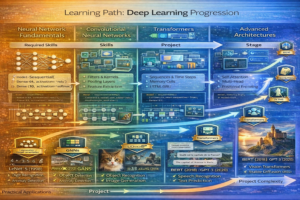
Learning Path: Deep Learning Progression
Duration: 10-12 weeks | Weekly Commitment: 20-25 hours | Prerequisites: Python for AI/ML path or equivalent
Path Overview
Master neural networks from fundamentals to state-of-the-art architectures. This path covers the mathematical foundations, implementation techniques, and practical applications.
Phase 1: Neural Network Fundamentals (Weeks 1-2)
Module 1.1: What are Neural Networks?
- The neuron model and biological inspiration
- Forward propagation (input → output)
- Activation functions (sigmoid, ReLU, tanh)
- Network architecture (layers, neurons)
- Why deep learning works
Module 1.2: Training Neural Networks
- Loss functions (MSE, cross-entropy)
- Gradient descent algorithm
- Backpropagation (chain rule in action)
- Understanding learning rates
- Optimization algorithms (SGD, Adam)
Practice: Implement backpropagation from scratch in NumPy
Phase 2: Deep Learning with TensorFlow/Keras (Weeks 3-5)
Module 2.1: Building Your First Neural Network
- Setting up TensorFlow/Keras environment
- Creating simple neural networks
- Compiling and training models
- Evaluating model performance
- Making predictions on new data
Module 2.2: Handling Real Data
- Data preprocessing and normalization
- Dealing with overfitting (regularization)
- Using validation sets properly
- Early stopping to prevent overfitting
- Dropout and other regularization techniques
Module 2.3: Understanding Layers
- Dense layers (fully connected)
- Different layer types and when to use them
- Batch normalization
- Architecture best practices
Practice Project: Build a classifier for MNIST dataset
Phase 3: Convolutional Neural Networks (Weeks 6-7)
Module 3.1: Convolutions for Images
- How convolution works (visual understanding)
- Filters and feature maps
- Pooling operations
- Building convolutional layers
Module 3.2: Building CNN Models
- Creating CNN architectures
- Classic architectures (LeNet, AlexNet, VGG)
- Transfer learning (using pre-trained models)
- Fine-tuning pre-trained models
Project: Build Image Recognition with CNN project
Phase 4: Recurrent Neural Networks (Weeks 8-9)
Module 4.1: Sequence Modeling
- Why RNNs for sequences (text, time series)
- The RNN architecture
- Vanishing gradient problem
- LSTM (Long Short-Term Memory)
- GRU (Gated Recurrent Unit)
Module 4.2: Applications
- Sequence-to-sequence models
- Machine translation basics
- Text generation
- Time series prediction
Project: Complete Stock Prediction with LSTM project
Phase 5: Modern Architectures & Applications (Weeks 10-12)
Module 5.1: Attention & transformers
- Attention mechanism
- The Transformer architecture
- BERT and other pre-trained transformers
- Using Hugging Face transformers
Module 5.2: Advanced Topics
- Generative models (VAE, GAN basics)
- Reinforcement learning introduction
- Model deployment and optimization
- Staying current with deep learning
Key Projects in This Path
- Week 2: Simple neural network from scratch
- Week 5: MNIST digit classification
- Week 7: Image recognition with CNN
- Week 9: Stock prediction with LSTM
- Week 12: Capstone project combining multiple architectures
Resources
- TensorFlow Official Tutorials
- Fast.ai Deep Learning Course
- Deep Learning Book (Goodfellow, Bengio, Courville)
- Hugging Face Transformers Library
Next Steps
- Specialize in a specific domain (NLP, Computer Vision, etc.)
- Learn AI Tools Mastery for production deployment
- Review AI Researcher career guide for research opportunities
Continue Learning: Related Articles
Create a Resume Parser with NLP: Complete Python Tutorial for Extracting Structured Data
Introduction to AI Resume Parsing
Resume parsing is a fundamental task in HR technology, powering applicant tracking sy…
📖 20 min read
Movie Recommendation System
Hands-On Project: Movie Recommendation System
Difficulty Level: Intermediate | Duration: 3-5 hours | Topics: Collaborati…
📖 7 min read
Structured Learning Paths for AI & ML
Structured Learning Paths for AI & ML
Complete progressions from beginner to advanced in different specializations
…
📖 2 min read
Enterprise AI Chatbot Implementation: Complete Guide to Deployment, Integration, and ROI Optimization
Enterprise AI chatbots handle 2.5 billion customer interactions monthly, reducing support costs by $11 billion annually …
📖 15 min read
💡 Explore 80+ AI implementation guides on Harshith.org
