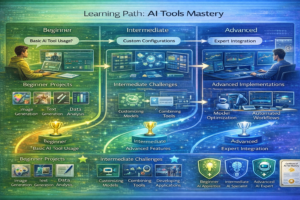
Learning Path: AI tools Mastery
Duration: 6-8 weeks | Weekly Commitment: 15-20 hours | Prerequisites: Basic Python knowledge and foundational ML concepts
Path Overview
Master the industry-standard tools and frameworks used in production AI/ML systems. This path focuses on practical application of TensorFlow, PyTorch, Scikit-learn, and Hugging Face.
Phase 1: TensorFlow & Keras Deep Dive (Weeks 1-2)
Module 1.1: TensorFlow Fundamentals
- TensorFlow architecture and computation graphs
- Tensors and tensor operations
- Eager execution vs graph mode
- tf.function for optimization
- Debugging and profiling TensorFlow code
Module 1.2: Advanced Keras
- Custom layers and models
- Custom training loops
- Callbacks for training control
- Model saving and loading
- Distributed training basics
Phase 2: PyTorch for Research & Production (Weeks 3-4)
Module 2.1: PyTorch Fundamentals
- PyTorch tensors and autograd
- Building models with nn.Module
- Training loops and loss functions
- Optimization with torch.optim
- PyTorch vs TensorFlow comparison
Module 2.2: Advanced PyTorch
- Custom layers and networks
- DataLoaders and data pipelines
- GPU training and mixed precision
- Model checkpointing and resuming
- Using torchvision for computer vision
Phase 3: Scikit-learn for Traditional ML (Week 5)
Topics:
- Machine learning fundamentals
- Classification models (SVM, Random Forest)
- Regression models (Linear, Ridge, Lasso)
- Clustering (K-means, hierarchical)
- Model evaluation and cross-validation
- Hyperparameter tuning (Grid Search, Random Search)
- Feature engineering and scaling
Phase 4: Hugging Face Transformers (Weeks 6-7)
Module 4.1: Getting Started with Transformers
- What are transformers and why they matter
- Using pre-trained models from Hugging Face
- Common NLP tasks (classification, summarization)
- Fine-tuning models for specific tasks
- Tokenization and preprocessing
Module 4.2: Building with Transformers
- The Transformers library architecture
- Using different model types (BERT, GPT, T5)
- Training custom models
- Deploying models for inference
- Working with datasets library
Phase 5: Production & Deployment (Week 8)
Topics:
- Model serialization and formats (SavedModel, ONNX)
- Serving models (TensorFlow Serving, TorchServe)
- Docker containerization
- Cloud deployment (AWS, GCP, Azure)
- Model monitoring and versioning
- Performance optimization (quantization, pruning)
Hands-On Projects
| Week | Tool/Framework | Project |
|---|---|---|
| 1-2 | TensorFlow/Keras | Build and deploy MNIST classifier |
| 3-4 | PyTorch | CNN for CIFAR-10 dataset |
| 5 | Scikit-learn | Customer churn prediction |
| 6-7 | Hugging Face | Fine-tune BERT for sentiment analysis |
| 8 | All tools | Deploy ML model as web service |
Tool Comparison & When to Use
TensorFlow
- Best for: Production ML systems, large-scale training
- Strength: Mature ecosystem, deployment tools
- Learning curve: Moderate
PyTorch
- Best for: Research, experimentation
- Strength: Intuitive API, easy debugging
- Learning curve: Easier than TensorFlow
Scikit-learn
- Best for: Traditional ML, quick prototyping
- Strength: Simple, consistent API
- Learning curve: Easiest
Hugging Face
- Best for: NLP tasks with transformers
- Strength: Pre-trained models, huge community
- Learning curve: Easy with good documentation
Resources
After This Path
- Specialize deep in your preferred framework
- Learn about deployment and MLOps
- Explore domain-specific applications
- Transition to industry roles (ML Engineer, Data Scientist)
Continue Learning: Related Articles
AI-Powered Sales Forecasting Software: ROI Analysis and Implementation Guide for B2B Companies
Sales forecasting has evolved from spreadsheet-based guesswork to precision AI-powered predictions that can increase rev…
📖 15 min read
Math Foundations for AI & Machine Learning
Math Foundations for AI & machine learning
Master the mathematical concepts essential for artificial intelligence an…
📖 4 min read
Create a Resume Parser with NLP: Complete Python Tutorial for Extracting Structured Data
Introduction to AI Resume Parsing
Resume parsing is a fundamental task in HR technology, powering applicant tracking sy…
📖 20 min read
Understanding Large Language Models: A Comprehensive Guide
What Are Large Language Models?
Large Language Models (LLMs) represent one of the most significant breakthroughs in art…
📖 10 min read
💡 Explore 80+ AI implementation guides on Harshith.org
