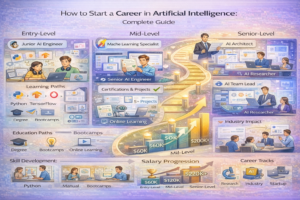
Introduction: The AI Career Revolution
The artificial intelligence industry is experiencing unprecedented growth, creating thousands of new job opportunities every month. Whether you’re a complete beginner looking to break into tech or an experienced professional considering a career transition, AI offers diverse pathways to rewarding careers. This comprehensive guide will walk you through everything you need to know about building a successful career in artificial intelligence in 2025 and beyond.
The AI job market has exploded in recent years, with companies across all industries seeking talented professionals who can help them leverage AI technologies. From healthcare to finance, retail to manufacturing, every sector is investing heavily in AI capabilities. This demand translates into competitive salaries, excellent benefits, and abundant opportunities for career growth and advancement.
Understanding the AI Career Landscape
The field of artificial intelligence encompasses numerous specialized roles, each requiring different skill sets and educational backgrounds. Understanding this landscape is crucial for making informed decisions about your career path.
Core AI Roles and Responsibilities
machine learning Engineers focus on designing, building, and deploying machine learning models that solve real-world problems. They work with large datasets, implement algorithms, and optimize model performance. A typical day might involve cleaning data, training neural networks, tuning hyperparameters, and deploying models to production environments. Machine learning engineers typically earn between $120,000 to $180,000 annually in the United States, with senior positions commanding even higher compensation.
Data Scientists combine statistical expertise with programming skills to extract insights from complex datasets. They perform exploratory data analysis, build predictive models, and communicate findings to stakeholders through visualizations and reports. Data scientists need strong mathematical foundations, programming proficiency in Python or R, and excellent communication skills to translate technical findings into business value. Entry-level data scientists typically start around $95,000, with experienced professionals earning $150,000 or more.
AI Research Scientists push the boundaries of what’s possible with artificial intelligence by developing new algorithms, architectures, and techniques. They work primarily in academia, research labs, or advanced R&D departments of major tech companies. Research scientists need PhDs in computer science, mathematics, or related fields, along with strong publication records. Compensation for research scientists at top companies can exceed $200,000, with senior researchers and research directors earning significantly more.
AI Product Managers bridge the gap between technical teams and business stakeholders. They define product vision, prioritize features, and ensure AI solutions deliver real business value. Product managers need technical understanding of AI capabilities and limitations, combined with strong business acumen and communication skills. AI product managers typically earn $130,000 to $200,000, depending on experience and company size.
AI Ethics Specialists ensure AI systems are developed and deployed responsibly, addressing concerns about bias, fairness, privacy, and societal impact. This emerging role requires interdisciplinary knowledge spanning technology, philosophy, law, and social sciences. As companies face increasing scrutiny about AI ethics, demand for these specialists is growing rapidly.
Essential Skills for AI Careers
Success in AI careers requires a combination of technical skills, domain knowledge, and soft skills. Let’s explore each category in detail.
Technical Foundations
Programming Proficiency: Python is the dominant language in AI, used for everything from data preprocessing to model deployment. You should be comfortable with core Python concepts, object-oriented programming, and key libraries like NumPy, Pandas, and Scikit-learn. Additionally, familiarity with SQL for database queries, Git for version control, and cloud platforms like AWS or Google Cloud is increasingly important.
Mathematics and Statistics: Linear algebra forms the foundation of machine learning algorithms, enabling you to understand how neural networks process information and how optimization algorithms work. Calculus helps you grasp gradient descent and backpropagation, core concepts in training neural networks. Probability and statistics are essential for understanding model evaluation, hypothesis testing, and uncertainty quantification. You don’t need to be a mathematician, but solid understanding of these fundamentals is crucial.
Machine Learning Fundamentals: Understanding supervised learning (regression, classification), unsupervised learning (clustering, dimensionality reduction), and reinforcement learning concepts is essential. You should know when to apply different algorithms, how to evaluate model performance, and how to avoid common pitfalls like overfitting. Practical experience implementing algorithms from scratch helps build deep understanding.
Deep Learning and Neural Networks: Modern AI heavily relies on deep learning. Familiarity with frameworks like TensorFlow, PyTorch, or Keras is essential. Understanding different architectures—convolutional neural networks for computer vision, recurrent networks for sequential data, transformers for NLP—enables you to choose appropriate tools for different problems.
Domain Knowledge and Specialization
While technical skills are crucial, domain expertise significantly enhances your value. A machine learning engineer working in healthcare needs understanding of medical terminology, regulatory requirements, and clinical workflows. Similarly, AI professionals in finance must grasp financial instruments, risk management, and regulatory compliance.
Specializing in specific AI applications also differentiates you in the job market. Natural language processing experts work on chatbots, translation systems, and content generation. Computer vision specialists develop facial recognition, autonomous driving systems, and medical image analysis tools. Speech recognition experts build voice assistants and transcription services. Choosing a specialization based on your interests and market demand can accelerate your career growth.
Soft Skills and Professional Competencies
Technical expertise alone isn’t sufficient for career success. Communication skills enable you to explain complex AI concepts to non-technical stakeholders, write clear documentation, and present findings effectively. Problem-solving abilities help you break down complex challenges into manageable components and develop creative solutions.
Collaboration skills are essential since AI projects typically involve cross-functional teams including data engineers, software developers, product managers, and domain experts. Business acumen helps you understand how AI projects contribute to organizational goals and prioritize work that delivers maximum value.
Continuous learning is perhaps the most important soft skill in AI, given how rapidly the field evolves. New techniques, tools, and best practices emerge constantly. Successful AI professionals dedicate time regularly to learning through online courses, research papers, conferences, and hands-on experimentation.
Educational Pathways and Certifications
Traditional Academic Routes
Bachelor’s Degrees: Computer Science, Data Science, Mathematics, or Statistics degrees provide excellent foundations for AI careers. Many universities now offer specialized AI or Machine Learning undergraduate programs. A bachelor’s degree is typically sufficient for entry-level machine learning engineer or data scientist positions.
Master’s Degrees: Graduate programs in AI, Machine Learning, or Data Science offer deeper specialization and research opportunities. They’re valuable for advancing to senior technical roles or transitioning from other fields. One-year intensive programs and two-year research-focused programs both exist, catering to different career goals.
PhD Programs: Doctoral degrees are typically necessary for research scientist positions or academic careers. PhD students conduct original research, publish papers, and develop expertise in specific AI subfields. While PhDs require significant time investment (4-6 years), they open doors to cutting-edge research opportunities and leadership positions.
Alternative Learning Paths
Not everyone can or wants to pursue traditional degrees. Fortunately, numerous alternative pathways exist for breaking into AI.
Online Courses and Specializations: Platforms like Coursera, edX, and Udacity offer comprehensive AI courses taught by professors from top universities and industry experts. The Deep Learning Specialization by Andrew Ng, Fast.ai’s Practical Deep Learning course, and Google’s Machine Learning Crash Course are excellent starting points. These courses are self-paced, affordable, and provide practical, hands-on experience.
Bootcamps: Intensive coding bootcamps offer accelerated paths into data science and machine learning careers. Programs like Metis, General Assembly, and DataCamp provide structured curricula, mentorship, and career support. Bootcamps typically last 12-16 weeks and cost $10,000-$20,000, positioning graduates for entry-level positions.
Professional Certifications: Industry certifications validate your skills and enhance credibility. Popular certifications include Google’s TensorFlow Developer Certificate, AWS Certified Machine Learning Specialty, and Microsoft Certified: Azure AI Engineer Associate. While certifications alone won’t land you a job, they strengthen your resume and demonstrate commitment to professional development.
Building Your Portfolio and Gaining Experience
Practical experience is often more valuable than credentials alone. Building a strong portfolio showcases your abilities to potential employers and provides concrete examples of your work.
Personal Projects
Start with projects that interest you and align with your career goals. Build a sentiment analysis tool for analyzing Twitter data, create a recommendation system for movies or music, or develop a computer vision application for object detection. Document your process, explaining your approach, challenges encountered, and solutions implemented. Host projects on GitHub with clear README files, well-commented code, and example outputs.
Quality matters more than quantity. Two or three well-executed, thoroughly documented projects impress recruiters more than ten half-finished experiments. Choose projects that demonstrate different skills—one might showcase deep learning expertise, another might highlight data engineering capabilities, and a third might demonstrate end-to-end deployment skills.
Kaggle Competitions
Kaggle provides excellent opportunities to practice machine learning on real-world datasets while competing with data scientists worldwide. Competitions range from beginner-friendly challenges to complex problems offering substantial prize money. Participating builds practical skills, exposes you to diverse problem types, and allows you to learn from top performers’ solutions. Strong Kaggle rankings can significantly boost your job applications.
Open Source Contributions
Contributing to open-source AI projects demonstrates collaboration skills and commitment to the community. Start by fixing bugs, improving documentation, or adding small features to established projects like Scikit-learn, TensorFlow, or PyTorch. As you gain confidence, tackle more substantial contributions. Open source contributions also help you learn from experienced developers and build your professional network.
Internships and Entry-Level Positions
Internships provide invaluable real-world experience and often lead to full-time offers. Many companies offer AI internships for students and recent graduates. Even if you’re transitioning from another field, consider junior positions or internships to gain experience. The experience and connections you build often matter more than the initial salary.
Job Search Strategies and Interview Preparation
Crafting Your Resume and Online Presence
Your resume should highlight relevant skills, projects, and experiences concisely. Quantify achievements where possible—”improved model accuracy by 15%” or “reduced processing time by 40%.” Tailor your resume for each application, emphasizing skills and experiences most relevant to the specific role.
Build a strong LinkedIn profile showcasing your skills, projects, and professional interests. Share AI-related articles, comment on industry trends, and engage with the community. Many recruiters actively search LinkedIn for candidates, so an optimized profile increases visibility.
Create a personal website or portfolio showcasing your best projects with detailed explanations, code samples, and results. A professional online presence differentiates you from candidates with similar credentials.
Networking and Building Connections
Networking often proves more effective than cold applications. Attend AI meetups, conferences, and workshops to meet professionals in your area. Join online communities like Reddit’s r/MachineLearning, AI-focused Discord servers, or LinkedIn groups. Engage genuinely—ask thoughtful questions, share insights, and offer help to others. Many jobs are filled through referrals before public posting, making connections invaluable.
Interview Preparation
AI interviews typically include multiple components. Technical screenings assess programming skills through coding challenges similar to general software engineering interviews. Machine learning interviews test your understanding of algorithms, model evaluation, and practical considerations. You might be asked to explain how you’d approach specific problems, discuss trade-offs between different algorithms, or walk through projects from your portfolio.
Expect behavioral interviews focusing on teamwork, problem-solving, and communication. Prepare stories illustrating your skills using the STAR method (Situation, Task, Action, Result). Some companies include take-home assignments where you build models or analyze datasets, demonstrating your practical abilities.
Practice coding interviews on platforms like LeetCode and HackerRank. Review machine learning fundamentals, focusing on intuitions and trade-offs rather than memorizing formulas. Mock interviews with peers or mentors help build confidence and identify areas for improvement.
Career Growth and Long-Term Success
Once you’ve landed your first AI position, focus on continuous growth and development. Seek challenging projects that stretch your abilities. Learn from senior colleagues, ask questions, and request feedback on your work. Consider pursuing specializations that align with your interests and market demand.
Stay current with industry developments by reading research papers, attending conferences, and participating in online courses. The AI field evolves rapidly, and continuous learning is essential for long-term success. Consider contributing to research through blog posts, papers, or open-source projects.
As you gain experience, explore leadership opportunities. Technical leadership involves mentoring junior engineers, designing system architectures, and setting technical direction. Management paths involve leading teams, defining strategy, and driving organizational change. Both tracks offer rewarding career progression.
Conclusion: Your AI Career Journey Starts Today
Building a career in artificial intelligence requires dedication, continuous learning, and practical experience. Whether you’re starting with online courses, pursuing a degree, or transitioning from another field, opportunities abound for motivated individuals. The key is starting now—choose a learning path, build projects, and engage with the AI community. Your future in artificial intelligence begins with the first step you take today.
The AI revolution is just beginning, and demand for skilled professionals will continue growing for years to come. By developing strong technical foundations, building a compelling portfolio, and continuously updating your skills, you position yourself for a rewarding, impactful career at the forefront of technological innovation.
Continue Learning: Related Articles
AI Image Generators Compared: DALL-E 3 vs Midjourney vs Stable Diffusion
The AI Art Revolution
AI image generation has exploded into the mainstream, with tools capable of creating stunning art…
📖 6 min read
Best AI Writing Tools Compared: Jasper vs Copy.ai vs Writesonic vs Rytr
The AI Writing Revolution
AI writing tools have transformed content creation, enabling marketers, entrepreneurs, and wr…
📖 6 min read
Generative AI for Creative Industries: Transforming Art, Music, and Design
The Creative Revolution: How Generative AI is Transforming Art, Music, and Design
Generative AI has emerged as one of t…
📖 10 min read
AI Content Creation Tools for Bloggers: Comparison and ROI Analysis
Introduction to AI Content Creation for Bloggers
The content creation landscape has been transformed by artificial inte…
📖 13 min read
💡 Explore 80+ AI implementation guides on Harshith.org
