Introduction to No-Code AI Chatbots
AI chatbots have revolutionized customer service, enabling businesses to provide 24/7 support, instantly resolve common inquiries, and dramatically reduce support costs. In 2026, sophisticated no-code platforms have made chatbot development accessible to anyone, regardless of technical background. This comprehensive guide walks you through building effective AI chatbots without writing a single line of code, complete with platform comparisons, implementation strategies, and ROI calculations.
Why AI Chatbots Are Essential for Customer Service
The Business Case for Chatbots
Customer expectations have fundamentally changed. Studies show 64% of customers expect instant responses to inquiries, and 73% prefer self-service options for simple questions. AI chatbots deliver on these expectations while reducing costs by 30-70% compared to traditional support teams.
The average customer service representative costs 5,000-5,000 annually and handles 30-50 tickets daily. An AI chatbot can manage hundreds of simultaneous conversations at 0-00 monthly, delivering ROI of 1,000-5,000% within the first year.
What AI Chatbots Handle Best
Modern AI chatbots excel at frequently asked questions (hours, policies, pricing), order status and tracking inquiries, appointment scheduling and calendar management, product recommendations based on customer needs, lead qualification and initial sales conversations, and password resets and account management. They successfully resolve 60-80% of common inquiries without human intervention, freeing support teams for complex issues requiring empathy and judgment.
Top No-Code AI Chatbot Platforms
Tidio – Best All-Around No-Code Solution
Tidio has emerged as the leading no-code chatbot platform, combining ease of use with powerful AI capabilities and native live chat integration.
Pricing starts with a free plan (50 conversations monthly, basic chatbots, live chat), Communicator at 9/month (100 conversations, advanced automation, multiple operators), Chatbots at 9/month (unlimited chatbots, AI responses, advanced triggers), and Tidio+ at 94/month (combining all features with 2,000 conversations and priority support).
Key features include drag-and-drop visual chatbot builder, AI-powered natural language understanding, seamless handoff to human agents, integration with Shopify, WordPress, Wix, and 20+ platforms, mobile app for managing conversations, and pre-built templates for common use cases.
ROI Analysis: Resolving just 100 customer inquiries monthly saves approximately 25 support hours at 5/hour (25 monthly, ,500 annually) against 48 annual cost for the Chatbots plan—a 2,057% ROI.
Best for: E-commerce stores, small to medium businesses, companies wanting combined chatbot and live chat, and teams new to chatbot implementation.
ManyChat – Best for Marketing and Lead Generation
ManyChat specializes in conversational marketing through Instagram, Facebook Messenger, WhatsApp, and SMS, making it ideal for businesses prioritizing lead generation and sales.
Pricing includes a free plan (1,000 contacts, basic automation), Pro at 5/month (unlimited contacts, advanced automation, growth tools), and Elite with custom pricing (dedicated support, priority review, unlimited seats).
Key features include visual flow builder with templates, multi-channel messaging (Instagram, Facebook, WhatsApp, SMS, email), advanced segmentation and targeting, e-commerce integrations and payment processing, growth tools (landing pages, pop-ups, QR codes), and detailed analytics and conversion tracking.
ROI Analysis: Capturing and nurturing just 50 additional leads monthly with 10% conversion at 00 customer value generates ,500 monthly revenue (0,000 annually) versus 80 annual cost—a 16,567% ROI.
Best for: E-commerce businesses, social media-focused companies, marketing agencies, and businesses prioritizing lead generation over support.
Intercom – Best for Growing SaaS Companies
Intercom provides enterprise-grade customer communication with sophisticated AI chatbot capabilities, targeting growing technology companies.
Pricing starts at 4/month for Starter (basic messenger, 1 seat, 100 people reached), 95/month for Pro (automation, reporting, 5 seats, 2,000 people reached), and custom Premium pricing (advanced features, dedicated support, enterprise volume).
Key features include AI-powered answer bot with machine learning, resolution bot for common tasks, custom bot workflows without coding, full customer data platform integration, advanced reporting and analytics, mobile SDK for in-app messaging, and sophisticated team routing and assignment.
ROI Analysis: For SaaS companies, reducing support response time and improving resolution rates directly impacts churn. Reducing churn by just 2% for a company with 500 customers at 00 monthly MRR retains 20,000 in annual recurring revenue versus ,740 annual cost—a 2,431% ROI.
Best for: SaaS companies, mobile app businesses, companies with complex products requiring extensive support, and teams prioritizing customer data integration.
Landbot – Best for Conversational Landing Pages
Landbot focuses on conversational experiences for websites and landing pages, replacing traditional forms with engaging chatbot interactions.
Pricing includes Sandbox (free testing), Starter at 0/month (1,000 chats, basic integrations, webhooks), Pro at 00/month (3,000 chats, advanced features, A/B testing), and Business at 00/month (10,000 chats, custom branding, dedicated support).
Key features include visual no-code builder for conversational flows, WhatsApp, web, and Facebook integration, conditional logic and branching, native integrations (HubSpot, Salesforce, Mailchimp, Google Sheets), embed anywhere or dedicated landing pages, and detailed conversion analytics.
ROI Analysis: Conversational forms typically improve conversion rates by 20-40% compared to traditional forms. A landing page with 5,000 monthly visitors at 2% conversion (100 conversions) improved to 3% (150 conversions) generates 50 additional conversions monthly. At 00 customer value, that’s 20,000 additional annual revenue versus ,200 annual cost—a 9,900% ROI.
Best for: Marketing teams, companies with high-traffic landing pages, lead generation focused businesses, and agencies building client chatbots.
Chatfuel – Best for Facebook and Instagram
Chatfuel specializes in chatbots for Facebook Messenger and Instagram, offering deep platform integration and marketing automation.
Pricing includes a free plan (50 conversations monthly), Pro at 4.99/month (unlimited conversations, advanced features, integrations), and Premium at 9.99/month (priority support, dedicated account manager, advanced analytics).
Key features include no-code visual builder, AI-powered NLP engine, Facebook and Instagram deep integration, e-commerce features and payment processing, audience segmentation and broadcasting, and growth tools for viral expansion.
ROI Analysis: For businesses with strong Facebook/Instagram presence, Chatfuel can automate sales conversations. Converting 30 additional sales monthly at 50 average order value generates 4,000 annually versus 60 annual cost—a 14,900% ROI.
Best for: E-commerce with strong social presence, social media marketing agencies, businesses targeting Facebook/Instagram audiences, and companies wanting viral growth features.
Step-by-Step Implementation Guide
Step 1: Define Your Chatbot Objectives
Start with clear, measurable goals. Common objectives include reducing support ticket volume by 40-60%, decreasing average response time to under 1 minute, qualifying 100+ leads monthly, increasing conversion rates by 15-30%, and maintaining customer satisfaction scores above 85%.
Identify your top 20-30 frequently asked questions through support ticket analysis, customer service team interviews, and website analytics review. These form your chatbot’s initial knowledge base.
Step 2: Choose Your Platform
Select based on your primary use case. For customer support with live chat backup, choose Tidio or Intercom. For marketing and lead generation, select ManyChat or Chatfuel. For conversational landing pages, use Landbot. For multi-channel enterprise support, choose Intercom.
Most platforms offer free trials—test 2-3 options with sample conversations before committing.
Step 3: Design Conversation Flows
Map out conversation paths for each major intent using flowcharts. A typical support flow includes greeting and intent identification, clarifying questions if needed, information delivery or action execution, satisfaction confirmation, and handoff to human if unresolved.
Best practices include keeping initial questions simple and clear, offering multiple choice options when possible to reduce errors, building in fallback responses for unrecognized inputs, maintaining conversational, brand-appropriate tone, and limiting responses to 2-3 sentences for readability.
Step 4: Build Your Chatbot (No Coding Required)
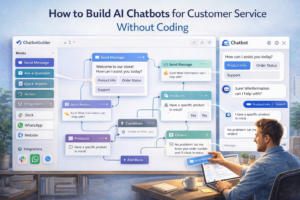
All modern platforms use visual drag-and-drop builders. The typical process involves starting with pre-built template matching your use case, customizing greeting and initial questions, creating conversation branches using conditional logic, adding response variations for common questions, setting up integration with your CRM, email, or other tools, configuring handoff rules to human agents, and testing thoroughly with real questions.
Budget 8-16 hours for initial build of a comprehensive chatbot covering 20-30 common inquiries.
Step 5: Integrate with Existing Tools
Connect your chatbot to your existing business systems for maximum effectiveness. Common integrations include CRM (Salesforce, HubSpot, Pipedrive) for lead capture, email marketing (Mailchimp, ActiveCampaign) for list building, help desk software (Zendesk, Freshdesk) for ticket creation, calendar tools (Calendly, Acuity) for appointment scheduling, e-commerce platforms (Shopify, WooCommerce) for order information, and analytics (Google Analytics, Mixpanel) for tracking.
Most platforms offer native integrations or Zapier/Make.com connectivity for hundreds of tools.
Step 6: Train Your AI
Modern AI chatbots learn from interactions, but initial training accelerates accuracy. Provide 10-20 variations of how customers might ask each question, review AI confidence scores for responses, manually tag misclassified intents, and update responses based on customer feedback.
Plan to actively train your chatbot for the first 30 days, then move to weekly review and optimization.
Step 7: Test Thoroughly Before Launch
Test every possible conversation path including happy paths (everything works perfectly), edge cases (unusual but valid questions), error cases (nonsense input, profanity), and handoff scenarios. Have team members who didn’t build the chatbot test it fresh and gather feedback on clarity and helpfulness.
Step 8: Launch and Monitor
Start with a soft launch to 10-20% of traffic, monitor conversations daily for first week, quickly fix any problematic responses or flows, and gradually increase traffic as confidence grows.
Key metrics to track include conversation volume, resolution rate (percentage resolved without human), average conversation length, customer satisfaction ratings, containment rate (percentage of conversations not escalated), and conversion rate for sales/lead chatbots.
Optimization Strategies for Maximum ROI
Continuous Improvement
Review chatbot conversations weekly focusing on failed resolutions, review AI confidence scores and retrain on low-confidence responses, add new intents based on common unrecognized questions, optimize conversation flows based on drop-off points, and A/B test different greeting messages, response styles, and call-to-actions.
Personalization
Increase engagement with personalized experiences using customer name in conversations, referencing previous interactions or purchase history, tailoring product recommendations to customer behavior, adjusting tone based on customer segment, and using dynamic content based on traffic source or campaign.
Personalized chatbots see 25-40% higher engagement and conversion rates.
Proactive Engagement
Don’t wait for customers to initiate—trigger conversations based on behavior. Examples include triggering after 30 seconds on pricing page to answer questions, offering help when cart abandonment is detected, reaching out to users who viewed product 3+ times, and welcoming returning visitors with personalized message.
Proactive chatbots generate 2-4x more conversations than reactive only.
Multi-Language Support
Many platforms offer automatic translation capabilities. For global businesses, add support for your top 3-5 customer languages. This expands addressable market and improves customer experience for non-English speakers.
Common Mistakes to Avoid
Don’t make your chatbot too complex initially—start with 15-20 core functions and expand. Avoid pretending to be human when you’re clearly a bot; transparency builds trust. Don’t make handoff to humans difficult; always offer clear escape path. Never launch without testing all conversation paths thoroughly. Don’t ignore chatbot analytics; regular review drives continuous improvement. And avoid generic, robotic responses; maintain brand voice and personality.
Measuring Success and ROI
Support Cost Reduction
Calculate tickets resolved by chatbot × average handling time × hourly support cost. Example: 500 monthly tickets × 15 minutes × 5/hour = ,125 monthly savings (7,500 annually).
Increased Conversions
Track conversion rate before and after chatbot implementation. Even 0.5% improvement on 10,000 monthly visitors with 50 average order value generates ,500 additional monthly revenue (0,000 annually).
Lead Generation Value
Calculate leads captured × conversion rate × customer value. Example: 100 monthly leads × 15% conversion × 00 customer value = 2,000 monthly (44,000 annually).
Customer Satisfaction Impact
Monitor CSAT scores for chatbot interactions. Top-performing chatbots maintain 80-90% satisfaction ratings, comparable to human agents for routine inquiries.
Advanced Techniques
Once your basic chatbot is performing well, explore advanced features like sentiment analysis to detect frustrated customers and prioritize human handoff, intent prediction to proactively address likely next questions, voice and video chat capabilities, rich media responses with images, GIFs, and videos, and AI-powered product recommendations based on conversation context.
Continue Learning: Related Articles
Build an AI Content Moderator: Complete Python Tutorial for Text and Image Moderation
Introduction to AI Content Moderation
Content moderation is one of the most critical applications of AI in the modern i…
📖 11 min read
The ChatGPT Phenomenon and the Rise of Large Language Models
In November 2022, OpenAI released ChatGPT, sparking an AI revolution that captured global attention. Within five days, i…
📖 5 min read
Autonomous Agents: Building Self-Learning Systems That Make Independent Decisions
Autonomous Agents: Building Self-Learning AI Systems That Make Independent Decisions
Artificial intelligence has evolve…
📖 5 min read
Build a Document Q&A System with RAG: Complete Python Tutorial
Introduction to RAG-Based Document Q&A
Retrieval-Augmented Generation (RAG) has revolutionized how we interact with doc…
📖 17 min read
💡 Explore 80+ AI implementation guides on Harshith.org
Conclusion
Building effective AI chatbots no longer requires coding expertise or massive budgets. Modern no-code platforms like Tidio, ManyChat, Intercom, and Landbot enable anyone to create sophisticated conversational experiences in hours, not months. With most businesses seeing ROI of 1,000-10,000% within the first year through reduced support costs and increased conversions, chatbots represent one of the highest-value technology investments available. Start with a clear objective, choose the right platform for your use case, thoroughly test your implementation, and continuously optimize based on real conversation data. Your customers expect instant, 24/7 support—AI chatbots deliver that experience while dramatically improving your bottom line.
