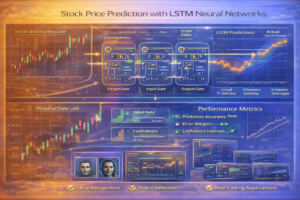
Hands-On Project: Stock Price Prediction with LSTM Neural Networks
Difficulty Level: Intermediate | Duration: 4-6 hours | Topics: deep learning, Time Series, Neural Networks
Learning Objectives
- Understand time series data and its characteristics
- Learn how LSTM (Long Short-Term Memory) networks work
- Build and train a neural network for stock prediction
- Evaluate model performance and make predictions
- Deploy the model for real-world use
Prerequisites
- Python 3.8 or higher
- Basic understanding of neural networks
- Familiarity with Pandas and NumPy
- Jupyter Notebook or Google Colab
Step 1: Setup & Installation
1.1 Create a Python Virtual Environment
# Create virtual environment
python -m venv stock-prediction
source stock-prediction/bin/activate  # On Windows: stock-predictionScriptsactivate

# Install required packages
pip install numpy pandas scikit-learn tensorflow keras matplotlib yfinance
1.2 Import Libraries
import numpy as np
import pandas as pd
import matplotlib.pyplot as plt
from sklearn.preprocessing import MinMaxScaler
from sklearn.metrics import mean_squared_error, mean_absolute_error
import tensorflow as tf
from tensorflow import keras
from tensorflow.keras.layers import Dense, LSTM, Dropout
from tensorflow.keras.models import Sequential
import yfinance as yf
import warnings
warnings.filterwarnings('ignore')

# Display settings
plt.style.use('seaborn-v0_8-darkgrid')
pd.set_option('display.max_columns', None)
Step 2: Data Collection & Preparation
2.1 Download Stock Data
# Download historical stock data (e.g., Apple stock)
ticker = "AAPL"
start_date = "2020-01-01"
end_date = "2024-11-19"

# Fetch data from Yahoo Finance
data = yf.download(ticker, start=start_date, end=end_date)
print(f"Data shape: {data.shape}")
print(f"nFirst few rows:n{data.head()}")
print(f"nData info:n{data.info()}")
2.2 Prepare Features & Scale Data
# Use only closing price
close_price = data['Close'].values.reshape(-1, 1)

# Normalize the data to range [0, 1]
scaler = MinMaxScaler(feature_range=(0, 1))
scaled_data = scaler.fit_transform(close_price)

# Visualize original vs scaled data
plt.figure(figsize=(14, 5))
plt.subplot(1, 2, 1)
plt.plot(close_price)
plt.title('Original Stock Price')
plt.xlabel('Days')
plt.ylabel('Price ($)')

plt.subplot(1, 2, 2)
plt.plot(scaled_data)
plt.title('Normalized Stock Price')
plt.xlabel('Days')
plt.ylabel('Normalized Value')
plt.tight_layout()
plt.show()
2.3 Create Training & Testing Sets
# Split data: 80% train, 20% test
train_size = int(len(scaled_data) * 0.8)
train_data = scaled_data[:train_size]
test_data = scaled_data[train_size:]

print(f"Train size: {train_size}, Test size: {len(test_data)}")

# Create sequences for LSTM
def create_sequences(data, lookback=60):
    X, y = [], []
    for i in range(lookback, len(data)):
        X.append(data[i-lookback:i, 0])
        y.append(data[i, 0])
    return np.array(X), np.array(y)

lookback = 60  # Use last 60 days to predict next day
X_train, y_train = create_sequences(train_data, lookback)
X_test, y_test = create_sequences(test_data, lookback)

print(f"X_train shape: {X_train.shape}, y_train shape: {y_train.shape}")
print(f"X_test shape: {X_test.shape}, y_test shape: {y_test.shape}")

# Reshape for LSTM [samples, timesteps, features]
X_train = X_train.reshape((X_train.shape[0], X_train.shape[1], 1))
X_test = X_test.reshape((X_test.shape[0], X_test.shape[1], 1))
Step 3: Build & Train LSTM Model
3.1 Create LSTM Model Architecture
# Build LSTM model
model = Sequential([
    LSTM(units=50, activation='relu', input_shape=(lookback, 1), return_sequences=True),
    Dropout(0.2),

    LSTM(units=50, activation='relu', return_sequences=True),
    Dropout(0.2),

    LSTM(units=25, activation='relu'),
    Dropout(0.2),

    Dense(units=1)
])

# Compile model
model.compile(optimizer='adam', loss='mean_squared_error', metrics=['mae'])

# Print model summary
print(model.summary())
3.2 Train the Model
# Train the model
history = model.fit(
    X_train, y_train,
    epochs=50,
    batch_size=32,
    validation_split=0.2,
    verbose=1
)

# Plot training history
plt.figure(figsize=(14, 5))
plt.subplot(1, 2, 1)
plt.plot(history.history['loss'], label='Training Loss')
plt.plot(history.history['val_loss'], label='Validation Loss')
plt.title('Model Loss Over Epochs')
plt.xlabel('Epoch')
plt.ylabel('Loss (MSE)')
plt.legend()
plt.grid(True)

plt.subplot(1, 2, 2)
plt.plot(history.history['mae'], label='Training MAE')
plt.plot(history.history['val_mae'], label='Validation MAE')
plt.title('Model MAE Over Epochs')
plt.xlabel('Epoch')
plt.ylabel('MAE')
plt.legend()
plt.grid(True)
plt.tight_layout()
plt.show()
Step 4: Evaluate Model Performance
4.1 Make Predictions
# Make predictions on test data
train_predictions = model.predict(X_train)
test_predictions = model.predict(X_test)

# Inverse transform to get actual prices
train_predictions = scaler.inverse_transform(train_predictions)
y_train_actual = scaler.inverse_transform(y_train.reshape(-1, 1))

test_predictions = scaler.inverse_transform(test_predictions)
y_test_actual = scaler.inverse_transform(y_test.reshape(-1, 1))
4.2 Calculate Metrics
# Calculate performance metrics
train_rmse = np.sqrt(mean_squared_error(y_train_actual, train_predictions))
train_mae = mean_absolute_error(y_train_actual, train_predictions)

test_rmse = np.sqrt(mean_squared_error(y_test_actual, test_predictions))
test_mae = mean_absolute_error(y_test_actual, test_predictions)

print("Model Performance Metrics:")
print("=" * 40)
print(f"Training RMSE: ${train_rmse:.2f}")
print(f"Training MAE: ${train_mae:.2f}")
print(f"Testing RMSE: ${test_rmse:.2f}")
print(f"Testing MAE: ${test_mae:.2f}")
4.3 Visualize Predictions
# Prepare data for visualization
# Need to add lookback-sized padding to training predictions
full_predictions = np.empty_like(scaled_data)
full_predictions[lookback:lookback+len(train_predictions)] = train_predictions
full_predictions[lookback+len(train_predictions):] = test_predictions
full_predictions[:lookback] = np.nan

# Inverse transform for visualization
full_predictions_price = scaler.inverse_transform(full_predictions)

# Plot actual vs predicted
plt.figure(figsize=(16, 6))
plt.plot(close_price, label='Actual Price', linewidth=2)
plt.plot(full_predictions_price, label='LSTM Predictions', linewidth=2, alpha=0.7)
plt.axvline(x=train_size+lookback, color='red', linestyle='--', label='Train/Test Split')
plt.title(f'{ticker} Stock Price Prediction using LSTM', fontsize=14, fontweight='bold')
plt.xlabel('Days')
plt.ylabel('Price ($)')
plt.legend()
plt.grid(True, alpha=0.3)
plt.tight_layout()
plt.show()

# Zoom in on test period
plt.figure(figsize=(14, 6))
test_start = train_size + lookback
plt.plot(range(test_start, len(close_price)), y_test_actual, label='Actual Price', marker='o')
plt.plot(range(test_start, len(close_price)), test_predictions, label='Predicted Price', marker='s')
plt.title(f'{ticker} Stock Price - Test Period Detail', fontsize=14, fontweight='bold')
plt.xlabel('Days')
plt.ylabel('Price ($)')
plt.legend()
plt.grid(True, alpha=0.3)
plt.tight_layout()
plt.show()
Step 5: Make Future Predictions
5.1 Predict Next 30 Days
# Prepare data for future predictions
last_sequence = scaled_data[-lookback:].reshape(1, lookback, 1)

# Generate predictions for next 30 days
future_days = 30
future_predictions = []

current_sequence = last_sequence

for _ in range(future_days):
    next_pred = model.predict(current_sequence, verbose=0)
    future_predictions.append(next_pred[0, 0])

    # Update sequence with new prediction
    current_sequence = np.append(current_sequence[:, 1:, :],
                                 next_pred.reshape(1, 1, 1), axis=1)

# Inverse transform predictions
future_predictions = np.array(future_predictions).reshape(-1, 1)
future_predictions = scaler.inverse_transform(future_predictions)

# Create dates for future predictions
from datetime import datetime, timedelta
last_date = data.index[-1]
future_dates = [last_date + timedelta(days=i+1) for i in range(future_days)]

print("nNext 30 Days Price Predictions:")
print("=" * 40)
for date, pred in zip(future_dates, future_predictions):
    print(f"{date.strftime('%Y-%m-%d')}: ${pred[0]:.2f}")
Step 6: Save & Deploy Model
6.1 Save the Model
# Save the trained model
model.save('stock_prediction_lstm.h5')

# Also save as SavedModel format (newer)
model.save('stock_prediction_lstm_model/')

# Save the scaler
import pickle
with open('scaler.pkl', 'wb') as f:
    pickle.dump(scaler, f)

print("Model and scaler saved successfully!")
6.2 Load and Use Saved Model
# Load the saved model
loaded_model = keras.models.load_model('stock_prediction_lstm.h5')

# Load the saved scaler
import pickle
with open('scaler.pkl', 'rb') as f:
    loaded_scaler = pickle.load(f)

# Make predictions with loaded model
predictions = loaded_model.predict(X_test)
print("Predictions made with loaded model!")
Learning Resources
Key Concepts
- LSTM (Long Short-Term Memory): A type of RNN that can remember long-term dependencies
- Time Series: Data points ordered by time, used for forecasting
- MinMax Scaling: Normalizes data to a range [0, 1] for better neural network performance
- Dropout: Regularization technique to prevent overfitting
- RMSE & MAE: Metrics for evaluating regression model accuracy
Project GitHub Repository
Find similar projects on GitHub
Additional Resources
- TensorFlow Time Series Tutorial
- Understanding LSTM Networks
- Pandas Documentation
- Scikit-Learn Preprocessing
Common Issues & Solutions
| Issue | Solution |
|---|---|
| Model overfitting | Increase dropout rate, reduce model size, use more training data |
| Poor prediction accuracy | Try different lookback periods, add more LSTM layers, increase epochs |
| GPU out of memory | Reduce batch size, use a smaller model, or use CPU instead |
| Data not available | Check internet connection, verify ticker symbol, use alternative data source |
Summary & Next Steps
Congratulations! You’ve successfully built an LSTM-based stock price prediction model. Here are the next steps:
- Optimize: Try different hyperparameters (layers, units, epochs)
- Enhance: Add technical indicators (RSI, MACD, Bollinger Bands) to improve predictions
- Deploy: Create a web app using Flask/FastAPI to serve predictions
- Monitor: Track model performance over time and retrain as needed
- Combine: Ensemble multiple models for more robust predictions
Note: Stock market predictions are inherently uncertain. This model should be used for educational purposes and supplementary analysis, not as the sole basis for investment decisions. Always conduct thorough research and consult financial advisors.
Related Learning Paths
Continue Learning: Related Articles
Create a Resume Parser with NLP: Complete Python Tutorial for Extracting Structured Data
Introduction to AI Resume Parsing
Resume parsing is a fundamental task in HR technology, powering applicant tracking sy…
📖 20 min read
Build a Sentiment Analysis App with Python: Complete Step-by-Step Tutorial
Introduction to Sentiment Analysis
Sentiment analysis is one of the most practical applications of natural language pro…
📖 10 min read
Prompt Engineering: The Art and Science of Communicating with Large Language Models
Prompt Engineering: Mastering the Art of Communicating with Large Language Models
Large language models like GPT-4, Cla…
📖 7 min read
ChatGPT vs Claude vs Gemini: Ultimate AI Chatbot Comparison
The AI Chatbot Revolution
The competition among AI chatbots has intensified dramatically, with OpenAI's ChatGPT, Anthro…
📖 7 min read
💡 Explore 80+ AI implementation guides on Harshith.org
