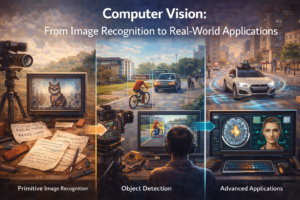
Introduction to Computer Vision
Computer vision is a subfield of artificial intelligence that trains computers to understand the visual world using digital images from cameras and videos, along with deep learning models. It has become increasingly important in modern applications ranging from autonomous vehicles to medical imaging and facial recognition.
Fundamentals of Computer Vision
Computer vision operates on the principle of extracting meaningful information from digital images. The process typically involves three main steps: image acquisition, image processing, and image analysis. Each step builds upon the previous one to create a comprehensive understanding of visual data.
Image Acquisition and Preprocessing
The first step in any computer vision pipeline is acquiring high-quality images. This can be done through various sensors including digital cameras, thermal cameras, or depth sensors. Once acquired, images often undergo preprocessing to normalize lighting, remove noise, and enhance relevant features.
Feature Extraction
Feature extraction involves identifying key characteristics within an image that are relevant to the problem at hand. Traditional methods like SIFT (Scale-Invariant Feature Transform) and SURF (Speeded Up Robust Features) manually define features, while modern deep learning approaches automatically learn hierarchical features through convolutional neural networks (CNNs).
Core Algorithms and Techniques
Convolutional Neural Networks (CNNs)
CNNs are the backbone of modern computer vision. They use multiple layers of convolution and pooling operations to progressively extract higher-level features from raw input. Popular architectures include VGG, ResNet, EfficientNet, and Vision Transformers, each designed for specific performance and efficiency requirements.
Object Detection and Localization
Object detection goes beyond classification to identify and locate objects within images. Modern approaches like YOLO (You Only Look Once), Faster R-CNN, and RetinaNet use region-based proposals or anchor boxes to predict both class and bounding box coordinates, enabling real-time detection capabilities.
Semantic Segmentation
Semantic segmentation classifies each pixel in an image to a predefined category. This is crucial for applications like medical image analysis, autonomous driving, and scene understanding. Models like FCN, U-Net, and DeepLab have achieved remarkable results in this domain.
Real-World Applications
Medical Imaging
Computer vision has revolutionized medical diagnosis. Algorithms trained on thousands of medical images can detect tumors, fractures, and other abnormalities with accuracy comparable to or exceeding human radiologists. The ability to process images quickly enables faster diagnosis and treatment planning.
Autonomous Vehicles
Self-driving cars rely heavily on computer vision to perceive their environment. Multiple cameras and sensors feed data into deep learning models that identify road markings, pedestrians, vehicles, and obstacles in real-time, enabling safe navigation without human intervention.
Facial Recognition
Modern facial recognition systems use deep learning to encode faces into high-dimensional feature vectors, enabling identification, verification, and emotion recognition. Applications range from security systems to social media tagging to finding missing persons.
Challenges and Future Directions
Robustness and Generalization
A major challenge is creating models that generalize well to different lighting conditions, angles, and backgrounds. Adversarial attacks have shown that even high-accuracy models can fail on slightly perturbed inputs, highlighting the need for more robust training techniques.
Interpretability
Deep learning models are often treated as “black boxes.” Understanding what features the model learned and why it made certain predictions is crucial for high-stakes applications like medical diagnosis and legal systems.
Data Requirements and Privacy
Training effective computer vision models typically requires large datasets, raising concerns about data collection, privacy, and potential bias. Federated learning and differential privacy techniques are emerging as solutions to train models while preserving privacy.
Getting Started with Computer Vision
Essential Libraries and Frameworks
Python has become the lingua franca of computer vision development. Key libraries include OpenCV for traditional image processing, TensorFlow and PyTorch for deep learning, and specialized libraries like MMCV for state-of-the-art implementations.
Learning Resources
Begin with understanding image fundamentals: pixels, color spaces, and convolution operations. Progress to studying popular architectures, implementing them from scratch, and then using pre-trained models. Kaggle competitions and open-source projects provide excellent hands-on learning opportunities.
Conclusion
Computer vision has evolved from a nascent research field into a powerful practical technology that impacts daily life. As models become more efficient and accessible, we can expect computer vision to be integrated into increasingly diverse applications. Whether you’re interested in medical imaging, autonomous systems, or creative applications, computer vision offers exciting opportunities for innovation and impact.
Continue Learning: Related Articles
Computer Vision in Manufacturing: Quality Control, Defect Detection, and Process Automation
Computer Vision in Manufacturing: Quality Control and Intelligent Automation
Manufacturing has traditionally relied on …
📖 8 min read
Medical Image Analysis with AI: Diagnostic Applications, Challenges, and Implementation Guide
Medical Image Analysis with AI: Diagnostic Applications, Challenges, and Implementation Guide
Meta Description: Impleme…
📖 11 min read
Object Detection Algorithms Explained: YOLO vs Faster R-CNN vs EfficientDet
Object Detection Algorithms Explained: YOLO vs Faster R-CNN vs EfficientDet 2026
Meta Description: Compare YOLO, Faster…
📖 11 min read
💡 Explore 80+ AI implementation guides on Harshith.org
