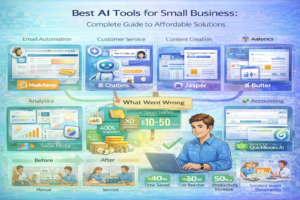
Introduction: AI is No Longer Just for Big Corporations
Small and medium-sized businesses often assume that artificial intelligence is exclusively for tech giants with massive budgets and dedicated data science teams. This misconception couldn’t be further from reality. Today’s AI landscape offers accessible, affordable tools that help businesses of all sizes automate operations, improve customer experiences, and make data-driven decisions. This comprehensive guide explores practical AI solutions that small businesses can implement immediately to compete more effectively in 2025.
The democratization of AI technology has created unprecedented opportunities for small businesses. Cloud-based AI services, user-friendly platforms, and pay-as-you-go pricing models mean you don’t need million-dollar budgets or technical expertise to leverage AI’s power. From customer service chatbots to inventory prediction systems, AI tools can transform how you operate, often delivering returns on investment within months of implementation.
Understanding AI for Business: Breaking Down the Basics
Before diving into specific tools, it’s important to understand what AI can and cannot do for your business. Artificial intelligence excels at recognizing patterns, making predictions, and automating repetitive tasks. It processes vast amounts of data far faster than humans, identifying insights that might otherwise remain hidden. However, AI isn’t magic—it requires good data, clear objectives, and realistic expectations.
Types of AI Relevant to Small Businesses
Machine Learning enables systems to learn from data and improve over time without explicit programming. For businesses, this might mean predicting which customers are likely to purchase, identifying products to stock based on trends, or detecting fraudulent transactions. Machine learning powers recommendation engines, demand forecasting, and customer segmentation tools.
Natural Language Processing (NLP) allows computers to understand and generate human language. Small businesses use NLP for chatbots that handle customer inquiries, sentiment analysis that monitors brand reputation on social media, and automated email categorization that routes messages to appropriate departments. NLP transforms how businesses communicate with customers at scale.
Computer Vision enables machines to interpret images and videos. Retail businesses use computer vision for inventory management, security monitoring, and quality control. Restaurants use it to monitor food preparation. Service businesses apply it to remote site inspections. The applications span virtually every industry.
Predictive Analytics uses historical data to forecast future outcomes. Small businesses apply predictive analytics to inventory planning, sales forecasting, maintenance scheduling, and customer churn prevention. These predictions inform better business decisions and resource allocation.
Customer Service and Communication Tools
AI-Powered Chatbots and Virtual Assistants
Customer service represents one of the most immediate and impactful areas where small businesses can deploy AI. Modern chatbots have evolved far beyond frustrating automated responses to become sophisticated assistants that handle complex customer inquiries.
Intercom offers an AI-powered customer messaging platform that combines live chat, chatbots, and email support. Their Resolution Bot can automatically answer common questions by learning from your existing support articles and past conversations. Pricing starts at $74 per month, making it accessible for growing businesses. Intercom’s analytics show which questions customers ask most frequently, helping you improve your products and services.
Drift specializes in conversational marketing and sales. Their AI chatbot qualifies leads, books meetings, and answers product questions around the clock. For small businesses focused on growth, Drift’s ability to engage website visitors in real-time and route qualified leads to sales teams can significantly improve conversion rates. Plans start at $2,500 annually, positioning it for businesses serious about scaling.
Tidio provides an affordable alternative perfect for small businesses just starting with AI. At $18 per month for their Communicator plan, Tidio combines live chat, chatbots, and email in one platform. Their chatbot templates make setup quick, requiring no coding knowledge. You can launch a functional customer service bot in under an hour.
ManyChat focuses specifically on Facebook Messenger and Instagram automation. If your business relies heavily on social media for customer engagement, ManyChat’s visual bot builder and marketing automation features excel at nurturing leads through social channels. They offer a free plan for up to 1,000 contacts, making it risk-free to try.
Email Management and Communication
Gmail’s Smart Compose and Smart Reply are built directly into Google Workspace, using AI to suggest email responses and complete your sentences as you write. For businesses already using Gmail, these features cost nothing additional and can save significant time on routine correspondence. Smart Reply suggests three potential responses to incoming emails, while Smart Compose predicts what you want to write based on your style and common phrases.
SaneBox employs AI to organize your inbox automatically, moving unimportant emails out of your way and highlighting what needs attention. At $7 per month, SaneBox learns your email patterns and priorities, creating a customized filtering system that adapts over time. Small business owners report saving hours weekly on email management.
Marketing and Sales Optimization
Content Creation and Marketing Tools
Marketing demands consistent content creation, a challenge for small teams with limited resources. AI writing assistants have matured significantly, offering genuine value rather than replacing human creativity.
Jasper AI (formerly Jarvis) specializes in marketing copywriting. Whether you need social media posts, blog outlines, product descriptions, or email campaigns, Jasper generates content based on your prompts. At $49 monthly for the Starter plan, it’s an investment that pays off quickly if you regularly create content. Jasper doesn’t replace writers but accelerates the process, helping you overcome blank-page syndrome and generate ideas rapidly.
Copy.ai offers similar capabilities with a more accessible free tier, allowing 2,000 words monthly at no cost. For $49 monthly, the Pro plan removes limits and adds features like long-form content generation and priority support. Copy.ai particularly excels at short-form content like headlines, social media posts, and product descriptions.
Canva’s Magic Write integrates AI writing directly into Canva’s design platform. If you’re already using Canva for visual content, Magic Write helps you draft accompanying text for social posts, presentations, and marketing materials without leaving the platform. It’s included in Canva Pro at $14.99 monthly.
Social Media Management
Buffer’s AI Assistant helps schedule posts, suggests optimal posting times based on audience engagement patterns, and generates post ideas. Buffer’s analytics use AI to identify which content types perform best, informing your strategy. Plans start at $6 monthly per social channel, making it affordable for businesses managing multiple platforms.
Hootsuite Insights powered by Talkwalker uses AI to monitor brand mentions, analyze sentiment, and identify trending topics in your industry. Understanding how people discuss your brand and competitors helps you respond quickly to issues and capitalize on opportunities. Hootsuite plans start at $99 monthly for the Professional tier including basic analytics.
Advertising and Conversion Optimization
Google Ads Smart Bidding uses machine learning to optimize your bids in real-time based on conversion likelihood. Rather than manually adjusting bids, Smart Bidding considers hundreds of signals—device, location, time of day, browser—to maximize returns on advertising spend. It’s available to all Google Ads advertisers at no additional cost beyond your ad spend.
Facebook Ads Automated Rules allow you to create if-then conditions that automatically adjust campaigns based on performance. While simpler than full AI, these rules incorporate basic machine learning to optimize delivery and budget allocation. Combined with Facebook’s campaign optimization features, small businesses can run sophisticated advertising campaigns without dedicated specialists.
Operations and productivity Enhancement
Scheduling and Meeting Management
Calendly uses AI to eliminate scheduling back-and-forth by automatically finding mutually available times. Calendly integrates with your calendar, shows availability to invitees, and handles time zones automatically. At $8 monthly for the Essentials plan, it’s an affordable solution that saves significant time weekly. Advanced features include team scheduling, reminders, and workflow automation.
x.ai provides an AI scheduling assistant that coordinates meetings via email. You simply copy the assistant on email threads, and it handles the scheduling logistics through natural language conversation. This feels more personal than sending booking links while still automating the process. Pricing starts at $8 monthly for basic features.
Project Management and Task Automation
Monday.com’s WorkCanvas AI automatically generates project templates, suggests task assignments based on workload, and predicts project completion dates. For small teams managing multiple projects, these AI features reduce administrative overhead. Plans start at $8 per user monthly, positioning Monday.com competitively for growing businesses.
Notion AI integrates artificial intelligence directly into your workspace, offering features like auto-generated summaries of meeting notes, draft proposals from bullet points, and intelligent search across all your documents. At $10 monthly added to your existing Notion subscription, it extends a platform many businesses already use for knowledge management.
Zapier connects different apps and automates workflows without coding. While not strictly AI, Zapier’s automation builder uses intelligent suggestions to recommend workflow connections based on your apps and goals. With 5,000+ app integrations and a free tier for basic automation, Zapier helps small businesses build efficient processes. Paid plans start at $19.99 monthly.
Financial Management and Accounting
Expense Tracking and Management
Expensify uses optical character recognition (OCR) and machine learning to automatically categorize expenses from photos of receipts. Snap a picture, and Expensify extracts merchant information, amounts, and dates, then categorizes the expense appropriately. At $5 per user monthly, it dramatically reduces time spent on expense reporting and bookkeeping.
QuickBooks Online’s AI features categorize transactions, match bank entries to invoices, and flag unusual activities that might indicate errors or fraud. QuickBooks suggests tax deductions based on your transactions and industry. While more expensive at $30-200 monthly depending on plan, QuickBooks provides comprehensive accounting with embedded AI intelligence.
Invoicing and Payment Processing
FreshBooks uses AI to predict when invoices will be paid based on client payment history, helping you manage cash flow more effectively. It automatically sends payment reminders and applies late fees per your terms. FreshBooks starts at $19 monthly for the Lite plan, offering excellent value for service-based businesses.
Cybersecurity and Risk Management
Threat Detection and Prevention
Darktrace employs AI to detect and respond to cyber threats in real-time by learning normal behavior patterns for your network and flagging anomalies. While enterprise-focused, Darktrace offers solutions scaled for smaller businesses. Investment in AI-powered security prevents costly breaches and downtime.
Malwarebytes uses machine learning to identify and block malware, ransomware, and other threats. Unlike traditional antivirus that relies on known threat signatures, Malwarebytes detects malicious behavior patterns, catching zero-day threats. Business plans start at $59.99 per device annually.
Human Resources and Recruitment
Recruitment and Applicant Tracking
LinkedIn Recruiter uses AI to match job postings with potential candidates based on skills, experience, and career trajectory. While primarily designed for recruiters, small businesses can access similar AI-powered candidate suggestions through LinkedIn’s standard job postings.
Workable provides an applicant tracking system with AI that screens resumes, ranks candidates, and schedules interviews automatically. At $149 monthly for small teams, Workable streamlines hiring processes, ensuring you don’t miss qualified candidates.
Employee Engagement and Performance
Officevibe uses AI to analyze employee survey responses, identifying satisfaction trends and potential issues before they become serious problems. The platform generates actionable insights and recommendations for improving team morale and retention. Pricing starts at $5 per employee monthly.
Inventory and Supply Chain Management
Demand Forecasting
Inventory Planner integrates with e-commerce platforms like Shopify and uses AI to predict product demand, optimize stock levels, and suggest purchase orders. By preventing both stockouts and overstock situations, Inventory Planner improves cash flow and customer satisfaction. Plans start at $99 monthly, scaling with inventory size.
NetSuite’s Demand Planning offers enterprise-grade forecasting accessible to growing businesses. Using historical sales data, seasonality patterns, and external factors, NetSuite predicts future demand with impressive accuracy. While more expensive than alternatives, businesses with complex inventory benefit significantly from these capabilities.
Industry-Specific AI Solutions
Retail and E-commerce
Shopify’s Kit acts as a virtual marketing assistant for e-commerce stores. Kit recommends products to promote, creates social media ads, responds to common customer inquiries, and provides sales reports. It’s included free with Shopify stores, adding substantial value to the platform.
Nosto provides AI-powered product recommendations and personalization for online stores. By analyzing browsing behavior and purchase history, Nosto shows each visitor products they’re most likely to buy. For stores with diverse inventories, personalization significantly improves conversion rates.
Professional Services
Harvey AI assists legal professionals with research, document review, and contract analysis. Small law firms can leverage Harvey to compete with larger firms’ resources. Pricing is custom based on firm size and usage.
Elicit helps researchers and consultants quickly find and summarize relevant academic papers. For consulting firms and research organizations, Elicit saves hours of literature review time.
Healthcare and Wellness
Suki provides AI-powered voice documentation for healthcare providers. Doctors dictate notes during patient visits, and Suki transcribes and organizes information into proper medical documentation. This reduces administrative burden and improves patient care time.
Implementation Strategy and Best Practices
Starting Your AI Journey
Begin by identifying your biggest pain points and time sinks. Where does your team spend disproportionate time on repetitive tasks? Where do customers experience friction? Where do you lack insights for decision-making? AI should solve real problems, not be implemented for novelty.
Start small with one or two tools addressing specific challenges. Master these before expanding to additional solutions. Many businesses fail with AI by deploying too many tools simultaneously, creating confusion and change fatigue.
Data Readiness
AI quality depends heavily on data quality. Before implementing AI tools, ensure your data is organized, accessible, and relatively clean. Many small businesses discover their data exists in silos across multiple systems, limiting AI effectiveness. Invest time in data organization—it pays dividends across all AI applications.
Training and Adoption
Successful AI implementation requires team buy-in. Involve employees early in tool selection, explaining how AI will make their jobs easier rather than replace them. Provide adequate training and support during transitions. Most AI tools offer excellent onboarding resources, tutorials, and customer support—use these resources.
Measuring ROI
Establish clear metrics before implementing AI tools. How will you measure success? Time saved? Revenue increased? Costs reduced? Customer satisfaction improved? Track these metrics consistently, comparing performance before and after AI implementation. This data informs future AI investments and helps you optimize existing tools.
Common Mistakes to Avoid
Expecting Perfection Immediately: AI systems improve over time as they learn from more data. Initial results may disappoint, but performance typically increases with usage. Give tools adequate trial periods before judging effectiveness.
Neglecting Human Oversight: AI augments human decision-making but shouldn’t replace it entirely for critical functions. Always maintain human oversight, especially for customer-facing applications, financial decisions, and legal matters.
Ignoring Privacy and Ethics: Ensure AI tools comply with data protection regulations like GDPR and CCPA. Be transparent with customers about AI usage, especially in customer service contexts. Ethical AI use builds trust with customers and employees.
Tool Overload: More tools don’t equal better results. Focus on tools that integrate well with your existing technology stack and address genuine needs. Each additional tool creates complexity and requires maintenance.
The Future of AI for Small Business
AI technology continues evolving rapidly, with tools becoming more powerful, accessible, and affordable. Small businesses that embrace AI now position themselves competitively for the future. As AI becomes ubiquitous, businesses not leveraging these tools will find themselves at significant disadvantages.
Emerging trends include voice-activated business assistants, advanced visual search for retail, and AI-powered supply chain optimization that rivals large corporations’ capabilities. Small businesses should stay informed about developments relevant to their industries.
Conclusion: Taking Action Today
The barrier to AI adoption has never been lower. With affordable tools, no-code platforms, and extensive support resources, small businesses can implement AI solutions immediately. Start by identifying one significant challenge in your business, research appropriate AI tools, and begin with a pilot implementation.
Success with AI comes from thoughtful implementation focused on solving real problems rather than chasing technological trends. By starting small, measuring results, and scaling what works, your small business can leverage AI’s power to compete more effectively, serve customers better, and grow sustainably. The question isn’t whether to adopt AI, but how quickly you can begin.
Continue Learning: Related Articles
AI Image Generators Compared: DALL-E 3 vs Midjourney vs Stable Diffusion
The AI Art Revolution
AI image generation has exploded into the mainstream, with tools capable of creating stunning art…
📖 6 min read
Generative AI for Creative Industries: Transforming Art, Music, and Design
The Creative Revolution: How Generative AI is Transforming Art, Music, and Design
Generative AI has emerged as one of t…
📖 10 min read
AI Content Creation Tools for Bloggers: Comparison and ROI Analysis
Introduction to AI Content Creation for Bloggers
The content creation landscape has been transformed by artificial inte…
📖 13 min read
Best AI Writing Tools Compared: Jasper vs Copy.ai vs Writesonic vs Rytr
The AI Writing Revolution
AI writing tools have transformed content creation, enabling marketers, entrepreneurs, and wr…
📖 6 min read
💡 Explore 80+ AI implementation guides on Harshith.org
