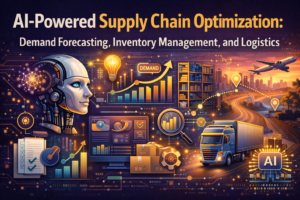
AI-Powered Supply Chain Optimization: Revolutionizing Logistics and Inventory Management
Supply chains are among the most complex systems in modern business, involving countless interconnected decisions about procurement, manufacturing, inventory management, transportation, and distribution. Even small inefficiencies cascade through the system, resulting in excess inventory, stockouts, delayed shipments, and substantially higher costs. Artificial intelligence is transforming supply chain management by enabling data-driven decisions that optimize every aspect of the supply chain from supplier selection to last-mile delivery.
This comprehensive guide explores how AI is revolutionizing supply chain management, the specific applications driving transformation, implementation approaches, and the measurable business benefits organizations are achieving.
The Supply Chain Challenge
Modern supply chains face unprecedented complexity. Global sourcing means dealing with multiple suppliers across different countries and time zones. Demand forecasting must account for seasonality, market trends, social media effects, and numerous other factors. Inventory management requires balancing the costs of holding inventory against the risks of stockouts. Transportation optimization must consider fuel costs, vehicle capacity, delivery windows, traffic patterns, and customer preferences.
Traditional approaches to supply chain management rely on historical rules, manual processes, and human intuition. These approaches work adequately in stable environments but struggle when conditions change rapidly—as demonstrated during recent global supply chain disruptions.
How AI Transforms Supply Chain Operations
Demand Forecasting: Machine learning models analyze historical sales data, market trends, seasonal patterns, social media signals, and external factors to predict future demand with remarkable accuracy. Neural networks and ensemble methods capture complex nonlinear relationships that traditional forecasting methods miss. Some organizations have achieved 20-50% improvements in forecast accuracy using AI-powered systems.
Inventory Optimization: AI determines optimal inventory levels across the supply chain, balancing holding costs against stockout risks. Dynamic programming and optimization algorithms account for demand uncertainty, lead times, supplier reliability, and storage constraints. The result is lower inventory costs while improving service levels.
Supplier Selection and Management: AI analyzes supplier performance across cost, quality, delivery reliability, and financial stability, recommending optimal suppliers and helping identify supplier risks before they become problems. Predictive models identify suppliers at risk of disruption, enabling proactive diversification.
Route Optimization: AI-powered routing systems consider vehicle capacity, delivery time windows, traffic patterns, fuel costs, and driver preferences to determine optimal delivery routes. Real-time optimization adapts routes as new orders arrive and conditions change. Organizations report 10-25% reductions in transportation costs.
Warehouse Operations: AI optimizes warehouse layout, picking sequences, and staffing levels to minimize picking time and errors. Computer vision systems verify shipment accuracy. Robotic systems coordinate with human workers to accelerate fulfillment.
Predictive Maintenance: AI predicts equipment failures in manufacturing and logistics facilities before they occur, enabling preventive maintenance that minimizes downtime and extends equipment life.
Key AI Technologies for Supply Chain
Machine Learning for Forecasting: Random forests, gradient boosting, and neural networks handle complex nonlinear patterns in demand data. Ensemble methods combine multiple models to improve accuracy and robustness.
Optimization Algorithms: Linear and nonlinear programming solve resource allocation problems. Evolutionary algorithms and ant colony optimization discover solutions to complex combinatorial problems like routing.
Computer Vision: Image recognition verifies shipment accuracy, identifies damaged goods, and automates inventory tracking.
Natural Language Processing: Text analysis of supplier communications, social media, and news sources identifies risks and opportunities early.
Digital Twins: Simulation models of supply chains enable testing changes before implementation, significantly reducing risk.
Real-World Implementation Success Stories
Demand Forecasting Improvement: A major retailer implemented AI-powered demand forecasting, reducing forecast error by 25% and improving inventory turns by 20%. The improvements prevented both stockouts and excess inventory, significantly improving profitability.
Route Optimization Success: A logistics company deployed AI-powered route optimization, reducing delivery costs by 18% while improving on-time delivery rates. The system continuously learns from actual delivery data to improve optimization.
Supplier Risk Prediction: A manufacturing company used AI to identify suppliers at financial risk, enabling diversification that prevented supply disruptions when several suppliers faced bankruptcy. The system analyzes financial reports, payment histories, and industry signals.
Last-Mile Delivery Optimization: An e-commerce company implemented AI-powered delivery optimization, reducing last-mile delivery costs by 22% while maintaining service levels. Dynamic routing adapts to real-time demand and traffic conditions.
Implementation Challenges and Solutions
Data Quality and Availability: Supply chain data quality varies widely. Legacy systems have incomplete data. Solution: Start with data governance initiatives to improve quality, integrate legacy systems, and establish data standards.
Organizational Resistance: Supply chain professionals may resist automation that changes familiar processes. Solution: Engage stakeholders early, demonstrate value on pilot projects, and emphasize how AI augments rather than replaces human expertise.
Integration Complexity: Supply chain systems are highly complex with numerous interconnections. AI improvements in one area can have unexpected effects elsewhere. Solution: Use digital twins to test changes, implement gradually, and monitor system-wide effects.
Changing Conditions: AI models trained on historical data may not predict accurately when conditions change (as during COVID-19). Solution: Implement model monitoring, maintain scenario planning, and create processes for model retraining when conditions shift.
Measuring ROI from Supply Chain AI
Inventory Cost Reduction: Lower inventory levels reduce storage costs, handling costs, and obsolescence. Typical savings: 10-25%.
Transportation Efficiency: Optimized routes, better vehicle utilization, and reduced fuel costs. Typical savings: 10-25%.
Demand Forecasting Accuracy: Better forecasts reduce stockouts and excess inventory. Impact varies by industry but often exceeds 15% improvement.
Supplier Performance: Better supplier selection and risk management reduces quality issues, delays, and supply disruptions. Difficult to quantify but substantial.
Operational Efficiency: Faster order fulfillment, reduced manual work, fewer errors. Typical improvement: 20-40% reduction in fulfillment time.
Total Impact: Companies implementing comprehensive AI supply chain systems typically realize 15-25% cost reduction while improving service levels.
Best Practices for Supply Chain AI
Start with High-Impact Areas: Identify areas where AI can have greatest impact. Demand forecasting and route optimization offer large, relatively quick wins.
Data Foundation First: Invest in data quality, integration, and governance before deploying AI. Poor data undermines AI effectiveness.
Build Internal Expertise: Develop internal capabilities rather than relying solely on external consultants. This builds organizational understanding and sustainability.
Use Digital Twins: Test changes in simulation before implementation. This reduces risk and accelerates learning.
Continuous Learning: Implement processes for ongoing model improvement as new data arrives and conditions change.
The Future of AI in Supply Chains
Supply chains will become increasingly autonomous, with AI systems making more decisions with minimal human intervention. We’ll see tighter integration between suppliers, manufacturers, and retailers enabled by shared data and collaborative optimization. Blockchain and AI will work together to increase transparency and traceability. Climate change and sustainability constraints will drive new optimization objectives beyond cost.
Conclusion
AI is fundamentally transforming supply chain management, enabling optimization of complex systems in ways previously impossible. Organizations implementing AI-powered supply chain systems realize substantial cost reductions while improving service levels and resilience. As competition intensifies and supply chains become more complex, AI capabilities will become table stakes. Organizations starting their AI supply chain journey now will gain significant competitive advantages as the technology matures and becomes more critical to business success.
Continue Learning: Related Articles
Learning Path: Python for AI/ML
Learning Path: Python for AI/ML
Duration: 8-10 weeks | Weekly Commitment: 15-20 hours | Target Audience: Beginners with …
📖 3 min read
Autonomous Agents: Building Self-Learning Systems That Make Independent Decisions
Autonomous Agents: Building Self-Learning AI Systems That Make Independent Decisions
Artificial intelligence has evolve…
📖 5 min read
Build a Document Q&A System with RAG: Complete Python Tutorial
Introduction to RAG-Based Document Q&A
Retrieval-Augmented Generation (RAG) has revolutionized how we interact with doc…
📖 17 min read
Math Foundations for AI & Machine Learning
Math Foundations for AI & machine learning
Master the mathematical concepts essential for artificial intelligence an…
📖 4 min read
💡 Explore 80+ AI implementation guides on Harshith.org
