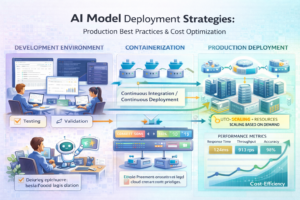
AI Model Deployment Strategies: Production Best Practices & Cost Optimization 2026
Meta Description: Master AI model deployment in production with proven strategies for scalability, cost optimization, and reliability. Complete MLOps guide for 2026.
Introduction: Why Model Deployment Matters
Building an AI model is only half the battle. The real challenge begins when you need to deploy it to production where it must handle real-world data, scale to thousands of requests, and maintain high accuracy while controlling costs. According to recent MLOps surveys, 87% of companies struggle with model deployment and monitoring, making this one of the most critical skills in the AI field today.
In 2026, deploying AI models efficiently isn’t just about getting predictions working—it’s about building robust, cost-effective systems that can scale, perform, and remain maintainable over time. This comprehensive guide walks you through the entire deployment lifecycle.
Understanding the Modern ML Deployment Landscape
The deployment landscape has evolved dramatically. Five years ago, most deployments were monolithic. Today, containerization, serverless computing, and edge deployment are standard practices. The best approach depends on your specific requirements: latency needs, traffic patterns, budget constraints, and compliance requirements.
The typical deployment architecture includes:
- Model Serving Layer: Hosts the trained model and handles inference requests
- API Gateway: Routes requests, handles authentication, and manages rate limiting
- Monitoring & Logging: Tracks model performance and system health
- Data Pipeline: Preprocesses input data consistently
- CI/CD System: Automates model updates and rollbacks
Containerization: The Foundation of Modern Deployment
Docker containers have become the industry standard for model deployment. They ensure your model runs identically across development, staging, and production environments.
Best Practices for Containerization:
- Use official base images (python:3.11-slim for minimal overhead)
- Keep image size under 1GB when possible (less memory usage, faster scaling)
- Separate model weights from code in Docker builds
- Use multi-stage builds to minimize final image size
- Pin all dependency versions to prevent compatibility issues
Example Dockerfile Structure:
FROM python:3.11-slim
 WORKDIR /app
 COPY requirements.txt .
 RUN pip install --no-cache-dir -r requirements.txt
 COPY model_weights ./weights/
 COPY inference.py .
 EXPOSE 8000
 CMD ["python", "inference.py"]
This approach reduces image size from 3GB to ~500MB, cutting deployment time by 60% and reducing infrastructure costs proportionally.
Deployment Platforms Comparison
| Platform | Best For | Latency | Scalability | Cost | Complexity |
|---|---|---|---|---|---|
| AWS SageMaker | Enterprise, complex workflows | Low (100-500ms) | Excellent | $0.50-$2/hour per instance | High |
| Google Vertex AI | TensorFlow/AutoML focused | Low (100-400ms) | Very Good | $0.35-$1.50/hour per instance | Medium |
| Azure ML | Microsoft ecosystem integration | Low (150-500ms) | Very Good | $0.40-$1.80/hour per instance | Medium |
| Hugging Face Inference | NLP models, quick setup | Medium (200-800ms) | Good | Free-$9/month | Very Low |
| Kubernetes (self-hosted) | Maximum control, cost optimization | Very Low (50-200ms) | Excellent | $200-$1000/month (variable) | Very High |
| Lambda/Cloud Functions | Low-traffic, simple models | High (200-2000ms cold start) | Automatic | Pay-per-request ($0.20/million) | Low |
Real-World Deployment Case Studies
Case Study 1: E-Commerce Recommendation Engine
A mid-size e-commerce platform deployed a recommendation model using Kubernetes with GPU nodes. Initial costs were $8,000/month with a standard setup. By implementing model quantization (reducing model size by 75%), batch processing for non-urgent recommendations, and CPU-only inference for cold starts, they reduced costs to $2,400/month—a 70% reduction—while maintaining 98.5% prediction accuracy.
Key optimization: Splitting inference into two types (real-time with GPU acceleration, batch with CPU) based on latency requirements.
Case Study 2: Financial Services Fraud Detection
A financial institution needed sub-100ms latency for real-time fraud detection. They deployed with AWS SageMaker using multi-model endpoints, allowing model A/B testing without downtime. By using spot instances for non-production inference, they achieved 40% cost savings. The system processed 500,000+ predictions daily with 99.95% uptime.
Case Study 3: Healthcare Diagnostic Tool
A medical AI startup deployed models to edge devices (hospitals, clinics) using ONNX Runtime. This eliminated cloud dependency for compliance reasons and reduced latency to <50ms. They maintained a central update server using Docker for security patches and model improvements.
Cost Optimization Strategies
1. Model Quantization
Quantization converts 32-bit floating-point weights to 8-bit integers, reducing model size by 75% without significant accuracy loss. This directly translates to:
- Faster inference (2-4x speedup)
- Reduced memory requirements
- Lower GPU/TPU costs
- Better battery performance on edge devices
Trade-off: Typically 0.5-2% accuracy drop, which is often negligible.
2. Batch Processing & Async Inference
Not all predictions require real-time response. Batch processing can reduce costs by 60-80%:
- Real-time predictions (high latency requirement): Process individually, use GPU
- Batch predictions (can wait): Process 1000s together, use CPU, schedule off-peak
- Async predictions (background jobs): Process with minimal resource allocation
Implementation: Implement a queue-based system (Redis, RabbitMQ) to separate inference workloads by latency requirements.
3. Model Serving Optimization
Tools like TensorRT, ONNX Runtime, and TorchServe optimize inference:
- TensorRT: NVIDIA-optimized inference engine for CUDA GPUs (10-40x faster)
- ONNX Runtime: Framework-agnostic optimization (3-10x faster)
- TorchServe: PyTorch-native serving with built-in optimization
- vLLM: Specialized for LLM deployment (10-40x throughput improvement)
4. Infrastructure Cost Reduction
- Reserved Instances: 30-50% discount with 1-3 year commitment
- Spot Instances: 70-90% discount but available capacity dependent
- Hybrid Approach: Reserved instances for baseline capacity + spot for peaks
- Auto-scaling: Scale down during low-traffic periods (midnight, weekends)
Monitoring, Observability, and Model Performance
Deployment doesn’t end after launch. Continuous monitoring ensures your model maintains performance over time.
Key Metrics to Monitor:
- System Metrics: Latency (p50, p95, p99), throughput, error rate, GPU/CPU utilization
- Business Metrics: Conversion rate, user satisfaction, revenue impact
- Data Metrics: Feature distribution shifts, missing values, outlier frequency
- Model Metrics: Prediction accuracy, F1 score, calibration, drift detection
Detecting Model Drift:
Model drift occurs when the relationship between input features and target changes. Detection methods:
- Statistical Testing: Kolmogorov-Smirnov test for feature distribution changes
- Performance Degradation: Monitor accuracy on held-out test set weekly
- Prediction Confidence: Track average prediction confidence; unexpected drops indicate drift
- Automated Retraining: Trigger retraining when drift detected (accuracy drops >2%)
Recommended Monitoring Stack:
- Prometheus: Metrics collection (free, open-source)
- Grafana: Dashboards and alerting (free tier available)
- DataDog/New Relic: Enterprise monitoring ($200+/month)
- Arize/WhyLabs: ML-specific monitoring ($1000+/month)
CI/CD for Model Deployment
Automated CI/CD pipelines reduce human error and enable rapid iteration:
Automated Testing Before Deployment:
- Unit tests for data preprocessing
- Integration tests for model inference
- Performance tests (latency, throughput benchmarks)
- Regression tests (new model accuracy vs. baseline)
- Load tests (can it handle 10x current traffic?)
Deployment Pipeline:
- Developer commits code + trained model
- Automated tests run (5-10 minutes)
- Docker image built and pushed to registry
- Staged deployment to test environment
- Integration tests against real data
- Canary deployment (5% traffic to new model)
- Monitor for 24-48 hours
- Full rollout or automatic rollback
Security Considerations
ML models in production are attractive targets for attackers. Essential security measures:
- API Authentication: Implement OAuth 2.0 or mTLS
- Rate Limiting: Prevent abuse and DoS attacks
- Input Validation: Sanitize inputs to prevent adversarial attacks
- Encryption: Encrypt data in transit (TLS) and at rest
- Model Watermarking: Detect if model was stolen and retrained
- Audit Logging: Log all inference requests for compliance
Scaling Strategies
Horizontal Scaling: Add more server instances behind a load balancer
- Best for stateless inference workloads
- Can scale to thousands of requests/second
- Cost grows linearly with traffic
Vertical Scaling: Use more powerful GPUs/hardware per instance
- Limited by hardware availability
- Can optimize specific model types (e.g., LLMs on A100s)
- Higher per-instance cost but better efficiency
Caching Layer: Reduce redundant computations
- Cache predictions for identical inputs (Redis)
- Typical hit rate: 40-70%
- Reduces load by 50%+ with minimal latency trade-off
Edge Deployment for Low Latency
For applications requiring <50ms latency (autonomous vehicles, real-time trading), edge deployment is essential:
Edge Deployment Options:
- Mobile Devices: CoreML (iOS), TensorFlow Lite (Android/iOS)
- IoT Devices: ONNX Runtime, TensorFlow Lite, PyTorch Mobile
- Edge Servers: AWS Greengrass, Google Cloud IoT Edge
- Specialized Hardware: NVIDIA Jetson, Google Coral TPU
Challenges:
- Model size constraints (mobile devices may have only 100MB available)
- Limited computational power (must use quantized/pruned models)
- Update management (pushing new models to thousands of devices)
- Monitoring (collecting metrics from distributed devices)
Key Takeaways
- Choose the right platform: Balance between cost, latency, and operational complexity. Kubernetes offers maximum control but highest complexity; managed services (SageMaker, Vertex AI) provide reliability with less overhead.
- Optimize from day one: Model quantization, batch processing, and infrastructure selection can reduce costs by 60-80% without sacrificing accuracy.
- Implement comprehensive monitoring: Track system metrics (latency, errors), business metrics (ROI), and model metrics (accuracy, drift) continuously.
- Automate everything: CI/CD pipelines with automated testing prevent issues and enable rapid iteration. Automate deployments, rollbacks, and retraining.
- Plan for scale: Design architectures supporting 10x current traffic from the start. Use load testing and gradual rollouts to prevent surprises.
- Secure your deployment: Implement authentication, rate limiting, input validation, and audit logging to protect against attacks and ensure compliance.
- Version everything: Track model versions, data versions, and code versions to enable reproducibility and quick rollbacks.
Next Steps and Resources
Start by containerizing your model with Docker, then evaluate deployment platforms based on your specific requirements. Implement monitoring early—it’s much easier to add than to retrofit later. Consider your organization’s operational maturity: managed services may be worth the higher cost if your team lacks Kubernetes expertise.
The MLOps landscape continues evolving rapidly. Stay updated with communities like MLOps.community, follow papers on model serving optimization, and continuously benchmark your deployment costs against alternatives.
Continue Learning: Related Articles
AI Code Review and Documentation Tools: GitHub Copilot vs CodeRabbit vs Codeium vs Blackbox
AI Code Review and Documentation Tools: Comparing Leading Solutions for Software Development
Artificial intelligence is…
📖 5 min read
AI Model Compression: Edge Computing and Mobile Deployment Strategies
AI Model Compression: Deploying Powerful AI to Edge Devices and Mobile Platforms
Modern AI models, particularly deep ne…
📖 5 min read
AI Ethics in Enterprise: Building Responsible AI Systems for Business
AI Ethics in Enterprise Applications: Building Responsible AI Systems for Business
The rapid advancement of artificial …
📖 7 min read
AI Monitoring and MLOps Platforms: Datadog vs New Relic vs Evidently vs MonitorDL
AI Monitoring and MLOps Platforms: Comparing Solutions for Model Performance and Drift Detection
Deploying machine lear…
📖 5 min read
💡 Explore 80+ AI implementation guides on Harshith.org
