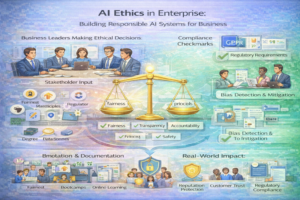
AI Ethics in Enterprise Applications: Building Responsible AI Systems for Business
The rapid advancement of artificial intelligence has transformed how organizations operate, automate processes, and make critical decisions. However, as AI becomes more integrated into business operations, the importance of AI ethics has become paramount. Enterprise organizations are increasingly recognizing that implementing responsible AI isn’t just a moral imperative—it’s a business necessity that affects brand reputation, regulatory compliance, and long-term sustainability.
In this comprehensive guide, we’ll explore what AI ethics means in an enterprise context, why it matters, and how organizations can implement ethical AI systems that balance innovation with responsibility.
What Is AI Ethics in Enterprise?
AI ethics in enterprise refers to the practice of designing, developing, and deploying artificial intelligence systems that align with societal values and organizational principles. Unlike academic AI ethics, which focuses on theoretical frameworks, enterprise AI ethics deals with practical implementation challenges in real-world business scenarios.
Enterprise AI ethics encompasses several key dimensions: fairness (ensuring AI systems don’t discriminate), transparency (making AI decisions understandable), accountability (taking responsibility for AI outcomes), privacy (protecting customer and employee data), and security (preventing misuse of AI systems).
Core Principles of Enterprise AI Ethics
Fairness and Non-Discrimination: AI systems trained on historical data often perpetuate existing biases. For example, if hiring algorithms are trained on data where certain groups were underrepresented, the AI will learn to discriminate against those groups. Enterprise organizations must actively audit their AI systems for bias and implement fairness constraints to prevent discriminatory outcomes.
Transparency and Explainability: Modern AI systems, especially deep learning models, operate as “black boxes” where even experts can’t fully explain why specific predictions were made. For critical business decisions—loan approvals, medical diagnoses, hiring—this lack of transparency is problematic. Enterprise AI ethics demands explainable AI (XAI) approaches that allow stakeholders to understand how AI reached its conclusions.
Accountability and Governance: Who is responsible when an AI system makes a harmful decision? Enterprise organizations need clear governance frameworks that define accountability lines, establish oversight mechanisms, and ensure someone is responsible for monitoring AI system performance.
Privacy Protection: AI systems often require large amounts of data, which may include sensitive personal information. Enterprise AI ethics demands robust data protection measures, informed consent from data subjects, and compliance with regulations like GDPR and CCPA.
Security and Robustness: AI systems can be vulnerable to adversarial attacks where slightly modified inputs cause incorrect predictions. Ethical AI systems must be robust against such attacks and secure from malicious actors who might exploit them.
Why Enterprise AI Ethics Matters
Regulatory Compliance: Governments worldwide are introducing regulations that require explainability, fairness, and accountability in AI systems. The EU’s AI Act, for instance, imposes strict requirements on high-risk AI applications. Organizations that don’t prioritize ethics face legal penalties and operational restrictions.
Brand Reputation: AI-related controversies can severely damage brand reputation. When organizations deploy biased AI systems or misuse customer data, the backlash can be severe. Conversely, organizations known for ethical AI practices gain competitive advantages through trust and brand loyalty.
Customer Trust: Consumers increasingly care about ethical practices. A study found that 79% of consumers want to know how companies use their data. Organizations that are transparent about AI usage and demonstrate ethical practices build stronger customer relationships.
Operational Efficiency: Biased or unfair AI systems can lead to costly mistakes, employee grievances, and legal disputes. Ethical AI systems, while requiring upfront investment, reduce long-term operational risks and improve decision quality.
Talent Attraction and Retention: Employees, especially in tech-oriented companies, increasingly value working for ethical organizations. Companies known for responsible AI practices attract better talent and have higher employee satisfaction.
Implementing Ethical AI in Enterprise
Step 1: Establish Governance Framework: Create an AI ethics board or committee with representatives from different departments. This body should review AI projects, ensure compliance with ethical principles, and address concerns raised by stakeholders or affected communities.
Step 2: Conduct Fairness Audits: Before deploying AI systems, audit them for bias using tools like IBM’s AI Fairness 360, Google’s What-If Tool, or Fairlearn. Test how the system performs across different demographic groups and identify disparities in accuracy or outcomes.
Step 3: Implement Explainability Methods: Use techniques like SHAP, LIME, or attention mechanisms to make AI decisions interpretable. For high-stakes applications, prioritize models that are inherently more explainable, even if they have slightly lower accuracy.
Step 4: Establish Data Governance: Implement strict data access controls, encryption, and anonymization procedures. Create clear policies about what data can be used for AI training and obtain explicit consent from data subjects when required by law.
Step 5: Develop Monitoring Systems: Deploy continuous monitoring to track AI system performance over time. Establish thresholds for acceptable performance and procedures for retraining when performance degrades or bias emerges.
Step 6: Create Incident Response Plans: Develop procedures for responding to ethical incidents—when AI systems make biased decisions or violate privacy. Quick, transparent response to incidents demonstrates commitment to ethical practices.
Real-World Enterprise AI Ethics Challenges
Challenge 1: Trade-offs Between Fairness and Accuracy: Sometimes enforcing fairness constraints reduces overall system accuracy. Organizations must decide what level of fairness is acceptable and communicate these trade-offs transparently to all stakeholders.
Challenge 2: Complexity of Bias: Bias in AI is multifaceted. Data bias, algorithmic bias, and societal bias can interact in complex ways. Organizations need sophisticated approaches to identify and address all forms of bias across the entire system.
Challenge 3: Rapid Deployment Pressure: Business pressure to deploy AI systems quickly can conflict with thorough ethical review. Organizations must balance speed with responsibility through streamlined but rigorous review processes.
Challenge 4: Lack of Expertise: Many organizations lack staff with expertise in AI ethics. Building ethical AI requires investment in training and hiring specialists who understand both technical and ethical aspects of AI development.
Challenge 5: Regulatory Uncertainty: As regulations evolve rapidly, organizations struggle with uncertainty about future requirements. Adopting a proactive, ethics-first approach helps organizations stay ahead of regulatory changes.
Best Practices for Implementation
Document Everything: Maintain detailed documentation of AI system development, including data sources, preprocessing steps, model selection rationale, and bias testing results. This documentation supports compliance and helps identify problems quickly.
Involve Stakeholders: Include diverse perspectives in AI development—not just engineers and data scientists, but also ethicists, legal experts, business stakeholders, and affected communities. This improves ethical outcomes significantly.
Regular Training: Provide ongoing training to teams on AI ethics principles, regulatory requirements, and best practices. As the field evolves, continuous learning is absolutely essential for organizational success.
External Validation: Have external experts review critical AI systems. Independent audits provide objective assessment and demonstrate commitment to accountability to all stakeholders.
Transparency Reports: Publish transparency reports about AI system development and outcomes. Transparency builds trust and helps organizations learn from industry peers and best practices.
Tools and Frameworks Available
Fairness Tools: IBM AI Fairness 360, Google’s What-If Tool, Fairlearn, and AIF360 help identify and mitigate bias in machine learning models across different scenarios and applications.
Explainability Tools: SHAP, LIME, and Captum provide interpretable explanations for AI decisions in ways that non-technical stakeholders can understand.
Privacy Tools: Differential Privacy libraries and federated learning frameworks help protect sensitive data while still enabling effective model training and deployment.
Governance Frameworks: IEEE’s Ethically Aligned Design, the Montreal Declaration on AI Ethics, and various corporate AI ethics frameworks provide comprehensive guidance for implementation.
The Future of Enterprise AI Ethics
As AI becomes more sophisticated and integrated into critical business processes, enterprise AI ethics will only become more important. We’ll likely see increased regulation requiring transparency, explainability, and fairness in AI systems. Standards and certifications for ethical AI will emerge, similar to ISO standards. Integration of AI ethics into machine learning operations (MLOps) will become standard practice. Greater emphasis on responsible AI as a competitive differentiator will emerge across industries.
Organizations that prioritize ethics now will be better positioned to navigate this evolving landscape and maintain stakeholder trust long-term.
Conclusion
Enterprise AI ethics isn’t a constraint on innovation—it’s a foundation for sustainable AI deployment. By implementing governance frameworks, conducting fairness audits, ensuring transparency, protecting privacy, and establishing accountability, organizations can build AI systems that are both powerful and responsible. As AI continues to transform business, those organizations that master ethical AI will gain competitive advantages through regulatory compliance, brand reputation, customer trust, and operational efficiency. The question isn’t whether organizations should invest in AI ethics—it’s whether they can afford not to.
Continue Learning: Related Articles
AI Model Compression: Edge Computing and Mobile Deployment Strategies
AI Model Compression: Deploying Powerful AI to Edge Devices and Mobile Platforms
Modern AI models, particularly deep ne…
📖 6 min read
AI Code Review and Documentation Tools: GitHub Copilot vs CodeRabbit vs Codeium vs Blackbox
AI Code Review and Documentation Tools: Comparing Leading Solutions for Software Development
Artificial intelligence is…
📖 5 min read
AI Monitoring and MLOps Platforms: Datadog vs New Relic vs Evidently vs MonitorDL
AI Monitoring and MLOps Platforms: Comparing Solutions for Model Performance and Drift Detection
Deploying machine lear…
📖 5 min read
AI Model Deployment Strategies: Production Best Practices & Cost Optimization
AI Model Deployment Strategies: Production Best Practices & Cost Optimization 2026
Meta Description: Master AI mode…
📖 10 min read
💡 Explore 80+ AI implementation guides on Harshith.org
