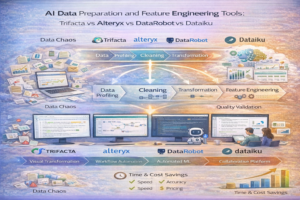
AI Data Preparation Tools: Comprehensive Comparison of Leading Solutions 2025
Data preparation and feature engineering traditionally consume 60-70% of data science project time, yet remain manual and error-prone. AI-powered data preparation tools automate data cleaning, transformation, and feature engineering, dramatically accelerating model development and improving data quality. These tools combine machine learning with intuitive interfaces to handle complex data wrangling tasks that previously required deep technical expertise.
This comprehensive comparison examines leading AI data preparation platforms, their approaches, capabilities, pricing, and ideal use cases.
Trifacta: Pioneering Data Wrangling
Strengths: Trifacta pioneered modern data wrangling, combining machine learning with visual interfaces to make data preparation accessible. The platform excels at understanding user intent and suggesting transformations. Strong integration with major data platforms.
Capabilities: Visual data profiling, AI-suggested transformations, intelligent data cleaning, pattern recognition, collaboration features, cloud and on-premises deployment.
Pricing: Enterprise pricing based on deployment and usage. Typically ranges from $50K-200K+ annually depending on scale.
Best For: Enterprises with large, complex datasets, organizations needing on-premises deployment, and teams transitioning from manual data prep to automation.
Alteryx: End-to-End Analytics Platform
Strengths: Alteryx provides comprehensive analytics platform encompassing data prep, blending, reporting, and machine learning. Strong visual workflow builder that doesn’t require coding. Excellent for business analysts and citizen data scientists.
Capabilities: Visual workflow builder, 250+ pre-built tools, spatial analytics, predictive modeling, reporting, interactive dashboards, marketplace of community-built components.
Pricing: Subscription-based, typically $5K-20K+ annually depending on deployment and user count. Includes all modules in most licenses.
Best For: Business analysts, organizations wanting complete analytics platform beyond just data prep, and teams preferring visual workflows over coding.
DataRobot: AutoML with Data Preparation
Strengths: DataRobot specializes in automated machine learning (AutoML), with integrated data preparation handling typical cleaning and transformation tasks automatically. Excellent for rapid model development with minimal data science expertise.
Capabilities: Automated data preprocessing, feature engineering, model selection, hyperparameter optimization, model explanations, deployment, monitoring.
Pricing: Subscription-based pricing, typically starting $50K+ annually. Usage-based pricing available for cloud deployments.
Best For: Organizations wanting to accelerate model development, teams without dedicated data scientists, and enterprises requiring end-to-end ML automation.
Dataiku: Collaborative Data Platform
Strengths: Dataiku emphasizes collaboration between business users and technical teams. Visual interface doesn’t require coding, but deep coding capabilities available for advanced users. Strong governance and project management features.
Capabilities: Visual data pipeline builder, SQL and Python support, data profiling and quality assessment, collaborative workspace, version control, deployment to various targets.
Pricing: Cloud and on-premises options. Pricing typically $5K-50K+ annually depending on deployment, users, and compute needs.
Best For: Organizations emphasizing collaboration between business and technical teams, enterprises needing strong governance, and teams wanting flexibility between visual and code-based approaches.
Comparative Analysis
Ease of Use: Trifacta and Alteryx prioritize ease of use with strong visual interfaces. DataRobot provides automation but requires understanding of ML concepts. Dataiku balances visual and coding approaches.
Data Handling Scale: All handle large data volumes. Alteryx and Dataiku locally process data, while Trifacta and DataRobot are cloud-native, handling larger scales more naturally.
Speed to Insight: DataRobot is fastest to model due to AutoML. Others emphasize thorough data preparation, which takes more time but often produces better models.
Flexibility: Dataiku offers most flexibility with Python/SQL support alongside visual interfaces. Alteryx provides visual workflows but less code flexibility. Trifacta and DataRobot optimize for their specific approaches.
Integration Capabilities: All integrate with major data platforms. Dataiku and Alteryx have broadest ecosystem integrations.
Implementation Considerations
Learning Curve: Trifacta and Alteryx are quickest to learn for business users. DataRobot and Dataiku require some technical understanding but are more flexible.
Infrastructure Requirements: Trifacta requires cloud or on-premises infrastructure. Alteryx and Dataiku can run on-premises. DataRobot is primarily cloud-based.
Data Governance: All provide governance features. Dataiku and Alteryx excel at collaborative governance. Trifacta focuses on transformation tracking.
Team Skills Required: Trifacta and Alteryx require fewer technical skills. DataRobot and Dataiku benefit from team with data science knowledge.
ROI Considerations
Time Savings: Data prep automation reduces project timelines by 40-60%. Calculate savings based on current manual time spent on data prep.
Model Quality: Automated feature engineering often produces better models than manual approaches. Factor quality improvements into ROI.
Skill Leverage: These platforms enable less skilled team members to accomplish complex data tasks, distributing skills more effectively.
Conclusion
AI-powered data preparation tools transform how organizations handle data wrangling. Trifacta pioneered the category with strong visual interface. Alteryx provides comprehensive end-to-end platform. DataRobot automates everything including ML modeling. Dataiku balances visual and code-based approaches with strong collaboration. The right choice depends on your team’s technical skills, data scale, governance requirements, and whether you want to focus purely on data prep or include downstream ML automation.
Continue Learning: Related Articles
AI in Finance: How Machine Learning is Transforming Fraud Detection and Risk Management
Introduction to AI in Financial Services
The financial services industry stands at the forefront of artificial intellig…
📖 7 min read
AI in Education: Personalized Learning Systems and Adaptive Assessment Transforming Classrooms
The Education Revolution
Education stands on the brink of its most significant transformation since the introduction of…
📖 7 min read
AI in Agriculture: Smart Farming, Crop Monitoring, and Yield Prediction Revolution
The Agricultural Transformation
Agriculture faces unprecedented challenges: feeding a growing global population while c…
📖 7 min read
AI in Healthcare: Revolutionizing Medical Diagnosis and Patient Care
The Transformation of Healthcare Through Artificial Intelligence
Artificial Intelligence is revolutionizing healthcare …
📖 7 min read
💡 Explore 80+ AI implementation guides on Harshith.org
