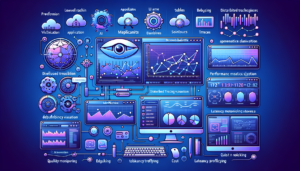
As Large Language Models move from experimental prototypes to production-critical systems serving millions of users, a new challenge emerges: how do you monitor, debug, and optimize systems whose behavior is fundamentally probabilistic? Traditional software observability—tracking logs, metrics, and traces—fails when your application’s core logic involves a black box that generates different outputs for identical inputs. An LLM-powered customer service chatbot might perform flawlessly for 99% of queries but hallucinate wildly on edge cases you never anticipated. Without proper observability, you’re flying blind.
AI observability extends beyond traditional monitoring to address the unique challenges of ML systems: tracking prompt quality and performance, understanding token usage economics, debugging hallucinations in production, monitoring model drift, and optimizing the entire AI application stack. This comprehensive guide explores production-tested strategies for building observable LLM applications in 2026, drawing from real implementations managing millions of API calls monthly.
The AI Observability Stack: What’s Different from Traditional Monitoring
Traditional application observability focuses on deterministic systems where the same input produces the same output. AI systems require fundamentally different monitoring approaches because they’re inherently non-deterministic, context-dependent, and their failure modes are subtle rather than catastrophic. A traditional API endpoint either returns 200 OK or 500 Error. An LLM endpoint might return 200 OK while generating completely incorrect but plausible-sounding information—the infamous hallucination problem.
The AI observability stack comprises five key layers: prompt and response tracking, token usage and cost monitoring, quality and accuracy metrics, latency and performance profiling, and user feedback integration. Each layer provides critical visibility into different aspects of your AI system’s behavior. A production e-commerce recommendation system might track 15 different metrics across these layers: prompt template versions, token counts per request, recommendation relevance scores, API latency percentiles, cache hit rates, error rates by error type, user click-through rates on recommendations, and cost per thousand requests.
Prompt Performance Monitoring
Every prompt sent to an LLM is an experiment. In production systems handling thousands of requests daily, systematic prompt tracking becomes essential. Effective prompt monitoring captures the full context: the exact prompt template version used, all variable substitutions, the model and parameters (temperature, top_p, max_tokens), the complete response, latency, token counts, and any downstream actions triggered. This data enables A/B testing different prompt strategies and identifying which variations produce better outcomes.
A customer support system using GPT-4 might track prompt performance across multiple dimensions. Version 2.3 of the troubleshooting prompt achieves 87% resolution rate with average 450 tokens consumed, while version 2.4 achieves 91% resolution with 380 tokens—a clear win on both quality and cost. Without systematic tracking, you’d never discover this 15% cost reduction opportunity that maintains higher quality.
Token Economics and Cost Tracking
LLM APIs charge per token, making token usage the primary cost driver for AI applications. Production observability must track tokens at every level: per request, per user, per feature, per prompt template, and per model. A SaaS application with 10,000 daily active users might discover that 80% of costs come from 5% of power users who trigger complex multi-turn conversations, or that a poorly optimized prompt template consumes 2x more tokens than necessary.
Real-time cost tracking enables immediate optimization. When a legal document analysis system notices average token consumption spiking from 2,500 to 4,200 tokens per document, investigation reveals that new document types with extensive tables trigger verbose extraction prompts. The team quickly implements table-specific handling that reduces tokens back to 2,600 while improving extraction accuracy—saving $8,000 monthly at scale.
Tracing Multi-Step AI Workflows and Agent Systems
Modern AI applications rarely involve single LLM calls. Agentic systems, RAG pipelines, and multi-step workflows require distributed tracing that connects dozens of operations: vector database queries, multiple LLM calls, tool executions, conditional logic branches, and error handling paths. Without proper tracing, debugging becomes impossible when a customer reports that the AI assistant “gave the wrong answer.”
Distributed tracing for AI workflows captures the complete execution path with timing and metadata at each step. A RAG-based research assistant answering “What were Q4 2025 sales trends?” might execute: query embedding generation (120ms, 15 tokens), vector similarity search (85ms, 25 results), reranking (45ms), context assembly (20ms, 1,800 tokens), final LLM call (850ms, 380 tokens), response formatting (10ms). Total latency: 1,130ms with 2,195 total tokens consumed at $0.0044 cost. This granular visibility enables precise optimization.
Debugging Agent Loops and Reasoning Paths
AI agents that use tools and make decisions introduce complex execution flows that require specialized observability. An agent using function calling might loop through: analyzing user intent, selecting appropriate tools, executing tool calls, processing results, deciding whether to continue or return an answer. Each decision point can branch in unexpected ways, and agents occasionally enter infinite loops or make incorrect tool selections.
Effective agent observability tracks the complete reasoning chain: what the agent thought at each step (captured from chain-of-thought prompts), which tools it considered and why it selected specific ones, tool execution results, and the agent’s interpretation of those results. When a customer booking agent incorrectly cancels a reservation instead of modifying it, tracing reveals that ambiguous phrasing in the tool description caused the agent to misclassify the intent—a prompt engineering fix rather than a logic bug.
Quality Monitoring and Hallucination Detection
The hardest aspect of AI observability is measuring output quality in production. Unlike traditional software where correctness is often binary, LLM outputs exist on a quality spectrum from excellent to subtly wrong to completely hallucinated. Automated quality monitoring combines multiple detection strategies: consistency checks, ground truth validation when available, anomaly detection in output patterns, and user feedback signals.
Consistency-based hallucination detection asks the same question multiple times with different prompt variations and flags responses that contradict each other. A medical information chatbot asked “What is the recommended dosage for aspirin?” should provide consistent answers across different phrasings. If three prompts return “81-325mg daily” but one returns “500-1000mg,” the inconsistent response gets flagged for human review. This approach catches approximately 60-70% of factual hallucinations in production systems.
Semantic Similarity and Drift Detection
Monitoring semantic embeddings of responses helps detect quality drift over time. If your customer support bot’s typical response embeddings cluster in a certain region of vector space, sudden shifts indicate changing behavior patterns. A fintech chatbot’s responses gradually drifting toward more promotional language (detected via embedding similarity to known marketing content) signals that prompt refinement is needed to maintain objective informational tone.
Production systems compute rolling baselines of response characteristics: average response length, lexical diversity, sentiment scores, topic distributions, and embedding cluster membership. Deviations trigger alerts. When a technical documentation assistant’s average response length drops from 850 words to 420 words over two weeks, investigation reveals that recent prompt optimizations inadvertently encouraged brevity at the expense of completeness—a regression caught by observability metrics.
Performance Profiling and Latency Optimization
LLM application latency comes from multiple sources: network round-trips to API providers, token generation time (proportional to output length), embedding computation for RAG systems, vector database queries, and local processing. Comprehensive profiling breaks down total latency into components to identify optimization opportunities. A system with 2,500ms average latency might decompose to: 300ms network overhead, 1,800ms LLM generation, 250ms vector search, 150ms local processing. The generation time dominates, suggesting streaming responses or faster model selection as optimization paths.
Token generation exhibits non-linear latency characteristics. The first token often takes 200-400ms (time to first token, or TTFB), then subsequent tokens generate at 20-40 tokens per second. For a 200-token response, latency might be 350ms + (200/30) = 350ms + 6,667ms = 7,017ms total. Streaming responses improve perceived performance by showing the first token in 350ms rather than waiting 7 seconds for the complete response. Observability should track both time-to-first-token and total generation time as separate metrics.
Caching Strategies and Hit Rate Monitoring
Intelligent caching can reduce LLM costs by 40-70% while improving latency. Exact match caching stores responses to identical prompts. Semantic caching uses embedding similarity to return cached responses for semantically equivalent queries even with different phrasing. Observability tracks cache hit rates, cache staleness, and cache effectiveness metrics. A FAQ chatbot achieving 65% cache hit rate on a 1,000-request daily workload saves $45 daily at GPT-4 pricing—$16,425 annually.
Monitoring cache effectiveness requires tracking multiple metrics: hit rate overall and by query type, average age of cache hits, cache size and eviction patterns, and quality comparison between cached and fresh responses. If cache hit quality degrades (measured by user ratings), aggressive cache TTLs might be needed despite the cost savings.
Building Observable AI Systems: Implementation Strategies
Implementing comprehensive AI observability requires instrumentation at multiple levels. The LLM API client layer captures all requests and responses with timing and metadata. The application logic layer tracks feature-specific metrics like recommendation click-through rates or conversation resolution scores. The infrastructure layer monitors resource utilization, API quota consumption, and error rates. User feedback mechanisms collect ratings, corrections, and explicit quality signals.
Modern observability platforms designed for AI include LangSmith (from the LangChain team), Weights & Biases for LLM tracking, Arize AI for ML monitoring, and Helicone for LLM observability. These platforms provide pre-built dashboards, automated anomaly detection, and integration with popular frameworks. A mid-sized AI application might log 50,000 LLM requests daily, generating 2GB of observability data—manageable with specialized tooling but overwhelming with generic logging systems.
Custom Observability Pipelines
Large-scale AI applications often build custom observability infrastructure tailored to their specific needs. A custom pipeline might stream all LLM interactions to a data warehouse, compute real-time aggregate metrics in a stream processor, maintain separate hot and cold storage for recent versus historical data, and expose metrics through Grafana dashboards and custom alerting systems. The investment in custom infrastructure pays off when processing millions of requests monthly with unique monitoring requirements that generic platforms don’t address.
OpenTelemetry provides standardized instrumentation for distributed tracing in AI systems. Properly instrumented code automatically captures trace context across LLM calls, database queries, cache operations, and service boundaries. A single user request might generate a trace with 30+ spans across vector database, LLM APIs, caching layer, and application logic—providing complete visibility into the request lifecycle.
Real-World AI Observability Case Study
A SaaS company providing AI-powered contract analysis implemented comprehensive observability that reduced costs by 42% while improving accuracy from 89% to 94%. Their observability stack tracked 25 metrics across 150,000 daily contract analyses. Key insights from their data: 15% of prompts were generating hallucinated clause interpretations (caught via consistency checks), their premium GPT-4 usage could be reduced 60% by routing simple contracts to GPT-3.5 (saving $3,200 monthly), and user feedback correlation revealed that contracts longer than 50 pages required specialized prompt strategies.
Implementation of observability-driven optimizations followed a clear pattern: instrument comprehensive metrics, establish baseline performance, identify outliers and anomalies, hypothesize root causes, test improvements in staging, deploy with gradual rollout monitoring for regressions, and continuously iterate. Over six months, this cycle produced 12 major optimizations that compounded to the 42% cost reduction and 5 percentage point accuracy improvement.
Conclusion
AI observability transforms LLM applications from unpredictable black boxes into well-understood, optimizable systems. By systematically tracking prompts, tokens, quality metrics, latency components, and user feedback, teams gain the visibility needed to debug issues, optimize costs, improve quality, and build confidence in their AI systems. The investment in observability infrastructure pays immediate dividends through cost reduction and continuous quality improvement.
As AI systems become more complex with multi-agent workflows, extended reasoning chains, and sophisticated tool use, observability becomes not just helpful but essential. The difference between teams successfully operating AI in production and those struggling with unreliable systems often comes down to observability. Start with basic prompt and token tracking, gradually add quality metrics and distributed tracing, and continuously refine your observability stack based on what you learn. The data will guide you to the optimizations that matter most for your specific application.
