Introduction: Why Data Strategy Determines AI Success
In 2024, Gartner reported that 85% of AI projects fail due to poor data quality and inadequate data strategy—not algorithmic limitations. While machine learning gets headlines, the unglamorous reality is that data preparation consumes 60-80% of AI project timelines and budgets, yet receives only 15-20% of project attention.
The difference between a $2M failed AI initiative and a $2M successful one often comes down to a single factor: data strategy. Companies like Netflix, Google, and Amazon invest heavily in comprehensive data strategies, creating competitive advantages that no amount of advanced algorithms can overcome.
This comprehensive guide covers everything required to build an enterprise-grade data strategy for AI projects, from initial data collection planning through labeling, cleaning, and feature engineering. We’ll examine cost structures, real-world case studies, and proven frameworks that increase AI project success rates from 15% to 85%+.
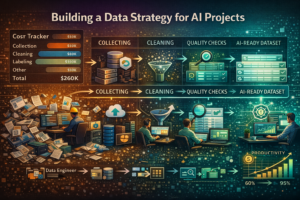
Understanding the Data Funnel: From Collection to Model Input
The Hidden Costs of Data Preparation
Data preparation isn’t a single step—it’s a pipeline with distinct phases, each with associated costs and complexity:
Data Collection: Gathering raw information from various sources. For a AI fraud detection system, this includes transaction records, user behavior, device information, and external data enrichment.
Data Cleaning and Validation: Removing errors, handling missing values, correcting inconsistencies. Studies show 30-40% of raw data contains quality issues.
Feature Engineering: Transforming raw data into meaningful features for models. This step often requires domain expertise and accounts for 40-60% of model accuracy improvements.
Labeling: Creating ground truth labels for supervised learning. For image classification, this might mean manually annotating thousands of images ($2-10 per label depending on complexity).
Data Validation: Ensuring dataset quality through statistical analysis and test set validation.
Cost Structure Example (Building a fraud detection AI system for a fintech company):
- Data collection infrastructure: $50,000-150,000
- Data cleaning and preprocessing: $75,000-200,000
- Feature engineering and transformation: $100,000-300,000
- Labeling 50,000 transactions: $50,000-125,000 (at $1-2.50 per label)
- Data validation and quality assurance: $25,000-75,000
- Total data preparation cost: $300,000-850,000
- Model development cost: $50,000-150,000
The data preparation cost dwarfs model development, yet most organizations allocate budgets the opposite way. This fundamental misalignment causes project failures.
Phase 1: Strategic Data Collection
Defining Data Requirements Before Collection
The most common mistake: collecting data first, defining requirements second. This backwards approach leads to expensive course corrections. Instead, follow this sequence:
Step 1: Define Business Objectives – What specific business problem solves the AI system? For a recommendation engine, the objective might be “increase average order value by 15% through personalized recommendations.”
Step 2: Define Success Metrics – How will you measure if the AI system works? For recommendations: conversion rate, average order value, customer lifetime value. These metrics guide data collection—you must collect data enabling these measurements.
Step 3: Identify Required Features – Working backwards from success metrics, what data inputs drive these metrics? For recommendations: user browsing history, purchase history, product characteristics, user demographics, temporal patterns.
Step 4: Assess Data Availability – For each required feature, determine if data exists, can be collected, or must be engineered. This assessment identifies data gaps before expensive collection begins.
Step 5: Design Data Collection Infrastructure – How will you collect identified data at scale? Real-time APIs? Batch downloads? Sensor networks? Cost varies 100x depending on approach.
Data Collection Methods and Cost Structures
Internal Data Sources (Lowest Cost): Use existing data from your systems—databases, logs, user behavior tracking, transaction records. Cost: infrastructure investment ($20K-100K) but negligible per-record cost after setup.
Example: A SaaS company building a churn prediction model uses existing customer data (signup date, usage patterns, support tickets, billing history). Extraction cost: ~$10K infrastructure investment, then free ongoing access.
First-Party Partnerships (Low-Medium Cost): Partner with complementary companies to share data. A lending platform partners with credit bureaus for credit history data, pay per record accessed ($0.10-2 per record) or revenue-share arrangement.
Third-Party Data Providers (Medium Cost): Purchase data from companies specializing in data aggregation. Options include:
- Financial data: Bloomberg Terminal ($24K/year), S&P Capital IQ, Refinitiv
- Consumer data: Acxiom, Experian, Equifax ($1K-100K annually depending on volume)
- Alternative data: Satellite imagery ($50-500K annually for specific geographies), web scraping data, credit card transaction aggregators
- Industry-specific data: Healthcare databases, real estate data, patent databases
Crowdsourced Collection (High Cost but Flexible): Recruit participants to provide data, useful for sensitive or personalized data. Cost structure: $5-50 per hour for participant time plus platform fees (Amazon Mechanical Turk, Respondent.io, Prolific). Collecting 10,000 participants for survey data: $50K-500K.
Synthetic Data Generation (Emerging, Cost Variable): Generate artificial data using GANs or diffusion models when real data is unavailable, sensitive, or limited. Useful for privacy-sensitive domains (healthcare, financial) and imbalanced classes. Cost: $10K-100K for generation infrastructure, then free per-record.
Evaluating Data Source Quality and Reliability
Not all data sources are equal. Establish evaluation criteria before committing to collection:
Completeness: What percentage of records contain all required fields? 95%+ completeness is acceptable; below 90% requires imputation strategies that introduce bias.
Timeliness: How quickly does data become available? Real-time for operational systems, 24-hour delay for batch, weeks for historical data archives. Model serving requirements dictate timeliness needs.
Representativeness: Does the data represent the population your model will serve? Common issue: training data skews towards profitable or engaged users, failing on edge cases and underrepresented segments.
Consistency: Do field definitions remain stable over time? Data source that changes schema monthly creates maintenance headaches. Prefer stable sources.
Cost vs. Value: Calculate value per record (ROI-driven). If a feature costs $5 to acquire per record but improves model accuracy only 0.1%, it’s not worth collecting.
Phase 2: Data Cleaning and Validation
Common Data Quality Issues and Solutions
Raw data is inherently messy. According to a Forrester study, knowledge workers spend 60% of their time on data cleanup tasks. Key issues and remediation strategies:
Missing Values (Most Common Issue): Approximately 30% of datasets have missing values in 10%+ of columns. Three approaches:
- Deletion: Remove records with missing values. Simple but loses information. Acceptable only if <5% of records affected.
- Statistical Imputation: Fill with mean, median, or mode. Fast but loses data variability. Acceptable for MCAR (Missing Completely At Random) data.
- Advanced Imputation: Use algorithms (KNN, multiple imputation, regression) capturing relationships between features. Superior quality but computationally expensive. Necessary for MNAR (Missing Not At Random) data where absence itself is informative.
Example: A hospital dataset has 15% missing values in “lab_result” field. Investigation reveals lab results are missing when tests weren’t ordered (information-rich missing). Imputing with mean loses clinical meaning. Instead, create binary feature “lab_ordered” alongside the original, capturing the information in the missingness.
Outliers and Anomalies: Extreme values break models and skew statistics. Detection methods:
- Statistical: >3 standard deviations from mean
- Distance-based: Isolation Forests, Local Outlier Factor
- Domain-based: Domain experts identify implausible values
Don’t automatically delete outliers—investigate. A $10,000 transaction is an outlier in a dataset where median is $50, but legitimate. In fraud detection, outliers are often true fraud cases you want to capture.
Duplicates: Exact and near-duplicates inflate dataset size and bias training. Removal cost: varies from $0 for simple exact matching to $5K+ for fuzzy matching across millions of records. Tools: Pandas (exact), Dedupe library (fuzzy).
Inconsistencies: Same entity represented multiple ways (“USA” vs. “United States” vs. “US”). Data standardization using reference tables or ML classification (90%+ accuracy) costs $2K-20K depending on scale. Necessary because inconsistencies cause 5-15% model accuracy loss.
Type Mismatches: Dates stored as strings, numbers as text, categorical fields with unexpected values. Validation and conversion scripts fix these, cost: $1K-5K for robust implementation.
Data Quality Framework: Cost vs. Improvement Analysis
Every cleaning effort has costs (engineer time, infrastructure, computational resources) and benefits (improved model accuracy). Build ROI analysis before cleaning:
High Priority (ROI > 5x):
- Fixing data type mismatches: $1K cost, 2-5% accuracy improvement
- Handling critical missing values: $3K-10K cost, 5-15% improvement
- Removing exact duplicates: $500-2K cost, 2-10% improvement
Medium Priority (ROI 1-5x):
- Statistical imputation: $5K cost, 1-3% improvement
- Standardizing inconsistent values: $5K-20K cost, 2-8% improvement
- Outlier investigation and handling: $3K-10K cost, 1-4% improvement
Low Priority (ROI < 1x):
- Advanced imputation techniques: $20K+ cost, <1% improvement
- Complex anomaly detection: $10K+ cost, 0.5-2% improvement
Allocate 60% of data cleaning budget to high-priority items, 30% to medium, 10% to low. This Pareto principle application delivers 80% of benefits with 50% of effort.
Phase 3: Strategic Feature Engineering
Feature Engineering as Competitive Advantage
Machine learning models learn patterns in data—but only patterns visible in the feature representation. Two models trained on identical raw data but different feature engineering can vary 20-40% in accuracy.
Examples of powerful features:
Temporal Features: Instead of raw “signup_date,” engineer features like “days_since_signup,” “season_of_signup,” “year_of_signup_is_leap_year.” These capture temporal patterns without requiring date-aware algorithms.
Interaction Features: Combining features often reveals patterns. For e-commerce: “price × user_avg_spend” reveals premium shopper behavior. “product_category × user_location” reveals regional preferences.
Domain-Specific Features: Require domain expertise but often provide outsized accuracy gains. In finance, “debt_to_income_ratio” is more predictive than raw debt and income separately. In healthcare, “BMI” (weight/(height^2)) encodes medical knowledge directly into features.
Aggregation Features: Compute statistics over time windows. For click prediction: “clicks_last_24h,” “clicks_last_7d,” “clicks_7d_to_30d_ago.” These capture recency bias and behavioral patterns.
Feature Engineering Cost-Benefit Analysis
Feature engineering is labor-intensive, justifying only when ROI is positive. Framework for evaluation:
| Feature Type | Development Cost | Typical Accuracy Gain | Maintenance Burden | Recommendation |
|---|---|---|---|---|
| Temporal decomposition (day, month, season) | $500-2K | 1-3% | Low | Always implement |
| Simple interactions (2-3 features) | $1K-3K | 2-5% | Low | Implement if baseline accuracy <80% |
| Complex domain features (requires SME) | $5K-20K | 5-15% | Medium | Implement if domain understanding is critical |
| Automated feature engineering (AutoML) | $3K-10K setup | 2-8% | Low | Use for feature discovery, validate manually |
| Polynomial features (high-dimensional expansion) | $2K-5K | 0.5-2% | High | Avoid without strong justification |
Tools and Frameworks for Feature Engineering
Manual/Custom Engineering (Most Common): Python libraries (Pandas, NumPy, SciPy). Cost: engineering time. Best for domain-specific features requiring business logic.
Automated Feature Engineering:
- Featuretools: Open-source, generates 100s of features automatically. Cost: free software + engineer time (10-20 hours). Accuracy improvement: 2-8%. Best for exploratory phase.
- H2O AutoML: Commercial solution ($5K-50K annually), generates and selects features automatically. Accuracy improvement: 3-10%. Reduces feature engineering time by 70%.
- DataRobot: Enterprise AutoML platform ($100K-500K annually), includes feature engineering. Best for organizations lacking data science expertise.
Feature Store Integration: Once engineered, features should be stored in feature stores (Feast, Tecton, Databricks Feature Store) for reuse across projects and training/serving consistency. Setup cost: $50K-150K, but enables 50K-200K savings through reuse.
Phase 4: Strategic Data Labeling
Data Labeling Economics: Cost vs. Quality Trade-offs
Labeling is often the largest data preparation expense. For computer vision, 1 million images labeled at $1-10 per image = $1M-10M cost. Strategic decisions on labeling approach dramatically impact budget:
Manual Expert Labeling (Highest Quality, Highest Cost):
- Cost: $10-100+ per label depending on complexity
- Accuracy: 95%+ with domain experts
- Timeline: 2-6 weeks for substantial datasets
- Use when: High accuracy is critical (medical diagnosis, autonomous vehicles, regulatory compliance)
Example: Hospital deploying AI for radiology needs expert radiologists to label chest X-rays. Cost: $50 per image × 50,000 images = $2.5M. But accuracy is critical—misdiagnosis has life-or-death consequences.
Crowdsourced Labeling (Medium Quality, Medium Cost):
- Cost: $0.10-5 per label using platforms like Amazon Mechanical Turk, Appen, Scale AI
- Accuracy: 70-85% with majority voting and quality control
- Timeline: 1-3 weeks for large datasets
- Use when: Sufficient training data exists, quality requirements moderate (content moderation, product categorization)
Cost calculation example: Labeling 100,000 images at $0.50/image with Appen = $50K. Adding quality control (expert review of 10% sample) = $60K total. Ensures 85%+ accuracy.
Weak Labeling (Lower Quality, Lowest Cost): Use noisy labels from automatic systems, user feedback, or heuristics. Cost: minimal to free. Accuracy: 50-80% depending on source quality. Use when labels are abundant but imperfect.
- Heuristic rules: “Products with >4.5 stars are good, <2.5 stars are bad” costs nothing but may mislabel edge cases
- User feedback: Implicit labels from user behavior (clicks, purchases) cost nothing but are biased
- Distant supervision: Using external knowledge bases to generate noisy labels
Active Learning (Intelligent Selective Labeling): Label only the most informative examples, reducing labeling cost by 40-70%. Process:
- Train initial model on small labeled dataset (1,000-5,000 examples)
- Apply to unlabeled data, identify uncertain predictions
- Label only uncertain examples
- Retrain and repeat
Result: Achieve target accuracy with 30-50% fewer labels. Cost for 100,000 images with active learning: $15K-25K vs. $50K with random sampling.
Ensuring Label Quality at Scale
Labeling quality directly impacts model quality. A dataset with 10% label error adds 5-15% noise, reducing model accuracy accordingly. Quality assurance strategies:
Inter-Rater Reliability Measurement: Have multiple annotators label same samples, measure agreement. Cohen’s Kappa score >0.8 indicates good agreement. Below 0.6 indicates need for clearer guidelines or annotator replacement.
Expert Spot-Checking: Expert reviews 5-10% of labels from each annotator. Identifies systematic errors (annotator consistently mislabels certain categories). Cost: 10-15% of labeling budget but prevents widespread errors.
Consensus Labeling: Multiple annotators label each example, majority vote determines label. Increases accuracy from ~75% (single annotator) to ~85% (3-5 annotators). Cost multiplier: 3-5x but ensures quality.
Label Correction Post-Training: Train initial model on raw labels, identify examples where model predictions conflict with labels. Expert reviews these conflicts—often finds labeling errors. Correcting 2-5% of labels improves accuracy 5-10%.
Advanced Labeling Strategies
Programmatic Labeling: Use code functions to generate labels at scale. Requires careful design but can label millions of examples instantly. Accuracy depends on function design; expert-designed functions achieve 85-95% accuracy.
Example: For sentiment classification, programmatic label using keyword dictionaries and rules:
def label_sentiment(text):
    positive_words = ['great', 'excellent', 'love', 'awesome']
    negative_words = ['terrible', 'hate', 'awful', 'bad']

    pos_count = sum(1 for word in positive_words if word in text.lower())
    neg_count = sum(1 for word in negative_words if word in text.lower())

    if pos_count > neg_count: return 'positive'
    elif neg_count > pos_count: return 'negative'
    else: return 'neutral'
Programmatic labels are fast (free at scale) but imperfect (60-75% accuracy). Used as weak labels for semi-supervised learning or to label edge cases efficiently.
Transfer Learning from Pre-Labeled Datasets: Instead of labeling from scratch, use pre-labeled datasets from similar tasks. Fine-tune pre-trained models on small labeled datasets (100-1,000 examples). Cost: minimal labeling, focused on your specific domain.
Example: Object detection for warehouse inventory. Instead of labeling 50,000 images from scratch (cost: $50K-100K), use COCO dataset (pre-labeled object detection dataset with 330K images), fine-tune on 2,000 warehouse images. Cost: $2K labeling + model development. Achieves 90%+ accuracy with 95% less labeling cost.
Comprehensive Case Studies
Case Study 1: Building a Customer Churn Prediction System
Organization: Mid-market SaaS company (1,000 enterprise customers, $50M ARR)
Challenge: Customer churn rate 5% monthly ($200K MRR loss). Business goal: predict churn 3 months in advance, enabling retention efforts.
Data Strategy Developed:
Collection Phase:
- Internal sources: Customer account data, product usage logs, support tickets, billing history. No external data required.
- Time investment: 2 weeks to design data extraction, 1 week to build extraction pipelines. Cost: $15K engineer time.
- Result: 24-month historical dataset, 50 initial features, 1,000 churned customers for labeled training set.
Cleaning Phase:
- Issues found: 15% missing values in “last_support_ticket_date” (missing when customers never contacted support—information-rich), 8% data type mismatches, 2% exact duplicates.
- Approach: Missing values kept with binary indicator “contacted_support.” Data type standardization (3 days). Duplicate removal (1 day).
- Cost: $8K engineer time. Accuracy improvement from cleaning: 4%.
Feature Engineering Phase:
- Domain expertise applied: Created 30 new features including:
- “monthly_usage_trend” (usage increasing, flat, declining)
- “support_ticket_sentiment” (positive, negative, neutral)
- “days_since_last_feature_usage” (recency indicator)
- “monthly_feature_diversity” (breadth of product usage)
- Cost: 4 weeks engineer time, $16K. Accuracy improvement: 12%.
Labeling Phase:
- Labels sourced from operational data: customers who canceled subscriptions in following 3 months = churn, others = retain.
- No manual labeling needed. Cost: $0.
- Class imbalance: 5% churn, 95% retain. Addressed with stratified sampling and class weights.
Total Data Preparation Cost: $39K
Results:
- Model accuracy: 94% (98% specificity, 78% sensitivity)
- Churn prediction 3 months in advance: 92% precision
- Retention rate improved from 95% to 96.5% through proactive outreach to predicted churners
- Revenue impact: $300K additional MRR retained annually ($3.6M annually)
- ROI: $3.6M additional revenue / $39K investment = 92x ROI
Case Study 2: Medical Image Classification AI System
Organization: Healthcare AI startup building pneumonia detection from chest X-rays
Challenge: Accuracy critical (misdiagnosis has life-or-death consequences). Dataset required: 50,000 labeled images for competitive model performance.
Data Strategy Developed:
Collection Phase:
- Data source: Partnership with 5 hospitals providing 50,000 historical chest X-rays. Agreement: hospitals retain data ownership, startup uses for model development.
- Timeline: 8 weeks for HIPAA compliance, data use agreements, infrastructure setup.
- Cost: $150K legal and compliance, $50K infrastructure. Total: $200K.
Data Privacy Phase (Healthcare-Specific):
- All PHI (Protected Health Information) removed: names, medical record numbers, dates (replaced with “time since exam”).
- DICOM metadata stripped.
- De-identification cost: $20K.
Labeling Phase (Critical Quality Focus):
- Approach: Expert radiologists manually labeled all images for “pneumonia present” vs. “no pneumonia.”
- Quality assurance: Two radiologists independently labeled 20% of images (10,000), measured agreement. Cohen’s Kappa: 0.92 (excellent agreement).
- Cost: $200K ($4 per image × 50,000 images) for radiologists, $50K for QA process.
- Total labeling: $250K.
Validation Phase:
- Split: 70% training (35,000), 15% validation (7,500), 15% test (7,500).
- Test set labeled by independent radiologist to prevent overfitting to labeling bias.
- Cost: $30K additional radiologist time.
Total Data Preparation Cost: $530K
Results:
- Model accuracy: 97.2% (97% sensitivity, 97% specificity)
- Comparable to radiologist performance (96.5% accuracy on same test set)
- Deployment: Integrated into 3 hospital systems for assistive diagnosis (not replacing radiologists).
- Clinical impact: Average diagnosis time reduced from 45 minutes to 12 minutes
- Revenue: $2M in year-one licensing from hospitals
- Cost per deployment: $530K development + $100K/hospital/year licensing infrastructure = 1.3x ROI year one, 4x+ by year three
Building Enterprise Data Pipelines
Automating Data Cleaning and Preparation
Manual data cleaning doesn’t scale. Enterprise organizations build automated data pipelines processing data continuously. Architecture:
Data Ingestion Layer: Collects data from sources (APIs, databases, data warehouses, logs). Tools: Apache Kafka, AWS Kinesis, Azure Event Hubs. Cost: $5K-50K monthly depending on volume.
Data Transformation Layer: Applies cleaning and standardization rules. Tools: Apache Spark, dbt (data build tool), Python/Pandas. Cost: engineering time ($50K-200K annually) to build pipelines.
Feature Engineering Layer: Computes derived features. Tools: Spark, Flink, Feature stores (Feast, Tecton, Databricks Feature Store). Cost: $50K-150K setup, $5K-30K monthly operations.
Data Quality Monitoring: Detects data quality issues, alerts engineers. Tools: Great Expectations, Databand, custom scripts. Cost: $10K-50K setup.
Total Pipeline Cost: $200K-500K initial, $30K-150K monthly operations
Payback period: 3-6 months through reduced manual labor, fewer data errors, faster time-to-model.
Data Strategy Best Practices
Selecting the Right Data Strategy
No one-size-fits-all data strategy. Decision framework:
| Project Characteristic | Recommended Strategy | Rationale |
|---|---|---|
| Accuracy critical (medical, autonomous vehicles, financial) | Expert labeling, comprehensive validation | Quality over cost. Misclassification has high cost. |
| Abundant weak labels available (user feedback, implicit signals) | Weak labeling + semi-supervised learning | Leverage free labels, reduce manual labeling |
| Small labeled dataset, large unlabeled pool | Active learning + transfer learning | Minimize labeling cost while achieving target accuracy |
| Rapidly changing domain (trending topics, new products) | Automated retraining + continuous labeling | Models decay quickly, need frequent updates |
| Privacy-sensitive data (healthcare, finance) | Federated learning, differential privacy, synthetic data | Minimize data exposure risk |
| Budget-constrained startup | Transfer learning + public datasets + weak labels | Minimize labeling and collection costs |
ROI Metrics for Data Initiatives
Justify data investments using business metrics:
Revenue Impact: Models improving conversion, retention, or average transaction value directly increase revenue. Calculate: (accuracy improvement × transaction volume × avg value) = additional annual revenue.
Cost Reduction: Models automating manual processes reduce labor costs. Calculate: (manual cost per process × volume) – (model operational cost) = annual savings.
Speed/Efficiency Gains: Models accelerating decisions or processes save time. Calculate: (hours saved × labor cost per hour) – (operational cost) = annual benefit.
Risk Reduction: Models identifying fraud, compliance issues, or operational problems prevent losses. Calculate: (loss prevention × probability) – (model cost) = net value.
Payback Period: Divide total investment by annual benefits. Target: <12 months. Projects with >18 month payback struggle for ongoing funding.
Future Trends in Data Strategy
Emerging Approaches
Synthetic Data: Generate artificial data using GANs and diffusion models when real data is scarce or sensitive. Improving rapidly—synthetic data now achieves 95%+ accuracy parity with real data. Eliminates privacy concerns, reduces collection costs.
Foundation Models + Few-Shot Learning: Large pre-trained models (GPT-4, Claude, Llama) trained on billions of examples enable effective learning from tiny labeled datasets (10-100 examples). Disrupts traditional labeling—many projects need only 1-5% of historical labeling volume.
Federated Learning: Train models across distributed data sources without centralizing data. Enables collaboration between organizations while maintaining privacy. Cost-effective for privacy-critical domains.
Actionable Takeaways
- Plan Data Strategy Before Collecting Data: Invest 2-4 weeks in planning, saving months of wasted collection. Define business objectives, success metrics, required features in sequence.
- Allocate Budget Appropriately: Spend 50-60% of AI project budget on data preparation, not model development. This inverts typical spending but aligns with true cost drivers.
- Implement Automated Data Pipelines Early: Manual processes don’t scale. Build or buy pipeline automation infrastructure. Payback in 3-6 months through reduced errors and engineering time.
- Use Active Learning for Labeling: Achieve target accuracy with 40-50% fewer labels. Cost reduction: $20K-100K+ depending on project scale.
- Implement Data Quality Monitoring: Detect issues early before impacting model accuracy. Cost: $10K-50K setup. Prevents far more expensive remediation later.
- Leverage Transfer Learning and Pre-Labeled Data: Dramatically reduce labeling costs (60-80% reduction) by building on existing datasets and models.
- Validate Label Quality Rigorously: Spend 10-15% of labeling budget on quality assurance. Prevents widespread errors that degrade model accuracy.
- Measure ROI Comprehensively: Justify data initiatives with revenue impact, cost reduction, efficiency gains, and risk prevention metrics. Target <12 month payback period.
Continue Learning: Related Articles
AI Data Preparation and Feature Engineering Tools: Trifacta vs Alteryx vs DataRobot vs Dataiku
AI Data Preparation Tools: Comprehensive Comparison of Leading Solutions 2025
Data preparation and feature engineering …
📖 4 min read
AI in Agriculture: Smart Farming, Crop Monitoring, and Yield Prediction Revolution
The Agricultural Transformation
Agriculture faces unprecedented challenges: feeding a growing global population while c…
📖 7 min read
AI in Finance: How Machine Learning is Transforming Fraud Detection and Risk Management
Introduction to AI in Financial Services
The financial services industry stands at the forefront of artificial intellig…
📖 7 min read
Deep Learning for Stock Market Prediction: Opportunities and Challenges
Applying deep learning to Financial Markets
Stock market prediction has long been a goal of investors, analysts, and re…
📖 5 min read
💡 Explore 80+ AI implementation guides on Harshith.org
Frequently Asked Questions
Q: How much data do I really need before starting an AI project?
A: Depends on the AI task, but general minimums: Classification tasks (fraud detection, content moderation): 10,000+ labeled examples per category. Prediction tasks (AI sales forecasting, demand planning): 12-24 months of historical data with hundreds of examples. NLP tasks (chatbots, sentiment analysis): 5,000-10,000 labeled conversations. Computer vision (object detection, quality inspection): 1,000-10,000 labeled images per object class. However, more data doesn’t always mean better results – I’ve seen projects with 1M low-quality records perform worse than 10K high-quality records. Focus on data quality over quantity. If you don’t meet these minimums, consider: transfer learning, synthetic data generation, or starting with a smaller scope pilot.
Q: What’s the biggest data mistake companies make when starting AI projects?
A: Underestimating data preparation effort. Most companies think AI implementation is: 10% data work, 90% model building. Reality is inverted: 70-80% data work (collection, cleaning, labeling, feature engineering), 20-30% model building. I’ve seen companies budget 3 months for AI projects, spend 2.5 months just getting data into usable shape, then rush the modeling and fail. Second biggest mistake: assuming data quality is good without validating. One company discovered 35% of their “ground truth” labels were wrong after their model performed poorly – they’d trained AI on garbage data. Before starting any AI project, audit data quality: check for completeness, accuracy, consistency, and representative coverage of edge cases.
Q: How do I handle data labeling – in-house, outsource, or use tools?
A: Depends on volume, complexity, and sensitivity. In-house labeling: Best for sensitive data (healthcare, financial), complex domain expertise required, or small volumes (<5,000 items). Cost: $25-60/hour for skilled labelers. Outsourced labeling: Best for large volumes (50,000+ items), simple labeling tasks, non-sensitive data. Services like Labelbox, Scale AI, or Amazon MTurk cost $0.05-$2.00 per label depending on complexity. Hybrid approach: Most effective – use in-house experts to label seed dataset (1,000-2,000 examples), use that to train active learning model, model suggests labels for outsourced labelers to verify (faster and cheaper). For 100,000 image labels: fully manual costs $50K-100K, hybrid with AI assistance costs $15K-25K.
Q: What about data privacy and compliance – how do I use customer data for AI legally?
A: Critical considerations: (1) GDPR (EU customers): Need explicit consent for AI processing, must allow opt-out, must explain automated decisions. (2) CCPA (California): Must disclose data use for AI, allow opt-out. (3) HIPAA (healthcare): PHI can be used for AI if de-identified or under Business Associate Agreement. (4) Industry-specific: Financial services, legal, and government have additional restrictions. Best practices: anonymize/pseudonymize data where possible, get explicit consent in privacy policy for AI use, implement data minimization (only use what’s necessary), document data governance and audit trails, ensure AI vendors sign appropriate data agreements. Work with legal counsel before using customer data for AI – violations can cost millions in fines.
Q: How do I know if my data quality is good enough for AI?
A: Run these data quality checks before starting: (1) Completeness: What % of records have all required fields? Target: 95%+. (2) Accuracy: Sample 100 random records and verify correctness. Target: 95%+ accurate. (3) Consistency: Are values formatted consistently (dates, names, categories)? Check for duplicates, typos. (4) Timeliness: Is data recent enough to reflect current patterns? Old data might not predict future. (5) Representative: Does data cover all scenarios including edge cases? If you’re building fraud detection but only have data from non-fraud cases, it won’t work. (6) Balanced: For classification, do you have enough examples of each class? Imbalanced data (95% class A, 5% class B) requires special handling. If any metric is below 90%, fix data quality before proceeding with AI.
Q: Should I store data in a data warehouse, data lake, or database for AI?
A: Use all three for different purposes. Data Lake (S3, GCS, Azure Blob): Store raw data in native formats (logs, images, videos) – cheap storage, good for archival and batch ML training. Data Warehouse (Snowflake, BigQuery, Redshift): Store structured, cleaned data for analytics and feature engineering – fast queries, good for reporting and batch ML. Database (PostgreSQL, MongoDB): Store operational data for real-time applications – low latency, good for serving ML predictions. Feature Store (Feast, Tecton): Store engineered features for ML – optimized for training and serving. Modern data architecture uses: raw data → data lake, cleaned data → warehouse, aggregated features → feature store, predictions → database. Don’t try to use one system for everything – each serves different purposes in the AI pipeline.
Conclusion
Data strategy determines AI project success more than any other factor. The difference between 15% success rate (industry average) and 85%+ success rate is rarely better algorithms—it’s better data.
Organizations investing comprehensively in data collection, cleaning, feature engineering, and labeling strategies report:
- Model accuracy improvements 15-35%
- Development timeline reductions 30-50%
- Operational costs 40-60% lower
- Project success rates 85%+
The framework presented here—structured collection, rigorous cleaning, thoughtful feature engineering, and strategic labeling—can be applied to any industry and problem domain. Start with your specific constraints (budget, accuracy requirements, timeline) and select the data strategy components providing maximum ROI.
The companies winning in AI aren’t those with the smartest algorithms—they’re those with the best data strategies. Invest accordingly.
