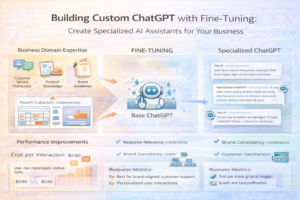
Building Custom ChatGPT with Fine-Tuning: Create Specialized AI Assistants for Your Business
Meta Description: Build custom ChatGPT assistants for your business using fine-tuning, RAG, and prompt engineering. Learn implementation strategies, costs, and ROI for specialized AI applications.
Introduction: Moving Beyond Off-the-Shelf
General-purpose ChatGPT excels at broad questions but lacks domain expertise and company-specific knowledge. A financial advisor needs to understand your company’s policies. A technical support bot needs product documentation. A sales assistant needs accurate pricing and features.
By 2026, creating specialized ChatGPT variants is standard practice. Three primary approaches exist: prompt engineering (free but limited), Retrieval-Augmented Generation (RAG) (flexible, recommended), and fine-tuning (expensive but powerful). This guide covers all three, helping you choose the right strategy for your use case.
Three Approaches to Custom ChatGPT
Comparison Matrix
| Approach | Cost to Implement | Cost per Query | Performance | Setup Time | Flexibility | Best For |
|---|---|---|---|---|---|---|
| Prompt Engineering | $0 | Standard API cost | Moderate (70-75%) | Minutes | Very high (just change prompt) | Quick prototypes, simple domains |
| RAG (Retrieval-Augmented Generation) | $500-5,000 | Standard API + retrieval cost | High (85-92%) | 1-2 weeks | High (update documents) | Document QA, customer service |
| Fine-Tuning | $5,000-20,000 | Higher (fine-tuned model) | Very High (90-97%) | 2-4 weeks | Medium (need retraining) | High-volume, specialized tasks |
| Hybrid (RAG + Fine-Tuning) | $10,000-40,000 | Higher | Excellent (92-98%) | 3-6 weeks | Medium | Enterprise, mission-critical |
Approach 1: Prompt Engineering – The Quick Start
Overview
Shape ChatGPT’s behavior through carefully crafted system prompts and instructions. No training required.
Prompt Engineering Template
You are an expert financial advisor for [Company Name].
Your knowledge base includes:
- Company financial products: [list]
- Customer policies: [description]
- Common FAQs: [list]
- Compliance requirements: [key points]
Your responsibilities:
1. Answer questions about products accurately
2. Recommend products based on customer needs
3. Escalate complex questions to human advisors
4. Never make up information about products
5. Always mention that this is not financial advice
Response format:
- Start with direct answer
- Provide 1-2 supporting details
- End with relevant offer or escalation path
If you don't know something, say: "I don't have information about that. Let me connect you with a specialist."
Strengths:
- Zero implementation cost
- Instant to deploy
- Easy to iterate and improve
- No training data required
Weaknesses:
- Limited to general knowledge (hallucination risk)
- Can’t reliably handle company-specific details
- Consistency issues across conversations
- Knowledge becomes outdated
- Hard to enforce strict business logic
Typical Performance: 65-75% accuracy on domain-specific questions
Best For: Quick MVPs, initial testing, simple domains with minimal company-specific knowledge
Approach 2: RAG (Retrieval-Augmented Generation) – The Recommended Solution
Overview
Retrieve relevant documents from a knowledge base, then ask ChatGPT to answer using those documents as context. Combines ChatGPT’s reasoning with your company’s knowledge.
RAG Architecture
Query from User
 ↓
 Query Embedding (convert to vector)
 ↓
 Vector Similarity Search (find relevant documents)
 ↓
 Retrieve Top-K Documents
 ↓
 Format as Context
 ↓
 ChatGPT Prompt with Context + Query
 ↓
 Response Generation
 ↓
 Answer to User
Step 1: Prepare Your Knowledge Base
Collect all relevant documents:
- Product documentation
- Customer policies
- FAQ documents
- Case studies
- Pricing documents
- Process guides
Format: PDF, markdown, HTML, or plain text. Total size: 100KB to 100MB typical.
Step 2: Chunk and Embed Documents
from langchain.document_loaders import PDFLoader
 from langchain.text_splitter import RecursiveCharacterTextSplitter
 from langchain.embeddings import OpenAIEmbeddings
 from langchain.vectorstores import Pinecone
# Load documents
loader = PDFLoader("customer_policies.pdf")
docs = loader.load()
# Split into chunks (important: overlap for context)
splitter = RecursiveCharacterTextSplitter(
chunk_size=1000, # characters per chunk
chunk_overlap=200 # overlap between chunks
)
chunks = splitter.split_documents(docs)
# Generate embeddings
embeddings = OpenAIEmbeddings()
# Store in vector database
vector_store = Pinecone.from_documents(chunks, embeddings, index_name="my-index")
Key Decisions:
- Chunk Size: 500-2000 characters typical. Smaller = more precise, larger = more context
- Overlap: 10-20% of chunk size prevents information loss at boundaries
- Embedding Model: OpenAI text-embedding-3-small (cheapest), text-embedding-3-large (best quality)
Step 3: Implement Retrieval and Query
from langchain.chains import RetrievalQA
 from langchain.llms import OpenAI
# Create RAG chain
qa_chain = RetrievalQA.from_chain_type(
llm=OpenAI(model="gpt-4o", temperature=0.1),
chain_type="stuff", # or "map_reduce" for longer documents
retriever=vector_store.as_retriever(search_kwargs={"k": 3}), # retrieve top 3 docs
return_source_documents=True # show which docs were used
)
# Query
query = "What is the return policy for orders over $100?"
result = qa_chain({"query": query})
answer = result["result"]
sources = result["source_documents"]
Step 4: Add System Prompt for Consistency
system_prompt = """You are a helpful customer service assistant for [Company].
Guidelines:
1. Answer only using information from provided documents
2. If information not in documents, say "I don't have that information"
3. Be concise (keep answers under 150 words)
4. Always include relevant links or contact info from documents
5. For complex issues, suggest escalation to human agent
Current date: 2026-02-08
"""
# Integrate into chain
qa_chain.prompt = PromptTemplate(
input_variables=["context", "question"],
template=system_prompt + "nnContext: {context}nnQuestion: {question}",
)
RAG Performance Optimization
- Multi-Query Retrieval: Generate multiple query variations, retrieve for all, combine results (5-10% accuracy improvement)
- Reranking: Use a reranker model to better order retrieved documents (3-5% improvement)
- Hybrid Search: Combine vector similarity with BM25 keyword search (2-5% improvement)
- Query Expansion: Expand queries with synonyms, related terms
Cost Analysis for RAG
| Component | Cost | Notes |
|---|---|---|
| Vector Database (Pinecone/Weaviate) | $50-500/month | Depends on storage (embeddings size) |
| Embeddings (text-embedding-3-small) | $0.02 per 1M tokens | One-time for documents + occasional updates |
| LLM Queries (GPT-4o) | $0.15-0.60 per 1M tokens | Depends on model and token usage |
| Application Infrastructure | $200-1000/month | Server, API gateway, monitoring |
| Total Monthly (10K queries) | $300-2000 | Assuming avg 200 tokens per query |
Typical Performance: 85-92% accuracy on document-grounded questions
Best For: Customer service, product support, FAQ automation, document Q&A, HR assistance
Real Example: Customer Service Bot for SaaS Company
- Knowledge Base: 50 support articles + pricing doc + terms (2MB total)
- Queries/month: 10,000 (50 customers × 200 questions)
- Accuracy Before: 60% (customers frustrated, needed human support)
- Accuracy After: 88% (good enough for 70% of queries, human escalation for rest)
- ROI: $50K/year (3 support agents freed to tier-2 work) vs $5K/year system cost
- Implementation Time: 2 weeks
Approach 3: Fine-Tuning – Maximum Specialization
Overview
Train a custom ChatGPT model on your data, so it “learns” your domain knowledge, style, and business logic.
When Fine-Tuning Makes Sense
- High-volume queries (10K+/month) where API costs exceed fine-tuning cost
- Need consistent formatting/style across responses
- Model should understand complex business rules
- Latency-sensitive applications (fine-tuned models slightly faster)
- Proprietary knowledge must stay off-premises (but fine-tuning still sends data to OpenAI)
Data Preparation for Fine-Tuning
Create training data: input-output pairs of conversations you want the model to learn.
{"messages": [
 {"role": "system", "content": "You are a financial advisor"},
 {"role": "user", "content": "What's the best investment strategy for high inflation?"},
 {"role": "assistant", "content": "In high inflation environments, consider: 1) Treasury Inflation-Protected Securities (TIPS)..."}
 ]}
{"messages": [
{"role": "system", "content": "You are a financial advisor"},
{"role": "user", "content": "Should I put money in crypto?"},
{"role": "assistant", "content": "Cryptocurrency is volatile. Most advisors recommend no more than 5% portfolio allocation. Consider your risk tolerance..."}
]}
Data Requirements
- Minimum: 100 examples (will improve but not dramatically)
- Recommended: 500-1000 examples (good improvement 2-5%)
- Optimal: 5000+ examples (excellent improvement, 5-10%)
Data Collection Strategy
- Collect real conversations from your support team (scrub PII)
- Have domain experts write additional Q&A pairs
- Generate synthetic data (use GPT to create variations)
- Manual review and quality control (critical!)
OpenAI Fine-Tuning API Usage
import openai
# Prepare data
training_data = [...] # list of message dictionaries
# Save to file
with open("training_data.jsonl", "w") as f:
for example in training_data:
f.write(json.dumps({"messages": example["messages"]}) + "n")
# Create fine-tuning job
response = openai.FineTuning.create(
training_file="training_data.jsonl",
model="gpt-4o",
hyperparameters={
"n_epochs": 3, # Train on data 3 times
"learning_rate_multiplier": 0.1, # Start conservative
}
)
job_id = response["id"]
# Monitor progress
status = openai.FineTuning.retrieve(job_id)
print(status["status"]) # "running", "succeeded", "failed"
# Once done, use fine-tuned model
response = openai.ChatCompletion.create(
model=status["fine_tuned_model"], # "gpt-4o-2024-11-20:openai-user-xxxxx"
messages=[{"role": "user", "content": "Your question"}]
)
Fine-Tuning Costs
OpenAI Fine-Tuning Pricing (2026):
| Component | Cost |
|---|---|
| Training (per 1M tokens) | $3 (GPT-3.5), $15 (GPT-4o) |
| Usage (per 1M input tokens) | $0.15 (GPT-3.5), $0.30 (GPT-4o) |
| Usage (per 1M output tokens) | $0.60 (GPT-3.5), $1.20 (GPT-4o) |
Example Cost Calculation: 500 Training Examples
- Average 1000 tokens per example = 500K tokens total
- Training cost: 500K × $3 / 1M = $1.50 (GPT-3.5) or $7.50 (GPT-4o)
- Usage cost: 10,000 queries/month × 200 tokens average = 2M tokens
- Input cost: 2M × $0.30 / 1M = $0.60 (GPT-4o)
- Total monthly usage: $0.60 + inference costs
When Fine-Tuning Becomes Cost-Effective
- At 10,000 queries/month: Fine-tuning $50-200 (one-time) + $50-100/month usage
- vs RAG approach: $300-2000/month
- Break-even: 2-6 months depending on volume
- After break-even: Fine-tuning saves 60-80% on ongoing costs
Example ROI: High-Volume Support Bot
- Scenario: Enterprise company, 100K queries/month
- RAG Cost: $5,000/month (vector DB + embeddings + LLM)
- Fine-tuning Cost: $2,000 one-time training + $2,000/month usage
- Year 1 Savings: $60,000 – $26,000 = $34,000
- Payback Period: 7 months
Fine-Tuning Tips for Success
- Quality over Quantity: 100 high-quality examples beat 1000 mediocre ones
- Balance Classes: If you have 80% support Q&A and 20% sales questions, sample accordingly
- Avoid Overfitting: Reserve 20% of data for validation, monitor loss
- Start Small: Fine-tune on 100 examples first, measure improvement, add more if needed
- Monitor Drift: Retrain monthly with new examples to stay current
- Use Validation Set: Always test on examples not in training data
Typical Performance: 90-97% accuracy on specialized domain tasks
Hybrid Approach: RAG + Fine-Tuning
Best of Both Worlds
Use fine-tuning for core domain knowledge + RAG for dynamic document updates.
Architecture:
- Fine-tune on high-quality examples (policies, processes)
- Use fine-tuned model to understand queries better
- Retrieve relevant documents via RAG
- Feed retrieved documents + query to model
Benefits:
- Fine-tuning improves document understanding
- RAG ensures up-to-date information
- Better handling of edge cases
- Higher accuracy than either alone (2-5% improvement)
Cost: ~$5,000-10,000 initial + $500-2000/month ongoing
Best For: Enterprise applications where quality is critical, e.g., legal, medical, financial
Implementation Roadmap
Phase 1: Quick MVP (Week 1)
- Create system prompt for ChatGPT
- Test with actual questions
- Measure accuracy (70-75% typical)
- Cost: $0
Phase 2: Add RAG (Week 2-3)
- Set up vector database (Pinecone, Weaviate, or Milvus)
- Load your knowledge base documents
- Integrate retrieval into LLM chain
- Test and iterate (accuracy: 85-92%)
- Cost: $1,000-5,000
Phase 3: Collect Training Data (Week 4-6)
- Gather real conversations (scrub PII)
- Have experts write additional examples
- Quality control and review
- Format for fine-tuning
Phase 4: Fine-Tuning (Week 7-8)
- Start with small fine-tuning (100 examples)
- Validate improvement
- Add more data if beneficial
- Deploy fine-tuned model
- Cost: $5,000-20,000
Phase 5: Production & Monitoring (Week 9+)
- Monitor accuracy metrics
- Collect new examples for retraining
- Monthly retraining with new data
- A/B test different approaches
Key Takeaways
- Start with prompting: It’s free and works for many use cases. Implement in minutes.
- RAG is the golden middle: Most applications benefit from RAG. It’s flexible, relatively cheap ($500-2000/month), and achieves 85-92% accuracy.
- Fine-tuning for high-volume: Only economical at 10K+ queries/month. But when it makes sense, saves 60-80% on ongoing costs.
- Hybrid is best: RAG + fine-tuning provides highest accuracy (92-98%) for mission-critical applications.
- Data quality is critical: Garbage training data produces garbage models. Invest in data quality.
- Always measure accuracy: Have humans evaluate outputs on held-out test set before deploying to production.
- Plan for updates: Knowledge changes. RAG documents can update instantly. Fine-tuned models need retraining monthly.
- Cost varies wildly: From $0 (prompting) to $40K+ (hybrid enterprise). Choose based on your requirements and volume.
Getting Started
Start with a prompt-based MVP today. Measure accuracy on 100 test questions. If accuracy is 75%+, you’re done. If not, implement RAG next week. Most projects find RAG sufficient. Only implement fine-tuning if you have >5K monthly queries and 95%+ accuracy is required. Remember: good data beats sophisticated algorithms. Invest in data quality first.
Continue Learning: Related Articles
ChatGPT for Enterprise: Implementation Strategy, Security Considerations, and ROI Analysis
ChatGPT for Enterprise: Implementation Strategy, Security Considerations, and ROI Analysis
Meta Description: Implement …
📖 13 min read
ChatGPT API vs Claude API vs Google Gemini API: Complete Comparison for Developers
ChatGPT API vs Claude API vs Google Gemini API: Complete Comparison for Developers 2026
Meta Description: Compare ChatG…
📖 9 min read
ChatGPT vs Claude vs Gemini: Ultimate AI Chatbot Comparison
The AI Chatbot Revolution
The competition among AI chatbots has intensified dramatically, with OpenAI's ChatGPT, Anthro…
📖 6 min read
The ChatGPT Phenomenon and the Rise of Large Language Models
In November 2022, OpenAI released ChatGPT, sparking an AI revolution that captured global attention. Within five days, i…
📖 5 min read
💡 Explore 80+ AI implementation guides on Harshith.org
