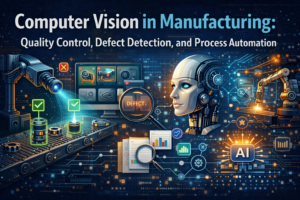
Computer Vision in Manufacturing: Quality Control and Intelligent Automation
Manufacturing has traditionally relied on human inspectors to detect defects, verify quality, and catch errors before products reach customers. However, human inspection is slow, inconsistent, expensive, and impossible to scale to modern manufacturing volumes. Computer vision—the ability of machines to interpret visual information—is revolutionizing manufacturing by automating quality control, detecting defects with superhuman accuracy, and enabling new forms of process automation that were previously impossible.
This comprehensive guide explores how computer vision is transforming manufacturing, the specific applications driving this transformation, implementation approaches, and the measurable business benefits organizations are achieving.
The Manufacturing Quality Challenge
Modern manufacturing operates at enormous scales—thousands of units produced hourly. Detecting defects with 100% accuracy is impossible for human inspectors working at these speeds. Yet undetected defects damage brand reputation, trigger expensive recalls, and expose companies to liability. This fundamental tension between speed and quality creates enormous pressure on manufacturers.
Computer vision addresses this challenge by providing consistent, tireless inspection that exceeds human capabilities in speed and accuracy. Systems can inspect every single unit, catching defects humans miss while operating at line speed.
Computer Vision Applications in Manufacturing
Defect Detection: Computer vision systems trained on images of acceptable and defective parts can automatically identify defects—scratches, dents, color variations, misalignment, contamination—with accuracy exceeding 99%. Systems catch defects that would be missed by human inspectors.
Dimensional Verification: AI systems verify that parts meet dimensional specifications by analyzing images. This is faster and more accurate than manual measurement with calipers and provides 100% coverage rather than sampling.
Assembly Verification: Computer vision confirms that assemblies are complete and correct—all components present, properly oriented, and correctly assembled. This catches assembly errors immediately rather than downstream.
Surface Quality Assessment: Systems analyze surface finish, texture, and appearance against specifications, catching quality issues in paint, coatings, and surface treatments.
Packaging and Labeling: Vision systems verify that products are correctly packaged, labeled correctly, and properly sealed. Errors in packaging are caught before shipment.
Robot Guidance: Computer vision enables robots to identify object location, orientation, and type, allowing flexible automation. Robots equipped with vision can handle variable inputs and adapt to changes.
Process Monitoring: Cameras monitor manufacturing processes, detecting when processes drift out of spec before defects are created. Predictive monitoring prevents waste.
Computer Vision Technologies for Manufacturing
Convolutional Neural Networks (CNNs): Deep learning models specifically designed for image analysis. CNNs learn patterns that distinguish good parts from defects through training on examples.
Object Detection: Identifies and locates specific features or defects within images. YOLO and R-CNN architectures enable real-time detection even on fast-moving production lines.
Semantic Segmentation: Classifies each pixel in an image, enabling precise understanding of complex scenes and surfaces.
Edge Detection and Analysis: Identifies edges and boundaries to verify dimensional accuracy and detect misalignment.
Color and Texture Analysis: Detects variations in color and texture that indicate surface defects or material issues.
Implementation Approaches
Off-the-Shelf Solutions: Commercial vision systems from companies like Cognex, Basler, and others provide pre-built solutions for common applications. Lower cost, faster deployment, less customization.
Custom Deep Learning Models: Training custom models on your specific parts and defect types. Higher accuracy for your specific use case but requires substantial training data and expertise.
Transfer Learning: Using pre-trained models (trained on millions of images) as starting point, then fine-tuning on your specific parts. Faster training, requires less data, effective for many applications.
Hybrid Approaches: Combining traditional image processing for dimensional verification with deep learning for defect detection, leveraging strengths of each approach.
Real-World Manufacturing Success Stories
Electronics Manufacturing: A manufacturer of circuit boards deployed vision-based defect detection, catching soldering defects and missing components with 99.8% accuracy. Defect detection improved from 85% (human inspection) to 99.8% (vision), reducing warranty returns by 40%.
Automotive Supplier: Implemented computer vision for dimensional verification on machined parts, eliminating 100% of out-of-spec parts before assembly. Manual measurement with sampling missed 2-3% of defects; vision inspection caught all defects.
Food Manufacturing: Deployed vision systems to detect foreign objects, damage, and contamination in food products. System catches defects human inspectors miss, improving food safety and brand reputation.
Pharmaceutical: Implemented vision inspection for tablet appearance and packaging verification. Automated inspection handles 24/7 operations, something human inspectors cannot do. Improved batch consistency and reduced defects by 35%.
Challenges and Solutions in Manufacturing Vision
Lighting Variability: Inconsistent lighting makes vision systems unreliable. Solution: Use specialized lighting (backlighting, ring lights, or structured light) that creates consistent imaging conditions.
Training Data Requirements: Deep learning systems require substantial training data. Solution: Use transfer learning, synthetic data generation, or work with vendors who have pre-trained models.
Line Speed Constraints: Cameras must capture and analyze images at production line speed. Solution: Use high-speed cameras and edge computing to process locally without network latency.
Dealing with Variation: Manufacturing involves inherent variation—different batches, lighting, product angles. Solution: Train systems on diverse examples capturing this variation.
Integration Complexity: Integrating vision systems with manufacturing equipment requires expertise. Solution: Work with integrators or use modular, plug-and-play solutions.
ROI from Manufacturing Computer Vision
Quality Improvement: Detection accuracy improves from 85-95% (human) to 99%+ (vision). Fewer defects reaching customers, reduced warranty costs and recalls.
Cost Reduction: Eliminating human inspectors, reducing scrap and rework, and improving first-pass yield. Typical savings: 20-30% of inspection costs plus additional savings from defect reduction.
Speed Improvement: Vision inspection at line speed vs. sampling inspection. Enables faster production without quality compromise.
Capacity Increase: With consistent defect detection, manufacturers can increase production speed, using freed-up line capacity for additional volume.
Data Collection: Vision systems generate valuable data about defect types, trends, and process performance, enabling continuous improvement.
Typical ROI: Manufacturing computer vision projects typically achieve 200-400% ROI within 2-3 years through combination of cost reduction and quality improvement.
Best Practices for Manufacturing Vision Implementation
Start with High-Impact Areas: Target inspection tasks causing largest quality problems or highest costs.
Get Lighting Right: Invest in proper lighting infrastructure. This is critical to system performance.
Acquire Quality Training Data: Good training data is critical. Capture examples of good parts, and all types of defects you want to detect.
Pilot Before Full Deployment: Run parallel inspection (vision + human) to validate accuracy before relying solely on vision.
Plan for Continuous Improvement: Systems improve over time as they encounter new defect types. Design processes for model updates and retraining.
Future Trends in Manufacturing Vision
We’ll see more sophisticated vision systems using multiple imaging modalities (visible, thermal, depth), tighter integration with robotic systems enabling flexible automation, and AI systems that can learn from occasional human feedback rather than requiring massive training datasets. 3D vision will become standard for complex assemblies.
Conclusion
Computer vision is fundamentally transforming manufacturing quality control and automation. By providing consistent, accurate, tireless inspection at production line speeds, vision systems catch defects that would escape human notice, significantly improving product quality while reducing costs. As computer vision technology matures and costs decrease, adoption will accelerate across manufacturing. Organizations implementing these systems now will gain substantial competitive advantages in quality and efficiency.
Continue Learning: Related Articles
Medical Image Analysis with AI: Diagnostic Applications, Challenges, and Implementation Guide
Medical Image Analysis with AI: Diagnostic Applications, Challenges, and Implementation Guide
Meta Description: Impleme…
📖 11 min read
Object Detection Algorithms Explained: YOLO vs Faster R-CNN vs EfficientDet
Object Detection Algorithms Explained: YOLO vs Faster R-CNN vs EfficientDet 2026
Meta Description: Compare YOLO, Faster…
📖 11 min read
Computer Vision: From Image Recognition to Real-World Applications
Introduction to Computer Vision
Computer vision is a subfield of artificial intelligence that trains computers to unders…
📖 4 min read
💡 Explore 80+ AI implementation guides on Harshith.org
