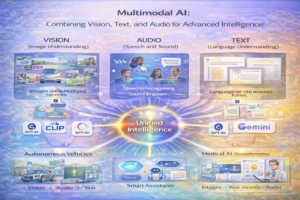
Multimodal AI: Combining Vision, Text, and Audio for Advanced Intelligent Systems
Artificial intelligence has traditionally specialized in single modalities—computer vision focused exclusively on images, natural language processing handled text, and speech recognition processed audio. However, humans perceive the world through multiple sensory inputs simultaneously, integrating information from vision, hearing, and other senses to understand complex situations. This gap between human cognition and traditional AI has driven the development of multimodal AI, which integrates information from multiple sensory or data modalities to create more intelligent, context-aware systems.
Multimodal AI represents a significant breakthrough in artificial intelligence, enabling systems to understand and respond to complex real-world scenarios with the nuance and context awareness that characterizes human intelligence. This comprehensive guide explores what multimodal AI is, why it matters, how it works, and its transformative applications across industries.
Understanding Multimodal AI
Multimodal AI refers to machine learning systems that can process, analyze, and integrate information from multiple sources or modalities—such as images, text, audio, video, and sensor data—simultaneously. Unlike traditional single-modality systems, multimodal AI systems leverage complementary information from different sources to achieve better understanding and decision-making.
For example, a multimodal system analyzing a video could simultaneously process visual content (what objects are present), audio (what conversations are happening), and text (subtitles or labels). By combining insights from all three modalities, the system achieves a more complete and accurate understanding than any single modality could provide alone.
Why Multimodal AI Matters
Enhanced Understanding: Real-world scenarios are inherently multimodal. A conference talk includes visual slides, spoken words, and potentially written notes. Multimodal AI captures this richness, leading to more accurate understanding and better decisions.
Robustness: If one modality is unavailable or degraded, multimodal systems can still function effectively using information from other modalities. This redundancy makes systems more reliable in real-world conditions.
Cross-Modal Learning: Systems can learn patterns that span multiple modalities. For instance, connecting visual elements in images to corresponding text descriptions improves understanding of both modalities.
More Natural Interactions: Humans naturally combine modalities in communication. Multimodal AI enables more natural human-computer interfaces that combine voice, gesture, and text.
Superior Performance: When designed effectively, multimodal systems outperform single-modality systems on complex tasks, sometimes dramatically.
Technical Approaches to Multimodal AI
Early Fusion: Raw data from multiple modalities are combined before processing. This approach allows the system to learn interactions between modalities from the earliest stages but can be computationally expensive.
Late Fusion: Each modality is processed independently first, then the results are combined for final decision-making. This approach is more computationally efficient and allows use of specialized models for each modality but may miss subtle cross-modal interactions.
Hybrid Fusion: Combines features from early and late fusion approaches, processing some information jointly and other information separately, optimizing for both performance and efficiency.
Attention Mechanisms: Modern multimodal systems use attention mechanisms to dynamically weight information from different modalities based on relevance to the task. The system learns which modality is most informative for different situations.
State-of-the-Art Multimodal Models
Vision and Language: Models like CLIP, ALIGN, and BLIP combine visual understanding with language comprehension, enabling tasks like image captioning, visual question answering, and cross-modal retrieval.
Transformers for Multimodal Learning: ViLBERT, LXMERT, and Uniter extend transformer architectures to multiple modalities, achieving strong results on vision-language tasks.
Video Understanding: Models like TimeSformer and ViViT process temporal video data combined with audio and text to understand video content comprehensively.
Speech and Language: Models like Wav2Vec 2.0 and HuBERT combine speech processing with language understanding for more effective speech recognition and understanding.
Unified Multimodal Models: Emerging models attempt to handle vision, language, and audio in a single unified architecture, moving toward more general artificial intelligence.
Real-World Applications
Autonomous Vehicles: Self-driving cars use multimodal AI to process cameras, lidar, radar, and ultrasonic sensors simultaneously, creating a comprehensive understanding of the driving environment. This redundancy is critical for safety in real-world conditions.
Healthcare: Medical diagnosis systems can analyze patient images (X-rays, MRI scans), medical records (text), and patient audio (symptoms description), providing more accurate diagnoses than specialists using single modalities.
Video Understanding: Multimodal systems analyzing video content with visual, audio, and subtitle information can achieve better video understanding, enabling more effective content recommendation, moderation, and analysis.
Smart Assistants: Advanced voice assistants combine speech recognition (audio), natural language processing (text), and visual understanding to interact with users more naturally and helpfully.
Retail and E-commerce: Multimodal systems analyzing product images, descriptions, customer reviews, and transaction data can provide personalized recommendations more effectively than single-modality systems.
Challenges in Multimodal AI
Data Alignment: Multimodal systems require properly aligned data from different modalities. Collecting, cleaning, and aligning multimodal datasets is significantly more challenging than single-modality data.
Computational Complexity: Processing multiple modalities simultaneously increases computational requirements. Training and deploying multimodal systems is more expensive than single-modality alternatives.
Modality Imbalance: Different modalities may contribute unequally to the task. Learning to weight modalities appropriately is a non-trivial problem.
Missing Modalities: Real-world systems often encounter situations where some modalities are unavailable. Building systems that handle missing modalities gracefully is important but challenging.
Interpretability: Understanding how multimodal systems make decisions is more complex than interpreting single-modality models, complicating debugging and trust-building.
Best Practices for Multimodal Development
Start Simple: Begin with well-understood tasks and modalities. As understanding grows, expand to more complex scenarios.
Evaluate Each Modality: Understand the contribution of each modality independently before combining them. This helps identify problematic modalities early.
Handle Missing Data: Design systems that work effectively even when some modalities are unavailable or degraded.
Use Existing Architectures: Leverage pre-trained models and established architectures rather than building from scratch.
Focus on Alignment: Invest effort in properly aligning and synchronizing data from different modalities.
The Future of Multimodal AI
The future of AI is increasingly multimodal. As systems become more capable of integrating diverse information sources, they’ll achieve new levels of understanding and effectiveness. We can expect improved unified architectures that handle multiple modalities more elegantly, more efficient multimodal learning techniques that reduce computational requirements, and broader application across industries and domains.
Conclusion
Multimodal AI represents a fundamental step forward in artificial intelligence, moving closer to how humans actually perceive and understand the world. By combining information from vision, language, audio, and other modalities, these systems achieve richer understanding and more robust performance. As the field continues to evolve, multimodal AI will enable increasingly sophisticated applications across healthcare, autonomous systems, content understanding, and human-computer interaction, transforming how technology assists and interacts with people.
Continue Learning: Related Articles
10 Common AI Mistakes to Avoid: Learn from Failed Projects
Introduction: Learning from Others' AI Failures
The excitement surrounding artificial intelligence has led countless bu…
📖 15 min read
How to Start a Career in Artificial Intelligence: Complete Guide
Introduction: The AI Career Revolution
The artificial intelligence industry is experiencing unprecedented growth, creat…
📖 11 min read
Best AI Tools for Small Business: Complete Guide to Affordable Solutions
Introduction: AI is No Longer Just for Big Corporations
Small and medium-sized businesses often assume that artificial …
📖 14 min read
Getting Started with AI: Complete Beginner’s Guide to Machine Learning
Introduction: AI is More Accessible Than You Think
The world of artificial intelligence can seem intimidating. Terms li…
📖 14 min read
💡 Explore 80+ AI implementation guides on Harshith.org
