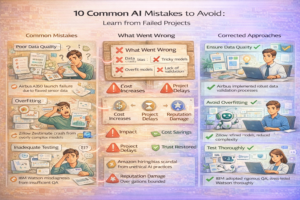
Introduction: Learning from Others’ AI Failures
The excitement surrounding artificial intelligence has led countless businesses, developers, and organizations to rush into AI projects with high hopes and substantial investments. Unfortunately, many of these initiatives fail to deliver expected results, wasting time, money, and resources. Understanding common AI mistakes—and how to avoid them—can mean the difference between successful implementation and costly failure. This comprehensive guide examines the most frequent AI pitfalls, shares real-world examples, and provides actionable strategies for avoiding these traps.
The AI industry is littered with failed projects, abandoned pilots, and underwhelming deployments. Research suggests that up to 85% of AI projects never make it to production, and many that do fail to deliver promised value. However, these failures aren’t inevitable. They typically stem from predictable mistakes that careful planning and realistic expectations can prevent. Whether you’re a business leader considering AI adoption, a developer building AI systems, or a data scientist managing projects, understanding these common mistakes will help you navigate AI challenges more successfully.
Mistake 1: Starting Without Clear Business Objectives
The Problem
Perhaps the most fundamental mistake in AI projects is implementing AI for its own sake rather than solving specific business problems. Organizations become enamored with AI’s possibilities and deploy solutions searching for problems to solve, rather than the reverse. This “solution looking for a problem” approach leads to unfocused projects that fail to deliver measurable business value.
When projects lack clear objectives, teams cannot measure success, prioritize features, or make informed trade-off decisions. Stakeholders grow frustrated when projects consume resources without producing tangible results. Even technically successful AI systems fail if they don’t align with business needs.
Real-World Example
A retail company invested heavily in an AI system that predicted which products customers would buy. The predictions were accurate, but the company lacked inventory management processes to act on these predictions. The AI system generated excellent insights that nobody used because the company hadn’t defined how predictions would integrate into operations.
How to Avoid This Mistake
Before beginning any AI project, define specific, measurable objectives. Ask: What business problem are we solving? How will we measure success? Who will use the system’s outputs, and how? What decisions or actions will AI enable or improve?
Document these objectives and get stakeholder buy-in before development begins. Ensure objectives include both technical metrics (like model accuracy) and business metrics (like revenue impact or cost savings). Regularly revisit objectives throughout development, ensuring the project remains aligned with business goals.
Mistake 2: Underestimating Data Requirements
The Problem
AI systems are fundamentally data-hungry. machine learning models require substantial amounts of high-quality, labeled data to learn effectively. Many projects fail because organizations overestimate their data readiness and underestimate the effort required to prepare data for AI systems.
Common data-related issues include insufficient data quantity, poor data quality, missing labels, data silos that prevent integration, and inadequate documentation about data sources and meanings. Even organizations with large databases often discover their data isn’t suitable for AI applications without significant cleaning and preparation.
Real-World Example
A healthcare organization attempted to build an AI system for diagnosing rare diseases. They had thousands of patient records but only dozens of examples for each rare condition—far too few to train accurate models. The project spent months collecting additional data before development could meaningfully proceed. Had they assessed data requirements upfront, they could have planned appropriately or chosen different approaches.
How to Avoid This Mistake
Conduct thorough data audits before committing to AI projects. Assess data quantity, quality, accessibility, and relevance to your objectives. Be honest about data limitations and plan accordingly. Sometimes this means collecting more data, purchasing external datasets, using data augmentation techniques, or choosing simpler models that require less data.
Create data pipelines early in projects, establishing processes for continuous data collection, cleaning, and labeling. Invest in data infrastructure and governance—these investments benefit all AI projects and improve data-driven decision-making broadly. Consider starting with rule-based systems or simpler statistical approaches while building data assets for more sophisticated AI.
Mistake 3: Choosing the Wrong Problems for AI
The Problem
Not every problem benefits from AI solutions. Some problems are better solved with traditional software, business process changes, or simple rules-based systems. Applying AI to inappropriate problems wastes resources and creates unnecessarily complex systems that underperform simpler alternatives.
AI excels at pattern recognition in complex data, prediction based on historical patterns, and automation of tasks requiring judgment calls. However, AI struggles with problems requiring common sense reasoning, causal understanding, or handling of truly novel situations. It’s also overkill for problems with clear logical rules or small, simple datasets.
Real-World Example
A company built a complex machine learning system to route customer service emails to appropriate departments. This seemed like an AI problem—categorizing unstructured text based on content. However, customers already selected department categories when submitting requests. The company could have used simple rule-based routing based on this selection, saving months of development time and ongoing model maintenance.
How to Avoid This Mistake
Before committing to AI solutions, ask whether simpler approaches might work. Can clear rules solve the problem? Would traditional statistical methods suffice? Is the problem complex enough to justify AI’s overhead? Consider AI when problems involve:
– Complex patterns in large datasets
– Subjective judgments that humans make inconsistently
– Tasks requiring processing vast information quickly
– Situations where optimal solutions aren’t obvious
– Problems benefiting from continuous learning and improvement
Start with the simplest solution that might work and increase complexity only when necessary. Many successful “AI” systems are actually hybrid approaches combining rule-based logic, statistical methods, and machine learning where each truly adds value.
Mistake 4: Ignoring Model Interpretability and Explainability
The Problem
Complex AI models, particularly deep neural networks, often operate as “black boxes” where even developers struggle to explain specific decisions. While these models might achieve high accuracy, their lack of interpretability creates serious problems in many applications.
When models make critical decisions affecting people’s lives—loan approvals, medical diagnoses, criminal sentencing recommendations—stakeholders need to understand reasoning. Regulators increasingly require explanations for automated decisions. Users lose trust in systems they don’t understand. Developers cannot effectively debug or improve opaque models.
Real-World Example
An insurance company deployed an AI system for pricing policies. The model achieved excellent accuracy in predicting claims but occasionally produced inexplicably high or low prices. Customers complained, but developers couldn’t explain the model’s reasoning. Eventually, the company discovered the model had learned spurious correlations unrelated to actual risk. They reverted to simpler, interpretable models they could explain and audit.
How to Avoid This Mistake
Consider interpretability requirements when choosing model architectures. Sometimes simpler, more interpretable models are preferable to marginally more accurate black box alternatives. Decision trees, linear models, and rule-based systems offer inherent interpretability.
For complex models, implement interpretability tools like SHAP (SHapley Additive exPlanations) or LIME (Local Interpretable Model-agnostic Explanations) that explain individual predictions. Document model behavior thoroughly, including feature importance, decision boundaries, and typical patterns.
Establish processes for auditing model decisions, especially for high-stakes applications. Create human-in-the-loop workflows where humans review and approve critical automated decisions. This maintains accountability while leveraging AI efficiency.
Mistake 5: Neglecting Model Monitoring and Maintenance
The Problem
Many organizations treat AI deployment as a one-time project rather than an ongoing process. They build models, deploy them to production, and then fail to monitor performance or update models as conditions change. This leads to performance degradation as the world evolves and training data becomes stale.
Model performance typically degrades over time through a phenomenon called “data drift” or “concept drift.” Input data distributions change, relationships between features and outcomes shift, and patterns the model learned become less relevant. Without monitoring and retraining, production models increasingly deliver poor results while teams remain unaware until serious problems emerge.
Real-World Example
An e-commerce company built a product recommendation system trained on 2019 data. They deployed it in early 2020 and didn’t monitor performance closely. When the COVID-19 pandemic dramatically shifted shopping behaviors, recommendations became increasingly irrelevant. Conversion rates dropped significantly before developers realized the model needed retraining with current data.
How to Avoid This Mistake
Implement comprehensive monitoring for production AI systems. Track both technical metrics (prediction accuracy, inference time, error rates) and business metrics (conversion rates, user satisfaction, revenue impact). Set up alerts for when performance degrades below acceptable thresholds.
Establish regular retraining schedules based on how quickly your domain changes. Some applications need daily retraining, others work fine with quarterly updates. Automate retraining pipelines where possible, including data collection, model training, validation, and deployment.
Create A/B testing infrastructure to safely deploy model updates. Compare new model versions against current production versions before full rollout. This prevents deploying models that perform worse than existing systems and helps you quantify improvements from updates.
Mistake 6: Overlooking Bias and Fairness
The Problem
AI systems learn from historical data that often contains societal biases. When not carefully addressed, models perpetuate and sometimes amplify these biases, leading to discriminatory outcomes. Beyond ethical concerns, biased systems create legal liabilities, damage reputation, and lose customer trust.
Bias manifests in many ways: training data may under-represent certain groups, features may correlate with protected characteristics, evaluation metrics may not account for fairness across groups, or historical decision patterns may reflect discriminatory practices that models learn to replicate.
Real-World Example
Amazon built an AI recruiting tool to screen resumes but discovered it systematically down-ranked women’s applications. The model learned from historical hiring data that predominantly featured male employees in technical roles. The system identified patterns like “women’s chess club” on resumes and penalized them. Amazon ultimately scrapped the system rather than risk discriminatory hiring practices.
How to Avoid This Mistake
Proactively assess potential biases in your data and models. Analyze training data for representation of different demographic groups. Examine whether model performance varies across groups. Test models with diverse test cases representing different populations.
Implement fairness metrics alongside accuracy metrics. Different fairness definitions exist (demographic parity, equal opportunity, predictive parity), and you must choose appropriate measures for your context. Sometimes improving fairness requires trading off small amounts of accuracy, but this is often legally and ethically necessary.
Include diverse perspectives in AI development teams. Homogeneous teams more easily overlook biases that affect other groups. Regular bias audits by independent reviewers can identify issues that development teams miss.
Mistake 7: Underestimating Required Infrastructure and Engineering
The Problem
Building prototype AI models in notebooks is relatively easy. Deploying those models to production at scale with proper reliability, security, and performance is significantly harder. Many projects succeed in proof-of-concept phases but fail when attempting production deployment because teams underestimate required engineering infrastructure.
Production AI systems need robust data pipelines, scalable serving infrastructure, monitoring and alerting systems, model versioning and rollback capabilities, security measures, and integration with existing systems. These engineering challenges often exceed the complexity of the actual AI models.
Real-World Example
A startup built an impressive computer vision model that accurately identified defects in manufacturing. Their prototype worked perfectly analyzing hundreds of images. When they attempted deployment in a factory processing thousands of images per minute, their system couldn’t keep pace. They spent months rebuilding infrastructure for scale, delaying product launch significantly.
How to Avoid This Mistake
Involve engineering and operations teams early in AI projects. Don’t treat deployment as an afterthought following model development. Consider production requirements from project inception, including latency requirements, throughput needs, reliability expectations, and integration constraints.
Build deployment infrastructure incrementally rather than waiting until models are finalized. Develop deployment pipelines early and use them to deploy simple baseline models before sophisticated AI systems. This validates infrastructure and integration points before critical deadlines.
Leverage existing tools and platforms rather than building everything custom. Cloud AI platforms (AWS SageMaker, Google AI Platform, Azure Machine Learning) provide production-ready infrastructure. MLOps tools (MLflow, Kubeflow, Weights & Biases) streamline model lifecycle management. Using established tools lets you focus on unique aspects of your application.
Mistake 8: Setting Unrealistic Expectations
The Problem
Popular media and vendor marketing create unrealistic expectations about AI capabilities. Decision-makers expect human-level intelligence, perfect accuracy, and immediate ROI. When reality falls short of these inflated expectations, stakeholders view projects as failures even when delivering genuine value.
AI systems have real limitations. They’re narrow in scope, require substantial training data, make mistakes even when accurate overall, and need ongoing maintenance. Projects that don’t manage expectations realistically face stakeholder disappointment and funding cuts.
Real-World Example
A hospital implemented an AI system for diagnosing diseases from medical images. Marketing materials suggested near-perfect accuracy. In practice, the system achieved 94% accuracy—excellent by medical standards but less than the implied perfection. Doctors grew skeptical and stopped using the system, viewing it as unreliable. Proper expectation setting would have framed 94% accuracy as strong support for human decision-making rather than perfect automation.
How to Avoid This Mistake
Educate stakeholders about realistic AI capabilities and limitations. Explain that AI augments rather than replaces human intelligence. Be transparent about accuracy levels, failure modes, and scenarios where the system struggles.
Frame AI projects in terms of specific improvements over current processes rather than revolutionary transformation. If AI can handle 70% of routine customer inquiries automatically, focus on this tangible benefit rather than promises of complete automation.
Demonstrate incremental value early through pilot projects or phased rollouts. Small wins build credibility and realistic understanding of what AI can achieve. Showcase actual results with honest discussion of both successes and limitations.
Mistake 9: Failing to Consider Ethical and Legal Implications
The Problem
AI systems increasingly make decisions affecting people’s lives, livelihoods, and rights. Many projects proceed without adequate consideration of ethical implications or legal compliance. This creates liability risks, regulatory problems, and reputational damage.
Different jurisdictions have varying regulations about AI use, data privacy, algorithmic decision-making, and automated systems. GDPR in Europe, CCPA in California, and sector-specific regulations (like HIPAA in healthcare or financial services regulations) impose requirements that AI systems must meet. Ignoring these creates serious legal exposure.
Real-World Example
Clearview AI built a facial recognition system by scraping billions of images from social media without consent. While technically impressive, the system faced legal challenges across multiple jurisdictions for violating privacy laws and platform terms of service. Several countries banned its use, and the company faced substantial fines and restrictions.
How to Avoid This Mistake
Conduct ethical reviews for AI projects, especially those affecting people directly. Consider questions like: Does this system treat people fairly? Are we transparent about AI usage? Do users have recourse when the system makes mistakes? Are we collecting and using data appropriately?
Ensure legal compliance from project inception. Work with legal counsel familiar with relevant regulations. Implement privacy by design principles, obtaining appropriate consents, minimizing data collection, and ensuring data security. Document compliance measures thoroughly.
Consider establishing AI ethics boards or committees that review projects for ethical concerns and provide oversight. Include diverse perspectives representing different stakeholder groups affected by AI systems.
Mistake 10: Working in Isolation Without Domain Expertise
The Problem
Technical teams sometimes build AI systems without adequate input from domain experts who understand the problem context deeply. This leads to systems that are technically sophisticated but practically useless because they don’t align with real-world needs or constraints.
Domain experts know subtle requirements that aren’t obvious to outsiders. They understand which errors are acceptable and which are catastrophic. They recognize edge cases and practical constraints that significantly impact system usefulness. Without their input, even technically excellent AI systems may fail to deliver practical value.
Real-World Example
A team of AI researchers built a system for optimizing hospital scheduling without consulting healthcare workers. Their solution produced mathematically optimal schedules that were completely impractical—splitting shifts inappropriately, ignoring required patient continuity of care, and scheduling specialists for tasks outside their expertise. The system was technically correct but operationally useless because researchers didn’t understand healthcare workflows.
How to Avoid This Mistake
Include domain experts as active participants throughout AI projects, not just in initial requirements gathering. Have domain experts review training data, evaluate model outputs, identify edge cases, and validate whether the system actually solves real problems.
Establish collaborative teams where technical and domain expertise work closely together. Regular communication ensures technical teams understand constraints and priorities while domain experts learn AI capabilities and limitations. This collaboration leads to better problem formulation, more appropriate evaluation metrics, and practically useful solutions.
Consider employing or partnering with people who bridge technical and domain expertise. These individuals can translate between technical and domain perspectives, ensuring effective communication and collaboration.
Conclusion: Building a Culture of Thoughtful AI Development
Avoiding these common AI mistakes requires discipline, realistic expectations, and commitment to thoughtful development practices. Success in AI isn’t just about technical skill—it requires clear objectives, good data practices, appropriate problem selection, ongoing monitoring, ethical consideration, and collaborative development.
Organizations that learn from others’ failures and proactively address these common mistakes significantly improve their AI success rates. They deliver real business value, avoid costly failures, and build AI systems that genuinely solve problems rather than creating new ones.
The key is approaching AI projects with appropriate humility, recognizing both the technology’s potential and its limitations. By learning from the mistakes covered in this guide and implementing recommended practices, you position your AI initiatives for success while avoiding predictable pitfalls that doom so many projects.
Continue Learning: Related Articles
AI Productivity Hacks: Reclaim Hours Every Week Using Smart Tools
Introduction: How AI Can Reclaim Your Time
Knowledge workers report feeling more stressed and busy than ever despite te…
📖 14 min read
AI Content Creation Tools for Bloggers: Comparison and ROI Analysis
Introduction to AI Content Creation for Bloggers
The content creation landscape has been transformed by artificial inte…
📖 13 min read
Best AI Tools for Small Business: Complete Guide to Affordable Solutions
Introduction: AI is No Longer Just for Big Corporations
Small and medium-sized businesses often assume that artificial …
📖 14 min read
Text-to-Image Generation with AI: DALL-E, Midjourney, and Stable Diffusion Comparison for Creators and Businesses
Text-to-Image Generation with AI: DALL-E, Midjourney, and Stable Diffusion Comparison for Creators and Businesses
Meta …
📖 26 min read
💡 Explore 80+ AI implementation guides on Harshith.org
